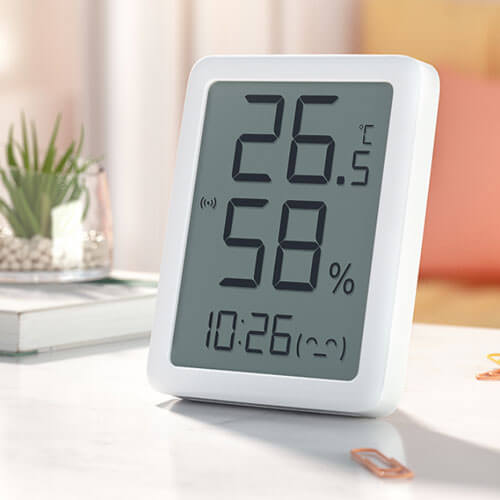
It is important to measure humidity (the concentration of water vapor) in the air, soil, and enclosed areas. High humidity can cause condensation and promote the growth of indoor pollutants(mold and viruses), while dry air can cause irritation to skin, static electricity and can cause respiratory issues. The apparatus that is used to measure air humidity is called a hygrometer. It is employed in measuring humidity in the fields of ultra-pure metal smelting, textile manufacturing, wine cellars or cigar storage units.
What is a hygrometer?
A hygrometer is an instrument for measuring the moisture content (usually relative humidity (RH)) of air or other gases.
What does a hygrometer measure?
The hygrometer measures the relative humidity (RH %), which is defined as the amount of water vapor in the air compared to the amount of water vapor that could be in the air at the same temperature. It is typically reported as a percentage (as %RH).
Some hygrometers can also measure other parameters, such as:
- Relative humidity (RH): A ratio of the amount of water vapor in air to the maximum amount that could be present at the same temperature and pressure.
- Absolute humidity: Mass of water vapor in a unit volume of air, usually measured in g/m³.
- Dew point: The temperature at which water vapor starts to condense into dew or frost. Can also be used as an indicator of humidity.
What is the difference between a hygrometer and a humidity sensor?
A hygrometer is a complete instrument that measures humidity, and a humidity sensor is more commonly a component that senses humidity.
- Differences in function: A humidity sensor is a simple sensor that produces only a type of raw data, e.g. resistance, capacitance, electrical signals, and generally needs a signal processing circuit to process these signals into useful data on humidity. A hygrometer contains a humidity sensor, signal processing electronics, and a display module which combine to directly display humidity readings.
- Differences in appearance: Humidity sensors are usually surface-mount devices or probes, easy to integrate into equipment. The hygrometers come in their own housing and may be mounted on a wall or stand alone.
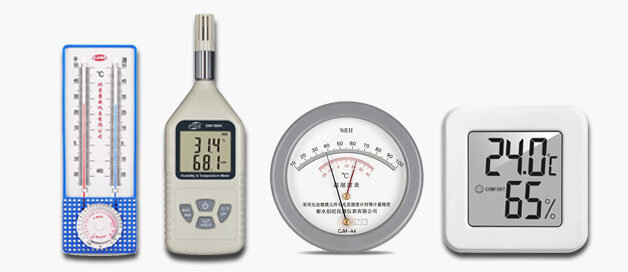
Types of hygrometers and how they work
The working principle of a hygrometer is mainly dependent on the change in the physical or chemical property of a substance which absorbs or releases water vapour. There are the following types of common principles:
| Five common types of hygrometers | ||||
|---|---|---|---|---|
| Type | Principle | Accuracy | Features | Applications |
| Mechanical type | Moisture-absorbing material expansion and contraction | ±5%RH | Cheap, no power required; slow response, low accuracy | Household analog hygrometer |
| Dry/wet-bulb type | Evaporative cooling | ±(2-5)%RH | Reliable; requires ventilation, calculation/table lookup required | Weather observation, well-ventilated environments |
| Resistive type | Polymer moisture absorption changes resistance | ±(2-5)%RH | Small size, fast response; requires circuitry, affected by temperature drift | Industrial process control, cost-sensitive applications |
| Capacitive type | Polymer moisture absorption changes dielectric constant | ±(1-3)%RH | Mainstream, good precision, high integration | Home appliances, weather stations, consumer electronics |
| Dew point type | Cooling down to condensation | ±0.1-0.5°C T_dp | Highest accuracy, complex and expensive, slow response | Metrological standard, precision laboratory |
1. Mechanical hygrometers
The mechanical hygrometers are instruments which measuring humidity by using the physical change of hygroscopic materials(such as hair, wood, paper etc.), when the humidity changes. As humidity increases the materials swell as humidity decreases they contract and shrink. They work with levers and gears to move a pointer to show humidity, and can be used in analog humidity measurements in older workshops or on vintage meteorological instruments.
2. Psychrometers
The principle of evaporative cooling is used in a psychrometric to measure the humidity of air. It is usually made from two identical thermometers, of which one has its bulb covered with water saturated gauze, known as a “wet bulb,” and the other has a naked bulb, known as a “dry bulb. Water evaporates off the wet bulb, removing heat from the bulb and making its temperature drop. This creates a temperature difference between the dry bulb and the wet bulb, and the relative humidity can then be calculated using a specialized reference table or formula.. The principle of operation of the psychrometer, its use at meteorological stations, in warehouse, in agriculture and for educational demonstration is simple, relatively high accuracy.
3. Electronic hygrometers
The electrical property changes of hygroscopic materials caused by moisture are measured by electronic hygrometers. These are mostly of two types capacitive and resistive.
Capacitive: This method utilizes the principle that the dielectric constant of a hygroscopic material changes when it absorbs moisture. A hygroscopic polymer film serves as the dielectric layer between two electrodes, forming a capacitor. As the material absorbs moisture, its dielectric constant increases, leading to an increase in capacitance; relative humidity is calculated by measuring this change in capacitance.
Resistive: This method is based on the principle that the resistance of a hygroscopic material changes when it absorbs moisture. When a hygroscopic polymer or salt-based film absorbs moisture, its ionic conductivity increases, causing the resistance to decrease. By measuring this change in resistance, the humidity can be calculated.
Electronic hygrometers are easy to integrate and are very accurate; high quality sensors can achieve ±1-3%RH. They are used extensively in contemporary weather stations, industry, home appliances (air conditioners/humidifiers) and consumer electronics.
4. Chilled mirror dew point hygrometers
It is based on dew point measurement principle. The instrument gradually cools the surface of the mirror during its operation. As the air cools down to the dew point temperature, water droplets (or frost) start to condense on the mirror surface. The measured temperature of the mirror surface at this time is called a dew point temperature; together with the air temperature, this is used to calculate the relative humidity. This type of hygrometer offers the highest accuracy but is expensive and relatively complex to maintain; it is primarily used in precision laboratories, industrial settings, and standard metrology applications.
Video from Youtube @TheWeatherStore
What is a hygrometer used for?
Meteorological and environmental monitoring
One of the meteorological parameters is humidity. A basic instrument used at weather stations to measure the relative humidity of the atmosphere is a hygrometer, and data from hygrometers, along with temperature, atmospheric pressure, wind speed and precipitation, are used to analyze climate change.
HVAC and indoor climate control
Optimum range of humidity for residential buildings, office buildings, shopping malls, hospitals and schools is 30% to 60% RH, while for pharmaceutical and GMP buildings, it is 30% to 65%. For maintaining indoor humidity levels, hygrometers can be incorporated into automated control systems to control air conditioners, humidifiers and dehumidifiers.
Industrial production and control
In industrial production, humidity meter readings are fed into controllers, which directly determine whether to turn dehumidification or heating systems on or off. This is because humidity affects product quality and equipment operation. In electronic manufacturing for instance, the environment needs to be controlled for humidity to prevent the risk of electrostatic discharge; in the pharmaceutical and food production, humidity in the environment must be monitored according to the various requirements of the production process to minimise the effect of humidity fluctuations on the product quality.
Warehousing and storage of goods
Humidity changes cause wood products to expand and contract (swell and shrink) – guitars and violins may experience instability in tuning or develop cracks, and paintings can be damaged by warping of the materials. Specific humidity requirements exist for the storage of cigars. Most cigars can only hold the aroma for an extended period at 65%-75% RH and 18-22°C. In these situations, a hygrometer should be placed next to the items being protected to accurately monitor air humidity.
Agriculture and greenhouse cultivation
Changes in the humidity of the greenhouse can influence transpiration of the crop and the incidence of plant diseases. Using a hygrometer to measure air humidity, growers can regulate their ventilation, humidification and dehumidification systems to achieve proper air environment conditions for cultivation.
Reptile care
Reptile enclosures typically require a humidity level of at least 50%. The humidity in the enclosure should be at least 50% for reptiles. Various species of snakes, lizards, tortoises and geckos require different humidities, and maintaining proper humidities allow for normal physiological functions. Keepers can adjust misting, humidification, ventilation, and substrate based on humidity readings to avoid conditions that are too dry or too humid.
How to choose the best hygrometer?
- Firstly, think about accuracy and measurement range. The digital capacitive models have an accuracy of about ±2%-3%RH, and analog models are about ±5%-8%RH. Digital hygrometers are not always more accurate, and electronic hygrometers may have a minimum readable humidity level, such as 20%. Before purchasing, look at the range of operation.
- Examine whether it has temperature sensor. The relative humidity is temperature dependent, so a combined temperature and humidity meter provides more accurate data.
- Consider the features. For those who only need to inspect one room every now and then, a simple model is going to be fine. For trends and comparisons between rooms and/or remote alerts, select a model that includes data logging and wireless capabilities.
- Consider the operating environment. Standard household hygrometers are only suitable for indoor use and should not be used outdoors. If your setting is humid or warm, or corrosive, then it requires a probe and an enclosure that will protect it.
- Check for calibration. Models that can be calibrated or have offset adjustment settings are more reliable for long-term use; for home use, you can verify accuracy yourself using a saturated salt test.
What is the ideal indoor humidity level?
The U.S. Environmental Protection Agency (EPA) suggests that the ideal humidity amount for indoors should be 30%~50%. If humidity is above 60%, it is considered high humidity; humidity below 30% is considered low humidity. Too high and too low humidity in your home can be detrimental to both your home and family’s health.
Why is monitoring indoor humidity important?
Monitoring of humidity at the interior can help avoid problems from an excessive high or low humidity.
High humidity (more than 60%) encourages the growth of mold and dust mites, which can cause allergies or asthma. When humidity is low (less than 30%), static electricity is produced, which causes dust to float.
The relative humidity influences the sensation of temperature. Humidification makes people feel colder in winter and stuffier and drowsy in summer. Humidity of 30%~60% is most comfortable for the human body and will help to get a better sleep.
Is a hygrometer really necessary?
It’s not strictly necessary, but it can certainly help you improve your indoor air quality. It can assist you determine whether you should install a whole house humidity control, or if you can use something simpler such as a bathroom exhaust fan.
Where should I place a hygrometer?
The most recommended position would be approximately 1.5 meters above the floor in the center of the room or in an area where you spend much of your time (such as in the middle of the living room), a little further away from walls, windows, radiators and air conditioning vents. It is recommended to be placed in the bedroom on a bedside table or 1 meter away from the sides of the bed but not near the humidifier. In the study, you can place it on a desk or in a corner, away from air conditioning vents.
What causes high humidity in a room?
- Daily activities such as cooking and bathing
- Poor ventilation
- Insufficient operation of air conditioning and dehumidifiers
- Water seepage into the home or leaking pipes
- The rainy season or high-humidity climates
- A large number of indoor plants and landscaping
- Effects of basements and building structures

This article was written by the Renke Technical Team at Shandong Renke Control Technology Co., Ltd., a high-tech enterprise specializing in environmental monitoring sensors and intelligent measurement solutions. With expertise in humidity sensing, temperature and humidity measurement, and environmental monitoring technologies, the team focuses on sensor development, measurement accuracy, and reliable monitoring solutions for industrial and environmental applications.