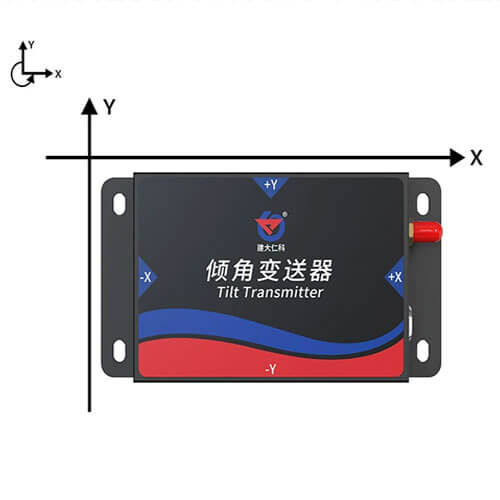
Are you curious about inclinometers? This article will take an in-depth look at the principles, types, and applications of inclinometers. Whether you work in construction, engineering, or surveying, understanding inclinometers can greatly improve your work efficiency. So, let’ s explore them together!
What is an inclinometer?
An inclinometer is a sensor or instrument used to measure the inclination, tilt, or angular deviation of an object relative to gravity or a reference plane.
How does an inclinometer work?
An inclinometer works by using gravity as a reference; it calculates the sensor’ s angle of inclination relative to the horizontal plane by detecting changes in the component of gravity acting on the sensor’ s sensitive axis.
When the sensor remains level with the object being measured, the internal sensing element is in a state of equilibrium and outputs a reference zero-point value. When the object tilts or its orientation shifts, the component of gravity acting on the sensor’ s sensing axis changes accordingly. The chip captures these subtle changes in real time; after signal processing, data filtering, and algorithmic calibration, it outputs precise data on the tilt angle or direction of displacement.
Compared to traditional detection methods, modern inclinometers operate without human intervention, capturing attitude changes at the millisecond level and comprehensively recording both static, slow deformations and dynamic, instantaneous shifts. This addresses the limitation of manual inspection, which cannot continuously monitor subtle deformations.
Types of inclinometers
1. Mechanical inclinometer
This is one of the most traditional methods of measuring inclination, which primarily relies on changes in the position of mechanical components under the influence of gravity to determine the angle of inclination. The most typical examples are the pendulum-type and bubble-level-type instruments.
- Pendulum-type: The weighted pendulum always points in the direction of gravity, and the angle of inclination is determined by reading the angle of deviation of the pendulum relative to the scale.
- Bubble level method: The bubble always moves in the direction opposite to gravity, and the inclination angle corresponding to the bubble’ s position is determined by visual inspection or an optical reading device.
Mechanical inclinometers feature a simple design, are low-cost, immune to electromagnetic interference, and require no power supply. However, their accuracy is limited, they rely on manual readings, and they cannot capture dynamic changes. As a result, these products have largely been replaced by electronic instruments. Mechanical inclinometers can be used for simple equipment leveling, construction sites, slope measurements, machinery installation, and as traditional surveying instruments.
2. Electrolytic inclinometer
An electrolytic inclinometer utilizes the property of an electrolyte to remain level under the influence of gravity and calculates the angle of inclination by measuring changes in electrical conductivity between the electrodes. Inside an electrolytic inclinometer is a sealed chamber containing a certain volume of conductive liquid and multiple electrodes. When the sensor tilts, the extent to which different electrodes come into contact with the liquid changes, resulting in a change in electrical conductivity or resistance between the electrodes. The key difference from mechanical inclinometers is that it does not rely on a pendulum to directly read the angle; instead, it converts changes in the liquid’ s position into an electrical signal.
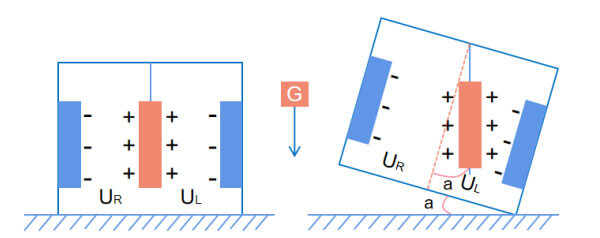
A notable advantage of the electrolytic inclinometer is its high sensitivity. Additionally, it lacks complex mechanical moving parts, resulting in relatively low mechanical wear. Its primary drawback is its sensitivity to environmental conditions. The physical and electrical properties of the conductive liquid can drift due to temperature changes. Therefore, it is particularly suitable for applications such as buildings, bridges, and dams that require high sensitivity but do not demand high dynamic performance.
3. MEMS inclinometer
MEMS inclinometers are currently a very important class of sensors; they calculate the tilt angle by using a MEMS accelerometer to detect the components of gravity along different sensitive axes. Inside a MEMS accelerometer are tiny mass blocks and elastic structures. When the sensor is tilted, the component of gravity along the sensitive axis changes, causing a slight displacement in the MEMS structure. This displacement results in a change in differential capacitance, which is then used to calculate the tilt angle.
The advantages of MEMS inclinometers include their small size, light weight, low power consumption, and ease of digitization and system integration. They can perform single-axis, dual-axis, or even multi-axis measurements when combined with other inertial sensors. Their disadvantages include noise and temperature drift, which require algorithmic compensation to ensure accuracy. Currently, MEMS inclinometers are widely used in fields such as mechanical safety control, industrial automation leveling, photovoltaic tracking, and attitude sensing in consumer electronics.
4. Servo inclinometer
Similar to MEMS sensors, servo inclinometers also rely on gravity detection, but they utilize a force-balanced servo-accelerometer. When the sensor tilts, its internal mass element shifts under the influence of gravity. The sensor detects this shift, and the control circuit then generates an electromagnetic force opposite to the force of gravity, “pulling” the mass element back to a position close to zero. The tilt angle is calculated by measuring the feedback current or voltage required to maintain equilibrium.
Its accuracy and long-term stability are generally superior to those of ordinary MEMS sensors, placing it in the category of precision instruments. The force-balanced structure offers good linearity and minimal output error across the measurement range. However, its structure and circuitry are more complex than those of MEMS sensors, and it is also more expensive. It is used in scenarios requiring compliance with the ASTM D6230 standard, such as monitoring deep horizontal displacement in slopes and deformation in excavation shoring structures.
Inclinometer vs Tiltmeter vs Clinometer: What's the difference"
The core principle behind these three terms is the same: they all refer to instruments that measure the angular rotation of an object relative to the vertical axis, using the gravitational vector as a reference. Essentially, they describe the same type of device. However, their specific applications in the technical field are not entirely the same.
- Inclinometer—This is the most general term. It is primarily used to measure the angle of inclination of an object relative to the horizontal plane or the direction of gravity, and is widely used in industrial equipment, construction machinery, structural monitoring, and geological monitoring.
- Tiltmeter—also measures inclination, but places greater emphasis on long-term, continuous monitoring of tilt changes; therefore, it is commonly used in the monitoring of buildings, bridges, dams, and geological structures.
- Clinometer—is used more frequently to measure slope, elevation angle, and other angles; traditionally, it is often used in surveying, construction, and field measurements.
| Name | Monitoring | Method | Application |
|---|---|---|---|
| Inclinometer | Measures tilt angle | Single or continuous measurement | Industrial equipment, construction machinery, structures, IoT |
| Tiltmeter | Monitors tilt changes | Long-term, continuous, high-sensitivity monitoring | Buildings, bridges, dams, geology, structural health |
| Clinometer | Measures angle/slope | Typically on-site measurement | Surveying, construction, tree surveying, slope measurement |
What is an inclinometer used for?
Engineering and structural safety
Big buildings and infrastructure rely on the use of inclinometers as the main application area for safety reasons. They measure the tilt, settlement and deformation of bridges, dams, tunnels, transmission towers, large storage tanks, and other structures to generate long-term safety early warning. Installed at potential hazard sites such as landslide areas, steep slopes, and mining sites, they monitor tilt changes in real time. They are also used to monitor horizontal displacement in ancient city walls and historic building walls and issue early warnings.
Industrial manufacturing and automation
In production and equipment maintenance, inclinometers are used to ensure precision and safety. They are mounted on excavators, cranes, or aerial work platforms for leveling. During production, they can be used for angle control on production lines, equipment installation and positioning, platform leveling, and position feedback for robotic arms.
Automotive and transportation
Automotive safety and performance is also greatly dependent on inclinometers. Taking wheel camber and king pin inclination measurements are essential for making significant adjustments to vehicle handling and minimizing tire wear. To prevent rollover accidents, they are used in body roll monitoring systems and rollover prevention systems (in offroad vehicles, buses, and other vehicles with a high center of gravity). They can also be applied to the detection of the tilt status of bogies on high-speed trains and subways.
What is the difference between single-axis and dual-axis inclinometer?
A single axis device is able to measure just one axis – either the X-axis or the Y-axis. A dual axis device can measure X-axis and Y-axis. A dual-axis device is capable of measuring tilt and pitch angles. With horizontal mounting, it will only measure the tilt angle with the single axis mount or the pitch angle with the vertical mount, and the pitch angle is not selectable.
Inclinometer vs IMU: which one should you use?
For “measuring angles and checking for tilt,” choose an inclinometer; for “controlling movement and knowing your location,” choose an IMU (Inclined Mutual Actuation Unit).
- Inclinometer: Measures the tilt angle relative to the horizontal plane. It relies on gravity and has high accuracy under static or quasi-static conditions. However, data can be affected by vibration or acceleration/deceleration.
- IMU: Contains an accelerometer and gyroscope (some also include a magnetometer). It can measure angular velocity and acceleration, and has a fast dynamic response. However, pure integration can lead to drift, and long-term accuracy relies on algorithmic correction or external references.
What affects inclinometer accuracy?
The main factors affecting the accuracy of an inclinometer include the gravity reference itself, temperature drift, zero-point offset, linearity, vibration, shock, cross-axis sensitivity, and acceleration/deceleration interference. Among these, temperature drift and zero-point offset are the most common and critical sources of interference.
How temperature affects inclinometer accuracy?
One of the major parameters that affect the accuracy is temperature and is divided into two parts, the zero point temperature coefficient and sensitivity temperature coefficient. Deviation of the output from zero when the sensor is horizontal, due to temperature changes is called zero-point temperature coefficient. The sensitivity temperature coefficient is the ratio of the change in the sensor’s response to angle changes with the temperature changes. The data indicates that the sensitivity temperature coefficient is in the order of one-thousandth and the zero-point temperature coefficient can be as low as 0.006 degrees Celsius. These values are small per se but when integrated in a broad range of temperatures, e.g., outdoors from -40 to 85°C, can lead to high errors. Most of today’s inclinometers include temperature compensation algorithms to offset these errors.
Can an IMU measure inclination?
Yes, IMU is a device widely used in measuring tilt angle. It’s usually a combination of an accelerometer and a gyroscope. An accelerometer’s role in a static condition is to measure the gravitational component to determine the tilt angle and in a dynamic condition to compensate for motion interference, and to provide information including pitch angle and roll angle.
What is the difference between an inclinometer and a tilt sensor?
- Tilt sensor = the sensing element alone (accelerometer die, electrolytic cell, liquid capacitive cell, etc.), outputting a raw analog or digital signal
- Inclinometer = the complete instrument, including the sensing element plus signal conditioning, processing, and a calibrated angle output

This article was written by the Renke Technical Team, a team of experienced sensor engineers specializing in environmental monitoring, industrial sensing, and IoT measurement technologies. Drawing on practical experience in sensor development and application, the team provides accurate, engineering-focused insights to help readers better understand inclinometer technology, measurement principles, and real-world applications.