Particulate matter (PM) is a pervasive and impactful air pollutant globally, with varying concentrations and compositions across the world, yet it poses a significant threat to public health in most countries. Despite extensive research into the effects of particulate matter, its concentrations remain above baseline levels for the vast majority of the world’s population, necessitating urgent action to improve air quality.
What is particulate matter?
Particulate matter (PM) refers to a mixture of solid and liquid particles suspended in the atmosphere, such as dust, pollen, ash, soot, dirt, and smog. Most particles are invisible to the naked eye, but some are visible, such as those that form smog.
1. Types of particulate matter
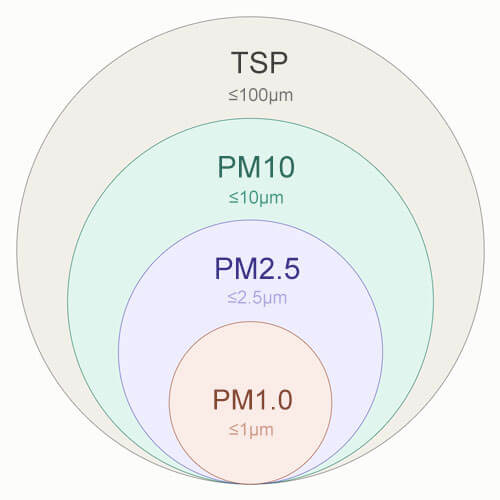
Particulate matter can be classified according to particle size, source, and physical form. In the field of air quality monitoring, the most common classification is by particle size. Based on particle size, particulate matter is generally divided into four types: TSP, PM10, PM2.5, and PM1.0.
| Types | Particle size | Inhalability | Risk | Regulation | Monitoring method |
|---|---|---|---|---|---|
| TSP | ≤100 μm | Partially | Low; most particles are trapped in the nose and throat | Limit values exist in some countries | Gravimetric method; laser scattering |
| PM10 | ≤10 μm | Yes | Moderate; affects the upper respiratory tract | Limit values exist in most countries | Laser scattering; beta attenuation |
| PM2.5 | ≤2.5 μm | Yes(can penetrate into the alveoli) | High; may enter the bloodstream | Key regulatory focus | Laser scattering; beta attenuation; TEOM |
| PM1.0 | ≤1 μm | Yes(can penetrate deeper) | Potentially highest risk | No limit values in most countries | Laser scattering |
PM1.0, PM2.5, and PM10 are related. They can all be inhaled, with smaller particles penetrating deeper into the lungs and posing potential health risks.
2. Particulate matter standards and global prevalence
To reduce the health risks posed by particulate matter exposure, the World Health Organization (WHO) has established acceptable particulate matter (PM) concentration benchmarks and recommendations globally. The U.S. Environmental Protection Agency (EPA), under the Clean Air Act, develops and regularly reviews the National Ambient Air Quality Standards (NAAQS) to regulate particulate matter concentrations in outdoor air.
In 2021, the WHO published the Global Air Quality Guidelines, setting health guidance values for PM2.5 and PM10. The annual average concentration guidance value for PM2.5 is 5 μg/m³, and the 24-hour average concentration guidance value is 15 μg/m³; the annual average concentration guidance value for PM10 is 15 μg/m³, and the 24-hour average concentration guidance value is 45 μg/m³. Furthermore, the WHO has set phased transition targets to help areas with high pollution levels gradually reduce particulate matter concentrations.
In the United States, the Environmental Protection Agency (EPA) divides particulate matter standards into Primary Standards and Secondary Standards, used to protect public health and the environment, respectively. According to current EPA standards, the annual average standard for PM2.5 is 9 μg/m³ for Primary Standards and 15 μg/m³ for Secondary Standards, with a 24-hour standard of 35 μg/m³ for both. The 24-hour standards for PM10 are both 150 μg/m³ for Primary and Secondary Standards. The annual average standard for PM2.5 is determined based on the annual average concentration calculated over three consecutive years.
What causes particulate matter?
Particulate matter sources are mainly divided into two categories: natural and anthropogenic. The U.S. Environmental Protection Agency (EPA) lists wind erosion dust, sea salt, wildfires, and bioaerosols as natural sources; and fuel combustion, industrial production, vehicle emissions, and construction as anthropogenic sources.
Natural sources
- Dust and Soil: Soil particles blown by the wind, road dust, etc.
- Biomass: Plant pollen, spores, bacteria, etc.
- Natural Disasters: Volcanic ash from eruptions, forest fires, dust storms, etc.
- Ocean: Sea salt spray.
Anthropogenic sources
- Fuel Combustion: The combustion of fossil fuels such as coal, oil, gasoline, and diesel, as well as biomass such as straw and firewood, is a significant source of urban particulate matter.
- Industrial Production: Emissions from power generation, metallurgy, cement, and chemical industries.
- Traffic Exhaust: Emissions from vehicles such as cars and airplanes.
- Construction and Roads: Construction dust, road dust, etc. Daily life: Food fumes from restaurants (such as barbecues), garbage incineration, and fireworks.
What are the effects of particulate matter?
How does particulate matter affect human health?
Particulate matter exposure is closely linked to respiratory diseases, cardiovascular diseases, and premature death. According to the World Health Organization (WHO), approximately 4.2 million premature deaths globally in 2019 were related to outdoor air pollution, with leading causes including ischemic heart disease, stroke, chronic obstructive pulmonary disease (COPD), acute lower respiratory tract infections, and lung cancer.
The negative health effects of particulate matter exposure are significant. PM10 can enter the respiratory tract, while PM2.5 can penetrate deep into the lungs, and PM1.0 and smaller particles can even enter the bloodstream. The US EPA states that particulate matter exposure is associated with health effects such as worsening asthma, decreased lung function, arrhythmias, non-fatal heart attacks, and premature death in patients with cardiopulmonary diseases. Short-term exposure may exacerbate existing conditions, while long-term exposure increases chronic health risks. Children, the elderly, and people with cardiopulmonary diseases are particularly vulnerable to particulate matter exposure.
Regarding the sources of pollution, a 2021 study by Vohra et al. published in Environmental Research estimated that approximately 10.2 million premature deaths globally in 2012 were related to PM2.5 produced by fossil fuel combustion, with about 3.9 million in China and about 2.5 million in India.
A 2019 study from the University of Southern California found that older women living in areas with PM2.5 exposure concentrations higher than the US Environmental Protection Agency (USEPA) standard (12 micrograms per cubic meter) nearly doubled their risk of developing dementia. The study’s lead researcher, epidemiologist Chen Jiuyuan, stated that if these findings were generalized to the general population, PM pollution exposure would account for approximately 21% of dementia cases globally.
How does particulate matter affect the environment?
Particulate matter reduces atmospheric visibility by scattering and absorbing light, and is transported long distances by wind, eventually settling on land, water, and vegetation. The U.S. EPA lists reduced visibility, ecosystem impacts, and pollution from building materials as significant environmental impacts of particulate matter.
Particulate matter is also a major contributor to smog, leading to reduced visibility, a phenomenon now common, especially in large cities. Large amounts of particulate matter also alter overall environmental health, acidifying lakes and streams, disrupting the nutrient balance of coastal waters and large river basins, depleting soil nutrients, damaging forests and crops, causing acid rain, and impacting ecosystem diversity.
How is particulate matter measured?
1. Gravimetric method
The most accurate measurement method is the gravimetric method. A certain volume of air is drawn into a pre-weighed filter membrane. Particulate matter accumulates on the filter, and its weight is then weighed and compared to the original weight before evacuation. The mass concentration is calculated by comparing the mass of the particulate matter with the volume of the sampled air. This method is commonly used for measuring PM2.5 and PM10 and can also be used for chemical analysis of particulate matter.
Due to its high data accuracy, this method is adopted by regulatory agencies such as the EU and the US EPA. However, because it requires collecting and weighing the filter membrane, this method cannot provide real-time data, only average values over a specific period. Furthermore, the operating cost is relatively high because it requires trained personnel to operate the instrument.
2. Beta attenuation method
Beta Attenuation Method (BAT) is also a commonly used automated measurement method for particulate matter concentration monitoring. It calculates the mass of particulate matter by measuring the attenuation of beta rays after passing through a filter membrane and collecting particulate matter, and combines this with the sampled air volume to obtain the mass concentration of PM2.5 or PM10. The U.S. Environmental Protection Agency (EPA) has listed beta ray monitors that meet specific technical requirements as a Federal Equivalent Method (FEM) for particulate matter.
The beta ray method can automatically and continuously measure particulate matter mass concentration; however, its equipment complexity requires regular maintenance, and the measurement results are easily affected by environmental interference.
3. Optical Instruments
Particulate matter is measured using optical instruments (e.g., PM sensors, particulate matter sensors) by observing various properties of light, including light scattering, absorption, and extinction, and their response to the presence of particulate matter.
Renkeer’s RS-PM-*-2-T PM sensor uses the laser scattering principle to monitor PM2.5, PM10, and PM1.0 concentrations in the environment, with a range of 0-1000 μg/m³. Wall-mounted installation is ideal for factories, workshops, offices, and residences. It is more economical than gravimetric and beta-ray methods and can measure particulate matter in near real-time.
Renkeer’s RS-*-*-BG/BGSMG-T particulate matter sensor can be flexibly configured to meet user needs. It can be used as a single-parameter sensor to monitor PM2.5, PM10, or temperature and humidity, or as an integrated sensor to simultaneously measure temperature, humidity, PM2.5, and PM10. It can be deployed in large numbers to form a dense air quality monitoring network.
How does a particulate matter sensor work?
Taking a common laser scattering particulate matter sensor as an example, the device introduces air into the detection chamber through a fan or air pump. After the laser irradiates the suspended particles, it generates a scattering signal. The sensor estimates the particle size and quantity based on the signal intensity, pulse characteristics, and algorithm. Then, combining the estimated relationship between particle size and mass, it outputs the mass concentrations of PM1.0, PM2.5, and PM10, usually expressed in μg/m³.
How to reduce particulate matter pollution?
The main ways to reduce PM pollution are as follows: control industrial waste gas emissions and use high-efficiency dust removal equipment; promote clean energy and public transportation to reduce vehicle exhaust emissions; strengthen dust management in construction sites, roads and stockpiles; prohibit open burning of garbage and straw; and at the same time strengthen PM2.5 and PM10 monitoring to promptly identify pollution sources and take control measures.
What does PM2.5 mean in air quality?
PM2.5 refers to fine particulate matter with an aerodynamic diameter of 2.5 micrometers (μm), also known as fine particulate matter. They mainly originate from fuel combustion, vehicle exhaust, industrial emissions, and dust, and can also be formed by chemical reactions of gaseous pollutants in the air.
Due to their small size, PM2.5 can penetrate deep into the lungs and even partially enter the bloodstream. Long-term or high-concentration exposure increases the risk of respiratory and cardiovascular diseases. PM2.5 concentrations in air quality monitoring are usually expressed in μg/m³ (micrograms per cubic meter); a higher value generally indicates more severe fine particulate matter pollution.
What is the difference between PM2.5 and PM10?
The key difference between PM2.5 and PM10 lies in their particle size. PM2.5 is a subset of PM10 and poses a greater threat to human health. PM10 refers to PM with a diameter of 10 micrometers or less, while PM2.5 refers to fine PM with a diameter of 2.5 micrometers or less.
What are safe levels of PM2.5?
There is no absolutely safe PM2.5 concentration, but the lower the concentration, the lower the health risk. The World Health Organization (WHO) 2021 Air Quality Guidelines recommend:
Annual average concentration: not exceeding 5 μg/m³
24-hour average concentration: not exceeding 15 μg/m³

This article was written by the Renke Technical Team. Drawing on practical experience in sensor development and environmental monitoring applications, the team shares technical insights into PM1.0, PM2.5, and PM10, measurement methods, and air quality monitoring technologies to help readers better understand particulate matter and make informed decisions about monitoring solutions.