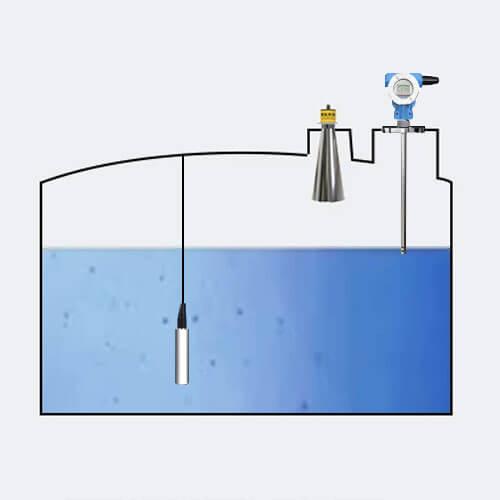
Level measurement is the process of determining the position of liquid or solid material inside a tank, container, silo, or other vessel. It is crucial in many applications for maintaining process efficiency, ensuring safety, and supporting inventory management, and is relied on in industries ranging from water treatment and food processing to oil and gas and chemical manufacturing.
Liquid level sensors are an indispensable part of this process. Currently, there are many types of liquid level sensors on the market, mainly classified according to their working principles and technical characteristics.
What Are the Main Types of Level Measurement?
Level measurement can be classified in different ways depending on the measurement technology and measurement method.
Point level measurement
Point level measurement detects whether a material(typically liquid, powder, or granular solids) has reached a specific, pre-set level in a container. It is typically used to identify conditions such as full, empty, high level, or low level, and to trigger an alarm or control response when the material reaches the set point.
Common sensor types:
1. Float switches
- Working principle: A float rises or falls with the material, mechanically triggering a switch.
- Best for: Clean, relatively low-viscosity liquids
2. Conductive level sensors
- Working principle: Use electrodes to detect conductive liquids.
- Best for: Water and other conductive liquids
3. Capacitive level sensors
- Working principle: Detect changes in capacitance caused by the presence of material.
- Best for: Liquids, powders, and granular materials
4. Vibrating fork level sensors
- Working principle: A vibrating fork changes frequency or stops vibrating when covered by material.
- Best for: Liquids, powders, and granular solids
Key applications
Overflow protection – Detecting when a tank or vessel reaches a high level
Low-level protection – Detecting when the material falls below a minimum level
Pump control – Starting or stopping pumps at preset level points
Safety & compliance – Ensuring hazardous materials stay within safe levels
Continuous level measurement
Continuous level measurement is a method for monitoring the precise level of material (such as liquids, slurries, or bulk solids) within tanks, silos, or containers over a full height range. Unlike measuring only a single point, this method provides real-time, uninterrupted data on material content, typically expressed as a percentage, volume, or height.
Common sensor types
1. Radar level sensors
- Working principle: Measure the distance to the material surface using electromagnetic waves.
- Best for: Harsh environments, steam, or high-pressure tanks.
2. Ultrasonic level sensors
- Working principle: Measure the distance to the material surface using reflected ultrasonic waves.
- Best for: Liquids and solids in open or closed tanks
3. Hydrostatic level sensors
- Working principle: Measure the pressure exerted by the material at the bottom to calculate level.
- Best for: Liquid applications with known densities.
Key applications
Process control – Monitoring material levels during production
Inventory management – Tracking material stored in tanks and vessels
Tank monitoring – Continuously monitoring storage and process tanks
Batching and dosing – Maintaining a specified level during processing
Contact level measurement
Contact level measurement refers to the physical contact between the sensor and the material being measured. It is very suitable for measuring clean, stable liquids or solids, which will not cause excessive wear to the sensor.
Pros: They are cost-effective because they typically require a low initial investment. Under suitable conditions, they can also provide high accuracy, and their simple structure makes them well-suited for less complex systems.
Cons: Because they are in direct contact with the medium, these sensors may require more frequent maintenance. They may wear out faster and may struggle with corrosive, sticky, or fouling materials, all of which can affect their long-term performance.
Common sensor types: Float switches, conductive level sensors, and hydrostatic pressure sensors.
Best for: These technologies are often used for simple applications such as monitoring water or fuel levels because they are simple and efficient.
Non-contact level measurement
Non-contact level measurement determines the material level without direct contact with the measured material. It is useful when direct contact with the medium is undesirable or when the material is corrosive, contaminated, or difficult to access.
Pros: The main advantages of non-contact sensors are their durability and low maintenance costs, as they do not require direct contact with materials, thus significantly reducing wear.
Cons: This high performance also means higher costs, and their accuracy can sometimes be affected by obstacles such as foam, dust, or steam. Furthermore, these sensors require an unobstructed signal path to function properly, which can be a limiting factor in cluttered or complex tank systems.
Common sensor types: Radar level gauges, ultrasonic sensors, etc.
Best for: Suitable for harsh applications (especially for corrosive, sticky or high-temperature materials) and environments with extremely high requirements for cleanliness or safety.
Video from @Set-Point
What Factors Affect Level Measurement?
When using liquid level measurement, several important factors need to be considered to ensure that the chosen method and technology meet the requirements of the specific application. Here are some key aspects:
Type of medium
- Density: Changes in density can affect pressure-based level measurement.
- Dielectric constant: Affects the performance of radar and capacitive level measurement.
- Conductivity: Determines whether conductive measurement methods can be used effectively.
- Viscosity: High-viscosity materials may cause buildup or slow changes in the measured level.
Surface conditions
The condition of the material surface can affect how reliably the level is detected.
- Foam: May interfere with reflected measurement signals.
- Turbulence: Can cause unstable or fluctuating level readings.
- Agitation: Mixing can make the material surface uneven.
- Buildup: Material deposits on the sensor can affect measurement accuracy.
- Dust: Dust in the tank can interfere with some non-contact measurement methods.
Process conditions
- Temperature: High or rapidly changing temperatures can affect sensor performance and material properties.
- Pressure: Changes in pressure can affect pressure-based measurement and sensor selection.
- Vapor: Vapor above the material may interfere with some measurement signals.
- Condensation: Condensation on the sensor or tank surface can affect measurement reliability.
Type of container
- Tank geometry: Tank shape and dimensions can affect sensor installation and measurement range.
- Internal structures: Pipes, agitators, ladders, and other structures may interfere with the measurement signal.
- Inlet and outlet position: Material entering or leaving the tank can create turbulence near the measurement point.
- Mounting location: Proper sensor positioning helps avoid obstructions and provides a more stable measurement.
Level Measurement Applications
Water and wastewater
In water and wastewater treatment, level measurement is used to monitor sludge or foam buildup in treatment ponds, as well as water levels in reservoirs and tanks. Reliable level data helps control pumping systems, prevent overflows, and support continuous water resource management.
The PM200 Series Submersible Level Transmitter is designed for the harsh environments commonly encountered in water and wastewater treatment. It employs a diffused silicon piezoresistive sensor encased in a corrosion-resistant stainless steel housing, and incorporates miniature signal processing circuitry for remote transmission. The PM200 series features a multi-layered protection design, offering strong overload and interference immunity, reverse polarity protection, and instantaneous overcurrent and overvoltage protection, meeting EMI protection requirements. It is an ideal choice for wastewater and sewage monitoring systems.
Oil and gas
In the oil and gas industry, level measurement is essential for monitoring other storage facilities such as refineries and storage tanks. Level sensors monitor separators and wellhead tanks, ensuring fluid separation and storage conditions meet requirements. Accurate level data helps operators track stored liquids and identify abnormally high or low levels.
Renkeer’s capacitive level sensor uses the radio frequency admittance principle to monitor the level of gasoline, diesel, hydraulic oil, and other mildly corrosive liquids in storage tanks. It controls the pump (valve) or triggers an alarm based on the level. It features a full stainless steel housing and strong anti-interference capabilities.
Chemical processing
In the chemical and petrochemical industries, accurate monitoring of the liquid level of corrosive or hazardous chemicals in pressure tanks can effectively prevent leaks and reduce the risk of accidents. Furthermore, interface detection (such as oil-water separation) is crucial for maintaining product quality and preventing contamination. Appropriate measurement methods should be selected based on the characteristics of the medium and the operating environment.
Renkeer’s RS-RAD-N01-1-T radar level gauge uses non-contact radar technology to measure the level of viscous or toxic liquids in storage tanks. Its narrow 8° beam angle helps reduce interference from surrounding structures, while its compact integrated design simplifies installation. The sensor supports measurement ranges up to 65 meters and is suitable for continuous level monitoring in harsh environments.
Food and beverage
In the food and beverage industry, precise level measurement is essential for critical processes involving raw materials such as milk, syrup, and oils to prevent overflows from mixing and stirring tanks. For equipment that may require frequent cleaning or sterilization, hygienic construction and reliable measurement are particularly important.
The food and beverage industry mainly uses capacitive and optical level switches for point detection, and ultrasonic and radar level gauges for continuous measurement. Their core requirements are sanitary-grade materials, easy cleaning, and resistance to CIP corrosion.
Pharmaceutical
In pharmaceutical manufacturing, level and pressure monitoring supports process control in tanks, containers, and fluid handling systems. Sensors must ensure level control in aseptic systems and batch mixing processes while meeting hygiene and compliance requirements.
For the pharmaceutical industry, sanitary capacitive level gauges are an option. The wetted parts are made of 316 stainless steel or PVDF, and there are no moving parts, making them easy to clean and sterilize. This meets the pharmaceutical industry’s requirements for accuracy and material compatibility.
HVAC
In HVAC systems, level sensors can monitor condensate levels in drain pans and pump reservoirs, detect overflows in humidifiers and air handling units, and manage refrigerant or glycol levels in chillers. This ensures smoother system operation, energy savings, and reduces the risk of system failure.
The RS-SJ series leak detector is designed to help prevent water damage to HVAC systems by detecting leaks in areas such as the drip tray beneath the air handling unit. It provides audible alarms and can remotely notify or control switch outputs.
Hydrology
In hydrology, level measurement is used to monitor water levels in rivers, reservoirs, lakes, and other natural water bodies. Continuous water level data helps track changes in water conditions and provides important information for flood monitoring, early warning, and water resource management.
The RS-DR-*-*-T water level staff can be used for water level monitoring in water conservancy projects such as rivers, lakes, reservoirs, hydropower stations, irrigation areas, and water conveyance systems. It acquires water level data through electrode changes and is specially treated with highly sealed materials internally, making it unaffected by mud, pollutant deposits, etc. The measurement height can be customized.
FAQs
How do I choose the right level measurement method?
Choose a level measurement method based on the material, measurement range, surface conditions, process conditions, and installation environment. Also consider whether contact or non-contact measurement is required and whether the sensor can provide the necessary output and communication interface for system integration.
What is the difference between point level and continuous level measurement?
- Point level measurement: Like a switch, it only provides a signal when the liquid level reaches the set point (e.g., high-limit alarm, low-limit alarm), without providing continuous values during the intermediate process.
- Continuous level measurement: Outputs the liquid level height value in real time, showing the entire process of the liquid level rising and falling, suitable for integration into control systems for monitoring.
What is the most accurate method for level measurement?
No single method is the most accurate for every application. Accuracy depends on the material, measurement range, temperature, pressure, surface conditions, and installation environment. Radar, hydrostatic, ultrasonic, and other methods can all provide accurate measurement when properly selected for the application.
Which industries use level measurement?
Level monitoring is widely used in industries such as chemical, food, plastics, pharmaceutical, recycling, building materials, timber, metal, water treatment, and wastewater treatment. It supports process monitoring, inventory control, and factory safety.
This article was written by the Renke Technical Team, which specializes in level measurement, sensor technology, and industrial monitoring applications. With practical experience in sensor development and measurement systems, the team shares reliable technical insights based on measurement principles and real-world applications, helping readers better understand level measurement technologies and select suitable monitoring solutions.