Soil is the fundamental basis for crop growth, and factors such as soil moisture, temperature, and nutrients play a critical role in plant development. To better monitor and manage soil conditions, soil sensors have been developed. They can monitor key soil parameters in real time, helping farmers and researchers precisely control irrigation, fertilization, and other agricultural activities. This article will provide you with a detailed introduction to the definition, measurement elements, working principle, and common types of soil sensors.
What is soil sensor?
Soil sensors are instruments specifically designed to measure single or multiple parameters in soil, like moisture, temperature, salinity, and nutrients. They include both single parameter soil sensors(such as soil temperature sensors, soil pH sensors, and soil electrical conductivity sensors), as well as multi parameter integrated sensors(such as soil NPK sensors, soil temperature and humidity sensors, and 4 in 1 soil sensors). All of these different types of instruments are collectively referred to as soil sensors.
Their main function is to collect soil data through internal sensing elements and convert this information into digital signals. These outputs support data analysis and decision making in agricultural management, environmental monitoring, and related applications.
In the process of agricultural cultivation, it is essential to have a timely understanding of the soil condition in order to determine which types of crops to plant based on the soil situation. This includes knowing when to replenish soil moisture and when to fertilize and apply specific types of fertilizers. By doing so, it becomes possible to effectively improve crop yield per acre and increase agricultural income.
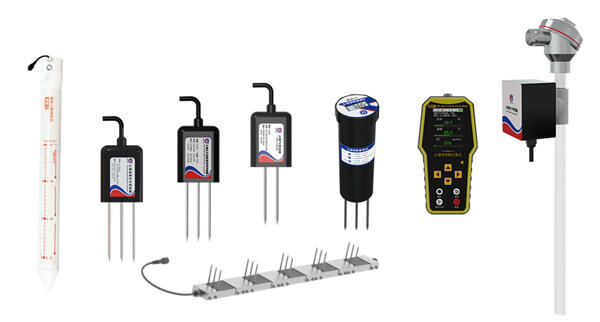
What do soil sensors measure?
Moisture, temperature, salinity, pH, and NPK are the most commonly measured parameters of soil sensors.
A low soil moisture content can adversely affect photosynthesis. Prolonged water scarcity can lead to crop withering and death because the soil pores, which contain both water and air, are limited. When there is a lack of moisture, the cohesive forces formed by soil compaction can exert tension on plant roots, causing them to break and leading to plant death. Conversely, excessive moisture reduces air density, preventing plant roots from respiration and resulting in rotting, which can also lead to plant death under severe conditions.
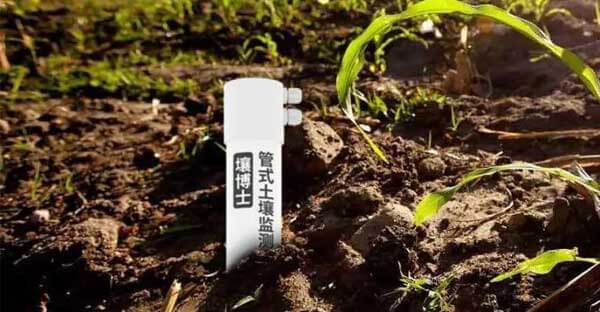
You can use a soil moisture sensor or a soil tensiometer to monitor soil water content. By collecting and analyzing soil moisture data, you can make timely irrigation decisions to ensure that soil moisture remains at an optimal level for crop growth.
Related Blog: Effective Ways to Measure and Maintain Soil Moisture
2. Soil temperature
Optimal soil temperature is beneficial for plant growth. Crop seeds require suitable soil temperatures for germination. When the soil temperature is favorable, crop growth rates accelerate. Utilizing soil temperature sensors to measure soil temperature and maintaining it within the appropriate range for crop growth can ensure increased productivity and improved agricultural income.
3. Soil pH
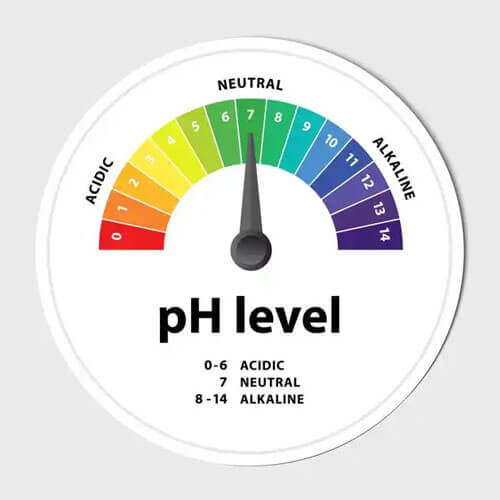
Each plant has an optimal soil pH condition, and most plants struggle to grow properly when the pH is either too high or too low. Using a soil pH sensor to measure soil acidity or alkalinity is beneficial for crop growth and helps reduce the occurrence of pests and diseases. Therefore, soil pH testing is essential for agricultural purposes.
4. Soil NPK
Nitrogen is the primary constituent of proteins and plays a crucial role in promoting stem and leaf growth as well as fruit development. Phosphorus facilitates flower bud differentiation and early flowering and fruiting in tomatoes. Potassium is responsible for promoting sturdy stem and enhancing plant resistance to cold, while also increasing sugar content and vitamin C levels in fruits. Soil NPK sensors can detect nitrogen, phosphorus, potassium and other elements in the soil to provide the nutrients needed by plants and promote plant growth.
5. Soil salinity
Soil salinity refers to the total content of soluble salts present in the soil. The primary sources of these salts include the weathering of parent material, capillary rise of groundwater, atmospheric deposition through dust and precipitation, and the return of salts through biological cycles. Different plants vary greatly in their salt tolerance. Soil salinity can either promote or inhibit plant growth at different levels, depending on soil type and plant species. Soil conductivity sensors can be used to measure the salinity of the soil.
Related Blog: Smart Irrigation Technology And System
How do soil sensors work?
The working principle of soil sensors can be summarized in the following steps:
Data Acquisition: Soil sensors typically consist of a sensing element that measures specific properties of the soil, such as soil moisture, temperature, pH value, electrical conductivity, etc.
Signal Conversion: The sensing element converts the measured data into electrical signals. Typically, the sensor’s built-in circuitry processes these signals into digital format for easier transmission and processing.
Signal Transmission: The digital signals are transmitted to a computer or controller via wireless or wired communication methods.
Data Processing: Upon receiving the digital signals, the computer or controller analyzes and processes the data to extract useful information, such as soil moisture, temperature, pH value, etc.
Device Control: Based on the analyzed results, the controller can automatically control corresponding devices, such as irrigation systems, weather stations, etc., enabling automated management.
In summary, the working principle of soil sensors involves converting physical or chemical parameters of the soil into digital signals, transmitting them to a control endpoint for analysis and processing, and facilitating soil condition management.
5 types of soil sensors
Based on different soil monitoring parameters, the five most commonly used types of soil sensors are soil moisture sensors, soil temperature sensors, soil electrical conductivity sensors, soil pH sensors, and soil NPK sensors.
1. Soil moisture sensor
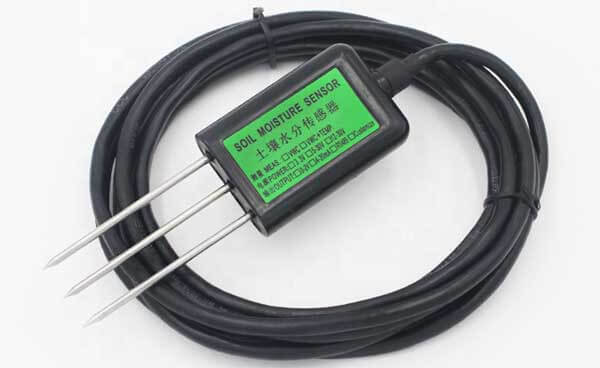
Soil moisture sensors, also known as soil humidity sensors, are mainly composed of stainless steel probes and a waterproof housing. They can be buried in the soil for long term use and are capable of online measurement of both surface and deeper soil moisture.
Compared with other types of soil sensors, soil moisture sensors offer a wider range of design options. Based on their working principles, they mainly include technologies such as measuring the soil dielectric constant, for example frequency domain reflectometry (FDR) and time domain reflectometry (TDR), as well as capacitive sensing and resistive sensing.
Dielectric constant
The electrical conductivity and dielectric properties of soil vary significantly with its moisture content. In general, the wetter the soil, the higher its overall dielectric constant. A sensor transmits an electromagnetic signal into the soil and analyzes its propagation characteristics to calculate the soil’s dielectric constant, which is then used to determine the volumetric water content. Based on how the electromagnetic signal is analyzed, dielectric measurement methods are further classified into time domain reflectometry (TDR) and frequency domain reflectometry (FDR).
Capacitive
This type of soil sensors employ the moisture-sensitive capacitor as its component, with commonly used materials being metal oxides and high polymer polymers. The materials used in capacitive sensors possess excellent water molecule adsorption capabilities. The higher the humidity at the measurement location, the more moisture is adsorbed onto the materials. These soil sensors are capable of converting the capacitance value into an electrical signal, facilitating data analysis for users.
Resistive
Resistive soil sensors typically use a moisture-sensitive resistor, which is commonly made of dielectric materials, semiconductors, or porous ceramics. These materials possess good water absorption capabilities, and their resistivity/conductivity changes significantly with humidity when they absorb moisture. The change in resistance value generates an electrical signal, which is then displayed on the instrument for analysis and interpretation.
Related Blog: Soil Moisture Sensor FAQ
Related Blog: Soil Moisture Sensors For Agriculture
2. Soil temperature sensor
Temperature is one of the key parameters in soil monitoring, as it influences a range of physical, chemical, and biochemical processes in the soil. Studies have shown that soil temperature affects crop physiological processes, external morphology, and internal structure, providing direct guidance for agricultural practices.
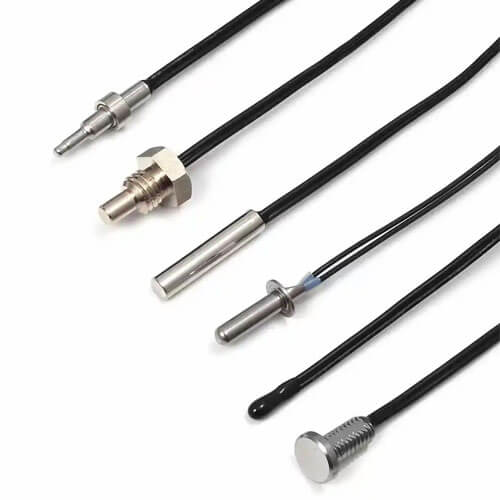
A soil temperature sensor converts temperature, a physical quantity, into an electrical signal that is easy to measure, such as resistance, voltage, or current. Common types include thermistors, platinum resistance sensors, and thermocouples.
Most soil temperature sensors on the market today are based on thermistor technology, measuring temperature through the change in resistance with temperature. Compared with conventional temperature sensors, soil temperature sensors are more durable and are specifically designed for temperature measurement in soil environments.
3. Soil conductivity sensor
Soil conductivity sensors measure the changes in soil conductivity to reflect variations in soil salinity. Soil conductivity is an indicator of both salt content and moisture content in the soil. Soil conductivity sensors use changes in resistance to output conductivity values, providing farmers with information about soil salinity and moisture content. This helps in better management and maintenance of plant growth.
4. Soil pH sensor
Soil pH level not only affects the ionic form and availability of large and trace elements in the soil but also has a significant impact on the life activities of microorganisms in the soil. Too low or too high pH will affect nutrient absorption.
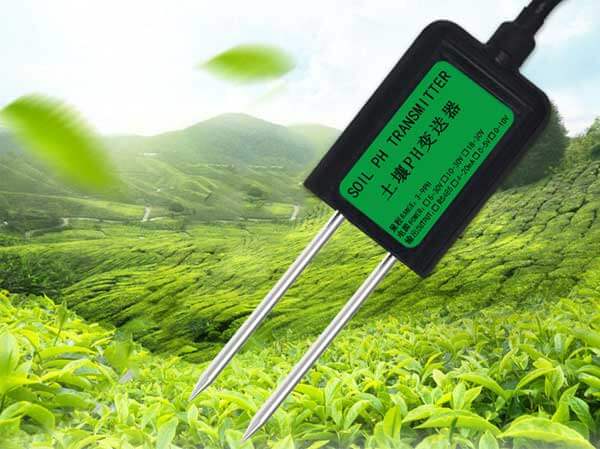
The soil pH sensor is composed of a metal sensor and a functional value-switching device. As the core hardware system, the metal sensor is in direct contact with the soil during detection and uses the oxidation reaction in the chemical reaction to generate current. The magnitude of the current value will drive the different pH value unit data corresponding to the ammeter, and the value can be directly displayed to people through the host conversion.
Related Blog: Top 8 Soil PH Testers For Garden Use
5. Soil NPK sensor
Soil NPK sensors are used to detect the content of nitrogen, phosphorus, and potassium in the soil. They utilize a physical sensing method rather than a chemical one. These sensors can be embedded in the soil or other media for long-term monitoring of soil nutrient data variations. By detecting the levels of nitrogen, phosphorus, and potassium in the soil, the fertility of the soil can be assessed, providing valuable information about soil conditions.
Related Blog: Knowing Soil NPK : Your Plants, Grow Better
Related Blog: Soil Fertility and How to Measure

Renke Technical Team specializes in the research and development of environmental sensing technologies, with a strong focus on soil and agricultural monitoring systems. With extensive experience in designing multi-parameter soil sensors, the team works on solutions that measure key soil indicators such as moisture, temperature, pH, and conductivity. By combining sensor hardware development with IoT data acquisition systems, Renke provides reliable and scalable monitoring solutions for real-world agricultural and environmental applications.