
Three Main Types of Rain Gauges
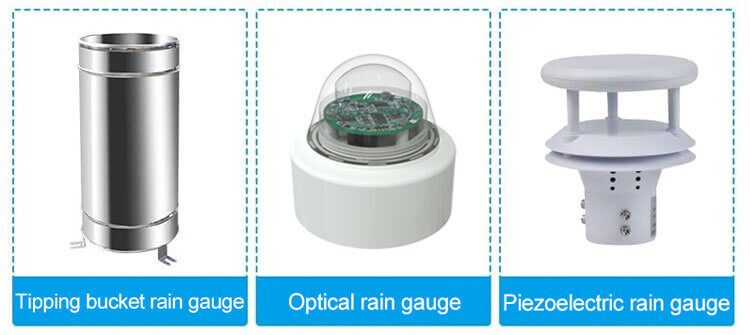
Rain gauges are essential instruments for accurately measuring precipitation and are widely used in meteorological monitoring, environmental research, and hydrological analysis. Based on their working principles and structural design, rain gauges can be classified into three main types: tipping bucket, optical, and piezoelectric rain gauges.
The tipping bucket rain gauge collects rainfall through a slanted funnel. When a fixed amount of water is accumulated, the internal bucket tips and empties automatically. Each tipping event is recorded by a magnetic or reed switch sensor, and the system calculates the total rainfall based on the number of tips. This type of rain gauge is highly reliable and commonly used in meteorological stations and hydrological monitoring systems.
The optical rain gauge measures precipitation using advanced optical technology. It features a light transmitter and receiver that monitor changes in light intensity as raindrops pass through the beam. By analyzing the degree of light attenuation, the device accurately determines rainfall intensity and amount. It has no moving parts, ensuring excellent durability and low maintenance.
3. Piezoelectric rain gauge
The piezoelectric rain gauge operates based on the piezoelectric effect. When raindrops hit the sensor surface, they generate tiny pressure variations that are converted into electrical signals by the piezoelectric element. The instrument calculates rainfall by analyzing these signal changes. This design offers high sensitivity, fast response, and excellent performance in harsh environments.
Pros and Cons of Three Rain Sensors
Optical and piezoelectric rain gauges are compact and easy to install, but they share a common drawback–low accuracy.
For optical rain gauges, accumulated dust over time or slight movement of leaves can interfere with the light path. Even a small deviation in the optical path can cause errors in the measured angle and intensity of the reflected light, leading to inaccurate rainfall readings.
For piezoelectric rain gauges, light rain (such as drizzle or sun showers) is often difficult to detect. During long-term outdoor monitoring, environmental factors such as wind, dust, and vibrations can cause false alarms. Sometimes, sandstorms may even be misinterpreted as rainfall. Measurement accuracy is also affected by raindrop size, shape, and velocity.
Piezoelectric rain gauges measure precipitation using the piezoelectric effect of piezoelectric ceramics. When windblown sand or other debris strikes the sensor surface, it generates pressure changes similar to raindrop impacts. The sensor may therefore mistakenly register these impacts as rainfall, resulting in false readings.
The only drawback of the tipping bucket rain gauge is its relatively large size, but it offers unmatched advantages in other aspects. It features efficient measurement, high sensitivity, strong protection, and, most importantly, high accuracy. It can record precipitation in real time and with precision, unaffected by dust or shadows. Combined with a carefully designed tipping mechanism and precise counting system, it maintains accurate measurements even under harsh weather conditions.
In contrast, optical rain gauges rely on optical technology and electronic components. While they require less daily maintenance, repairs and calibration are more complex and costly if malfunctions occur. The tipping bucket rain gauge, with its simple and reliable structure, is easy to clean and service, reducing operational and maintenance costs. It also does not require complex setup or calibration during use.
How to Choose a Tipping Bucket Rain Gauge?
There are many tipping bucket rain gauges on the market, and the selling points of each brand vary widely, making it difficult for users to choose. Here is a guide on how to select a high-quality tipping bucket rain gauge:
1. Check the rain collector (Orifice)
The rain collector is the most critical factor affecting the measurement accuracy of a tipping bucket rain gauge. Only collector orifices that comply with international standards can ensure reliable and precise data. The most commonly used standard diameter is 200 mm (approximately 8 inches), which meets the WMO (World Meteorological Organization) recommended specifications. Some meteorological applications also use 150 mm or 250 mm diameters, but the measurements must be adjusted according to calibration coefficients.
Additionally, the collector is usually circular with smooth edges and minimal burrs on both the inner and outer surfaces to prevent water adhesion, which can cause errors. The rim design should follow the ISO 7153-1 / WMO CIMO Guide recommendation for a sloped edge, which helps reduce wind effects on rainfall collection.
The tipping bucket rain gauge calculates rainfall per square meter by dividing the measured rain volume per minute by the collector’s cross-sectional area. Therefore, the collector diameter is a critical parameter for accurate rainfall measurement.
A 200 mm diameter collector effectively captures and measures precipitation of all types(light rain, moderate rain, heavy rain, and storms) across different regions. This size ensures that the recorded data accurately reflects local rainfall conditions.
If the diameter is too small, water may splash out or overflow quickly during heavy rain, leading to underestimation.
If the diameter is too large, the rainfall depth per unit area changes very little, making precise measurement difficult.
Thus, 200 mm is the internationally recommended standard, balancing accuracy and practical collection efficiency.
2. Check the lip angle (40°-45°)
When the collector lip angle is between 40°and 45°, it achieves the optimal sharpness to precisely divide incoming raindrops, clearly determining whether each drop falls inside or outside the collector. This prevents ambiguous zones that could affect measurement accuracy.
As rainwater strikes the lip, its shape and design guide the water evenly and orderly into the tipping bucket, avoiding chaotic splashing or overflow at the collector. Without a properly designed lip, water may enter the bucket randomly, causing significant variations in the amount collected by each tip. The lip also helps reduce interference from external factors such as wind or debris, preventing larger objects from entering the bucket.
However, this high-quality design increases manufacturing costs. As a result, some products on the market use thin stainless steel plates or bent steel substitutes instead of a true lip. Such cost-cutting designs often lead to poor measurement accuracy. Therefore, it is crucial to carefully inspect the lip design when selecting a tipping bucket rain gauge.
3. Check material and inner wall depth
The collector should be made of smooth, deformation-resistant materials to ensure that rainwater flows smoothly into the funnel. The collector depth should be no less than 100 mm, which prevents splashing caused by the impact of falling rain and ensures that the measured rainfall is accurate and not underestimated.
4. Distinguish different resolutions
For light rain or small precipitation amounts, a high-resolution rain gauge (e.g., 0.1 mm) is needed to sensitively capture subtle changes in rainfall. During heavy rain or storms, a lower-resolution device (e.g., 0.2 mm or 0.5 mm) can handle large volumes of rain in a short time without generating overly dense or complex data from frequent tipping events.
5. Determine rainfall intensity range
The mechanical design and working principle of a tipping bucket rain gauge determine the range of rainfall intensities within which it can maintain high accuracy and stability (typically 0.01 mm/min to 4 mm/min). Exceeding this range may cause overly fast or slow bucket tipping, splashing, or residual water, which can negatively affect measurement accuracy.
6. Check the internal structure
A single-bucket tipping rain gauge features a simple design with one funnel and one bucket, making it easy to install and maintain.
A double- bucket tipping rain gauge uses two buckets stacked vertically(the upper bucket acts as a transition bucket, while the lower bucket is the measuring bucket). This design improves rainfall detection accuracy. Users can choose the type based on their monitoring requirements.