Monitoring soil moisture is crucial for modern agriculture. An increasing number of farms are installing soil moisture sensors to monitor soil moisture levels in real-time and make irrigation decisions accordingly, to maximise irrigation efficiency, save water resources and promote crop growth.
But the availability of soil moisture information does not always ensure optimal irrigation. Many farms are only concerned about soil moisture but they neglect another important factor—measurement depth. This article will explain in detail the advantages of soil moisture monitoring at various depths, which results in a better irrigation plan.
The importance of monitoring soil moisture at different depths
Did you know? The depth at which different crops absorb water varies. The studies indicate that when growing most crops, the upper half of the root zone (20-40 cm below the soil surface) captures about 70% of the water taken up, as opposed to the near surface.
But moisture content of the soil differs greatly as depth increases. After a single irrigation, the topsoil may already be moist, while the deeper root zone remains water-deficient; even several days later, the topsoil may have dried out, yet the deeper soil layers still retain sufficient moisture. Thus it is important to measure data from the plant’s root zone to correctly assess if a plant is water-stressed. Soil sensors placed only 10-20 cm below the soil surface measure only the top soil layer where evaporation plays the most significant role, thus the moisture conditions in the root zone, which really affect crop growth, remain out of view.
Multiple soil moisture sensors installed at various depths will give information throughout the soil profile to help optimize irrigation during various parts of the growing season. Shallow soil moisture data can provide early warning, since that layer will dry faster than the deeper layers of the soil profile, while moisture data close to the roots will help to make the irrigation plan work.
The effect of soil moisture at different depths on plant growth
The importance of soil moisture to crops is not only determined by the amount, but also by the horizons of occurrence of the soil moisture.
0-20 cm (Surface layer)
The most variable moisture levels are found in the surface layer, which is most affected by rainfall and evaporation. Monitoring surface soil moisture directly influences seed germination and early seedling development, and does not directly affect the available water for mature crops. At the end of irrigation or after it has rained the surface layer will be wet first and dry first, thus creating the false impression that the soil moisture is adequate.
20-60 cm (Primary root water uptake zone)
This is the area that is the most critical for most crops and the area in which soil moisture needs to be closely monitored. In most large crops (corn, soybeans, and wheat), the 20-60 cm soil profile is the main moisture source. The moisture level in this layer directly influences the transpiration efficiency of the crops, nutrient acquisition and yields.
Below 60cm (Deep layer)
Drought resistant plants like cotton, sugarcane and sunflowers put their roots down deeper in response to drought conditions. The data shows that the correlation between soil water at the surface (0-10cm) and 60cm and 80cm is 0.33 and 0.23, respectively. This implies that there is virtually no predictive power when reading the conditions of the surface layers, compared to the deeper layers. Yield reduction symptoms can also be seen due to waterlogging in the deep soil for longer periods, which leads to root asphyxia.
Single-depth monitoring vs. Multi-depth monitoring
Every method has its own appropriate uses, and the selection will depend on what crop you are growing and the degree of precision of crop management that you’re looking for.
Single-depth monitoring is currently the more common method of soil moisture monitoring. The soil sensors are usually made of 1 to 3 long, thin probes, often 10 to 30 cm long, which are made of stainless steel and which have a signal cable or a display module attached at the top. The probes are inserted directly into the soil for taking a measurement.
Soil moisture sensors that measure at a single depth will not provide accurate information about the soil moisture status of the root zone since it is so short. For instance, the soil moisture content at 10 cm deep might be adequate, but at 40 cm deep it could still be water deficient.
So this makes single-depth monitoring viable for crops with shallow root systems and homogenous soil layers like vegetables, turf and nursery plants. Single-depth sensors are less expensive, offer a moisture measurement at the sensor depth, and are easier to install and maintain. If you just want to know if there is water in a particular layer, one-layer sensor is enough.
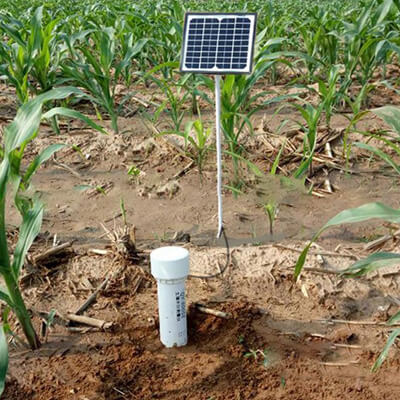
In contrast, multi-depth soil moisture monitoring allows for the simultaneous collection of moisture data from multiple soil layers, providing a more comprehensive picture of vertical soil moisture distribution. A multi-depth soil moisture sensor(like Renke RS-*W*S-N01-TR-6-T) consists of a slender, tubular PVC probe, with lengths ranging from 30 cm to 100 cm depending on the configuration. Installation involves drilling a hole with a soil auger and inserting the probe vertically until it is flush with the ground, causing virtually no disruption to farming operations. It is suitable for crops with deep root systems and long growing seasons, such as corn, cotton, and sugarcane.
By analyzing changes in moisture content at different depths, growers can not only understand the overall water supply conditions in the root zone but also determine whether irrigation is reaching the target root layer, as well as identify issues such as deep seepage or insufficient irrigation.
How does monitoring soil moisture at different depths improve irrigation?
The essence of multi-depth soil sensors is that they can measure multiple parameters, such as soil moisture and temperature, at shallow, intermediate, and deep depths, which allows for more informed decisions than simply guessing and helps turn irrigation decisions into a science.
1. Find the best time to irrigate
Shallow-layer data (0-20 cm) is related to surface evaporation and recent rain, and can be used as an early signal for irrigation. As shallow layer moisture reaches a threshold, it means that the crops have started to take up water from the top layer of soil, so if one starts drip irrigation at that time it will be possible to intervene before a high level of stress is reached.
2. Verifying irrigation effectiveness
Changes in data following irrigation directly show the water penetration at the mid-layer (20-60 cm) and deep layers. Deep-layer data with no response will result in irrigation only bringing the top layer of soil to moisture levels at field capacity but will leave the wateruptaking zone of the root system under-irrigated and needing supplemental irrigation; deep-layer data that quickly approaches field capacity will show that adequate moisture has been applied and supplemental irrigation is not necessary.
3. Avoid over-irrigation
Over-irrigation leaches soluble nutrients (N and K) from the root zone, which is a loss of water and fertilizer. Irrigators can use multi-depth soil moisture sensors to anticipate and prevent leaching, and adjust irrigation volumes accordingly. The research data indicates that farms can incorporate soil moisture data in irrigation management to save 20-30% of water without compromising yields.
Data from the multi-depth soil moisture sensor reflects changes over time in soil moisture levels in various depths following each irrigation. This data over the years will clearly show the actual effect of different volumes and timings of irrigation, and will be used when planning irrigation for the next season, not from scratch again each year.
What factors should be considered when selecting multi-depth soil sensors?
1. Monitoring depth and spacing
The monitoring depth should be in line with the distribution of the crop’s root system. Estimate the number of layers in which you want to measure. Do you just need to keep an eye on the two top layers (shallow, deep) or do you need to monitor three layers across (shallow, middle, deep) at 30, 60 and 90 cm? The more layers the more complete the data, but the more expensive. Pay attention to the possibility of adjusting the distance between the layers or maintaining a set distance between layers; flexible spacing provides more flexibility.
2. Measurement parameters
If you only need to monitor soil moisture data, a basic model will suffice. If your field has salinization issues, or if you need to assess crop health based on temperature, choose a three-in-one model that measures moisture, temperature, and electrical conductivity (EC) simultaneously—a single installation meets multiple needs.
3. Signal transmission method
RS485/Modbus is the most widely compatible output protocol that can be used with the majority of data loggers and agricultural IoT applications. For large farms where installation is challenging, consider farm models with LoRa or NB-IoT wireless communication.
4. Protection rating
Since the sensor is buried in the soil long-term, an IP68 rating is a basic requirement. Choose a housing made of PVC or stainless steel, which offers corrosion resistance and protection against fertilizer and pesticide erosion, ensuring a longer service life. This is particularly important for saline-alkali soils, high-humidity environments, or areas subject to long-term irrigation.
5. Calibration and maintenance
For some sensors, soil type calibration is necessary, adding to the learning curve. Look for models that are pre-calibrated for general use and can be quickly installed into different soil types, which will save more in terms of long-term maintenance.

This article was written by the Renke Technical Team, a group of engineers and application specialists focused on environmental and agricultural monitoring technologies. With extensive experience in the development and deployment of soil, weather, water quality, and IoT-based monitoring systems, the team works closely with growers, agricultural service providers, and research institutions to address real-world field monitoring challenges.