What are flow meters for water?
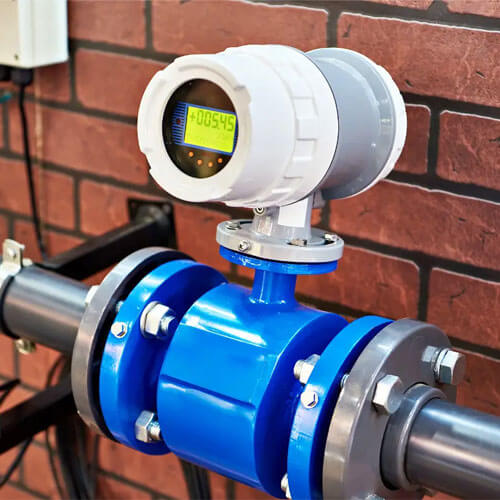
An instrument used to measure the flow rate of fluid in pipes or open channels is called a flow meter. The measurement results are usually expressed as volumetric flow rate or mass flow rate, with common units including m³/h, L/min, and kg/h. Water flow meters can be classified into several types based on their operating methods.
Flow rate representation
Flow rate can be expressed in two ways: instantaneous flow rate and cumulative flow rate.
Instantaneous flow rate is the amount of fluid flowing through the effective cross-section of a closed pipe or open channel per unit time. Instantaneous flow rate reflects the current flow state, and common units include m³/h and L/min.
Cumulative flow rate is the cumulative amount of fluid flowing through the effective cross-section of a closed pipe or open channel over a certain time interval (day/week/month/year). It is usually expressed in units such as m³ and L.
Instantaneous flow rate and cumulative flow rate can be converted to each other.
7 types of flow meters for water
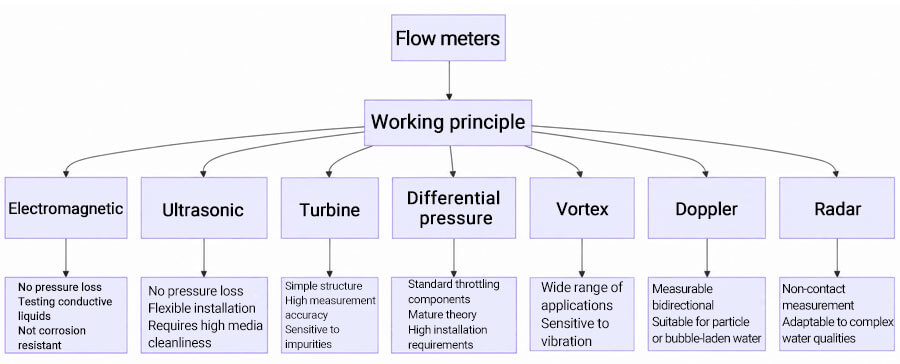
There are many types of water flow meters. In order to better understand them, they will be divided into the two main application scenarios; pipelines and open channels. We will be discussing their principles, characteristics, and applications, so you can decide which water flow meter is best for you.
Types of water flow meters for pipelines
Electromagnetic flow meter
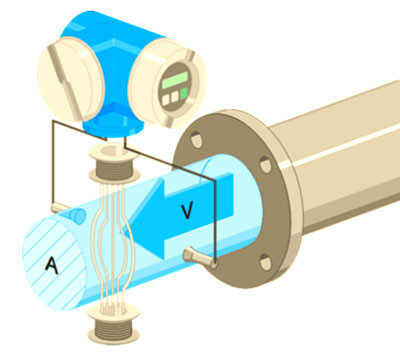
Electromagnetic flow meters are based on Faraday’s law of electromagnetic induction. They work by measuring the flow rate using the electromotive force produced as a conductive fluid flows through a magnetic field. They can be used to measure the flow rate of conductive liquids (such as tap water, industrial wastewater, sewage).
- Pros: Electromagnetic flow meters offer extremely low pressure loss and a wide measurable flow range. Their range ratio is typically above 20:1, with some models reaching even higher levels. They are suitable for a wide range of industrial pipe diameters, with some large instruments having a nominal diameter of up to DN3000. The output signal is linear with the measured flow rate, resulting in high accuracy.
- Cons: They can only measure the flow rate of conductive liquids, require full-pipe measurement, are susceptible to electrical interference, and are more complex to install and maintain compared to other flow meters.
Applications: Electromagnetic flowmeters are suitable for measuring the flow rates of acid, alkali and salt solutions, water, sewage, corrosive liquids and mud, slurry and pulp with conductivity ≥ 5μs/cm. It is however, not suitable for measuring the flow rates of gases, steam or pure water.
Installation requirements:
- Installation location: Choose a location with minimal vibration, away from strong electromagnetic interference sources, and ensure reliable pipe support.
- Full-pipe requirements: The measuring tube must be completely filled with liquid. Avoid installing at the highest point of the pipe or in locations prone to air bubble accumulation.
- Installation direction: For horizontal installation, it is recommended to keep the electrode axis horizontal; for vertical installation, a bottom-up flow direction is preferred.
- Grounding requirements: Ground correctly according to the instrument instructions. If necessary, configure a grounding ring according to the pipe material and structure.
- Straight pipe section requirements: Sufficient straight pipe sections should be reserved before and after installation to reduce flow field disturbance and ensure measurement accuracy.
Ultrasonic flow meter
The principle of ultrasonic flow meters is to determine the flow velocity with the time of flight principle, which is to measure the time difference between the forward and reverse direction of ultrasonic propagation. Ultrasonic flow meters use a non-contact measurement technique as compared to other water flow meters.
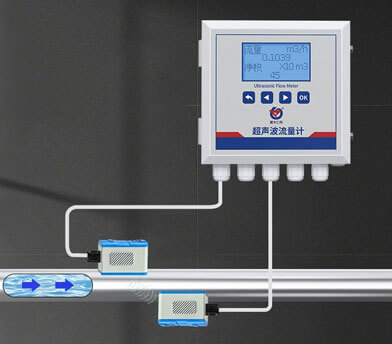
- Pros: The non-contact measurement method eliminates additional pressure loss, simplifies installation, and reduces maintenance requirements. Ultrasonic flow meters offer bidirectional measurement capability and an accuracy of up to ±1%. They have a wide range of applications and can be used for flow measurement in large-diameter pipelines.
- Cons: Requires full-pipe measurement. This measurement method is susceptible to influences from air bubbles, suspended particles, and pipe structure. They are more expensive than other flow meters.
Applications: Ultrasonic flow meters can be used to measure various media, including water, wastewater, industrial liquids, corrosive liquids, hazardous liquids, and high-purity clean liquids.
Installation requirements:
- Installation location: Choose a location with stable flow field and minimal vibration, avoiding pumps, valves, elbows, and reducers.
- Straight pipe requirements: Sufficient straight pipe sections should be reserved upstream and downstream of the flow meter to ensure stable flow velocity distribution. For ultrasonic gas flow meters, the straight pipe section requirement is usually high. Some applications may require an upstream straight pipe section of 30D-50D (D is the nominal diameter of the flow meter) or longer, and a downstream straight pipe section of at least 5D, depending on the instrument structure and pipeline conditions.
- Flow conditioner: When there is significant swirling flow or uneven velocity distribution in the upstream pipeline, a flow conditioner can be installed according to the instrument requirements to improve the flow field conditions.
Turbine flow meter
A turbine flow meter is based on the principle of conservation of fluid momentum. It is a velocity-type instrument that measures flow rate by rotating an impeller driven by fluid. It converts the turbine speed into an electrical pulse signal output through a magnetoelectric conversion device.
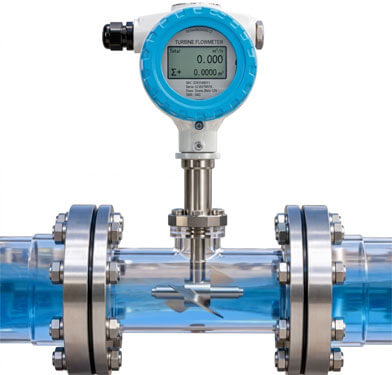
- Pros: There are a number of benefits of using turbine flow meters: they are simple in design, have virtually no pressure loss, have a fast response and offer a wide rangeability.
- Cons: The turbine comes in direct contact with the liquid to be measured and therefore is likely to wear. In addition, turbine flow meters are very sensitive to the flow conditions – any vortices or velocity imbalance will cause errors in reading.
Applications: Viscosity of the medium is the most important factor that influences the performance of a turbine flow meter. Turbine flow meters are appropriate for measuring liquids with a low viscosity (such as clean water, light oil, alcohol) and natural gas and liquefied petroleum gas (LPG).
Installation requirements:
- Installation direction: Install according to the flow direction arrow on the instrument housing. Horizontal or vertical installation is acceptable; for vertical installation, it is recommended that the fluid flow from bottom to top.
- Full pipe requirements: Ensure the pipe is always filled with liquid to prevent air bubbles from entering the measurement area.
- Straight pipe section requirements: It is generally recommended to reserve at least 10D of straight pipe section upstream and at least 5D downstream, subject to the product manual for specific requirements.
- Pipe connection: Ensure the flow meter is coaxial with the pipe, and the sealing gasket must not protrude from the inner wall of the pipe to avoid affecting the flow field.
Vortex flow meter
Vortex flow meters are based on the Karman vortex street principle. They calculate flow rate by detecting the frequency of vortex shedding generated when fluid flows over an obstacle. They are suitable for various gases and liquids. It belongs to the category of volumetric flow meters.
What is the Karman vortex street phenomenon? When fluid flows over an obstacle, it does not flow smoothly around it, but instead generates regular vortices alternating on both sides downstream of the obstacle. This is the Karman vortex street phenomenon. The vortices are periodic and velocity-dependent.
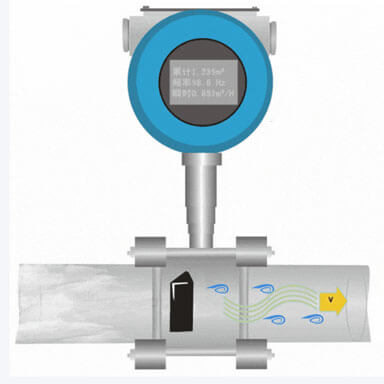
- Pros: Vortex flow meters have a simple structure, require little maintenance, have low pressure loss, and a wide range. The range ratio of common models is typically 10:1 to 20:1, and some enhanced models can reach 30:1.
- Cons: Vortex flow meters are not suitable for measuring low Reynolds numbers (ReD≥2×10⁴), and their application is limited in high viscosity, low flow velocity, and small diameter conditions.
Applications: They can be used to measure the flow rate of various media, including low-viscosity liquids with flow velocities greater than approximately 0.3 m/s, clean gases, saturated steam, and superheated steam.
Installation requirements:
- Installation location: Choose a location with minimal vibration. If the pipeline vibrates significantly, reinforcement or vibration damping measures are necessary. When measuring gases containing small amounts of liquid, it is advisable to install at a higher point in the pipeline; when measuring liquids containing small amounts of gas, it is advisable to install at a lower point in the pipeline.
- Straight pipe section requirements: Sufficient straight pipe sections should be provided upstream and downstream of the flow meter. The specific length should be determined based on the pipeline structure and product requirements.
- Pressure and temperature measurement holes: The pressure measurement hole should be located 2-7D downstream of the flow meter, and the temperature measurement hole should be located 1-2D downstream of the pressure measurement hole.
- Sealing gaskets: The sealing gaskets must not protrude from the inner wall of the pipeline to avoid interfering with the flow field and affecting measurement accuracy.
Differential pressure flow meter
Differential pressure flow meters are based on Bernoulli’s equation and the principle of throttling. They measure flow rate by the differential pressure generated when fluid flows through a specific throttling device in a pipe. There are many types of these flow meters, with common forms including orifice plate flow meters, venturi flow meters, and nozzle flow meters.
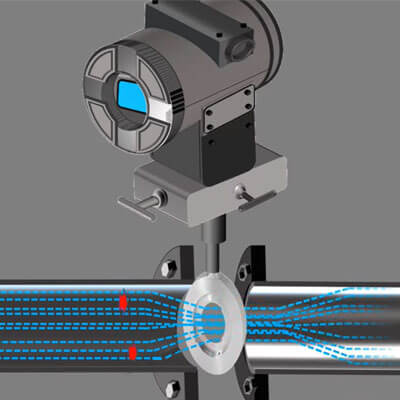
- Pros: They have a simple structure, mature technology, and high standardization. They are applicable to a wide range of media, including liquids, gases, and steam.
- Cons: The range ratio of differential pressure flow meters is typically 3:1 to 4:1, resulting in a relatively narrow measurement range. The throttling device generates significant pressure loss. Throttling elements such as orifice plates and nozzles are prone to wear, affecting measurement accuracy.
Applications: Differential pressure flow meters can measure various media such as liquids, gases, and steam, and are suitable for different operating conditions including normal pressure, high pressure, high temperature, and low temperature. Depending on the throttling device and instrument configuration, they can also measure the flow rate of fluids containing particles, high-viscosity fluids, and some miscible fluids.
Installation requirements:
- Installation location: Choose a location that facilitates inspection and maintenance, away from pumps, valves, and equipment subject to strong vibration.
- Straight pipe section requirements: Sufficient straight pipe sections should be reserved upstream and downstream of the flow meter to stabilize flow velocity distribution and reduce swirling flow. The specific length should be determined based on the type of throttling device and the upstream pipeline structure.
- Environmental conditions: The installation location should avoid high temperatures, strong corrosion, and other environments that may affect the instrument’s performance or service life.
Types of water flow meters for open channels
Doppler flow meter
A Doppler flow meter is based on the ultrasonic Doppler effect principle. It calculates fluid velocity by emitting ultrasonic signals and receiving echo signals. It typically has a built-in pressure level gauge, allowing simultaneous measurement of water level. The flow rate is calculated by multiplying the average flow velocity by the cross-sectional area of the open channel.
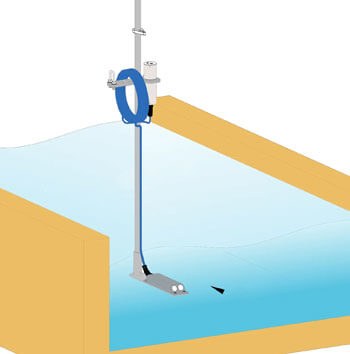
- Pros: It can measure in both directions, and can measure a variety of parameters at the same time, including flow velocity, flow rate, and water depth. It is suitable for situations where a river’s flow velocity changes frequently, and can adjust to various shapes of river cross sections and flow conditions.
- Cons: It is susceptible to corrosion and wear when submerged in water for extended periods. Can’t measure clean fluids. The probe needs to be cleaned regularly for accuracy of measurement. Requirements for installation are relatively high.
Applications: Doppler flow meters are suitable for fluids with solid particles or air bubbles, like natural rivers, artificial waterways, agricultural channels, urban sewers, industrial wastewater outlets, and sewage treatment plants.
Installation requirements:
- Installation site: Select a straight channel that has a steady flow of water, rather than at a gate, bend, etc. where turbulence can be expected. The upstream straight reach should be at least 10 times as wide as the channel, and the downstream straight reach should be at least 5 times as wide.
- Installation height: Min water level should be 20cm above the water level of the sensor. The probe should be 100-250 mm from the channel bottom. Don’t let silt or aquatic plants cover the probe.
- Installation direction: The flow direction of the sensor should be the direction of the water flow, preferably installed in the middle of the channel, and firmly attached.
- Protection requirements: The cable should be placed in the bracket in order to prevent the impact of the flow of water. Use a protective fence upstream, if necessary to keep floating objects from striking the probe.
Radar flow meter
Radar flow meters are based on the reflection characteristics of electromagnetic waves. They measure the surface velocity of water by analyzing the frequency difference (Doppler shift) between the transmitted and received signals. The final flow rate is calculated by combining the flow velocity and cross-sectional parameters. It is one of the non-contact instruments for measuring water flow velocity.
- Pros: Non-contact measurement method, strong anti-interference capability. No need for regular maintenance and low construction cost.
- Cons: Only measures surface velocity; measurement accuracy is poor under low flow velocity conditions. The minimum measurable flow velocity for most radars is 0.1 meters per second. Relatively high price.
Applications: It does not have high requirements for the cleanliness of the liquid; it can measure both clear natural water and turbid water containing silt and impurities. It is suitable for continuous flow monitoring in rivers, canals, and other open channels.
Installation requirements:
- Installation location: Choose a straight, stable section of river or canal with concentrated water flow. Install it in the center of the channel if possible, avoiding areas with whirlpools, turbulent currents, floating debris accumulation, and tree branches obstructing the flow. The measurement cross-section should be regular, and the bottom and sides of the channel should be hardened as much as possible.
- Installation height: The recommended installation height for the pole is 3-4 m. Installation too high may weaken the echo signal and expand the measurement area; installation too low will compromise equipment protection.
- Installation angle: The upper surface of the instrument housing should be kept as horizontal as possible, the flow velocity radar beam should be pointed towards the incoming water, and the level and flow velocity radar antennas should be unobstructed.
- Beam range: The radar beam coverage should be considered during installation to avoid branches, railings, and other moving objects entering the illumination area and reduce echo interference.
The above content provides a detailed introduction to the types, advantages, disadvantages, application scenarios, and installation requirements of common water flow meters, hoping to help you select the appropriate water flow meter based on your actual working conditions. For complex working conditions, it is also necessary to comprehensively consider the characteristics of the medium, flow conditions, and pipeline structure. Consulting professional technicians when necessary and accumulating rich experience are the most important aspects of problem-solving.
This article was written by the Renke Technical Team. With practical knowledge of water flow measurement technologies and their applications, the team provides technical insights into different types of water flow meters, their operating principles, performance characteristics, and installation requirements, helping readers better understand flow measurement and select suitable water flow meters.