

Table of Contents Are you curious about inclinometers? This article will take an in-depth look at the principles, types, and applications of inclinometers. Whether
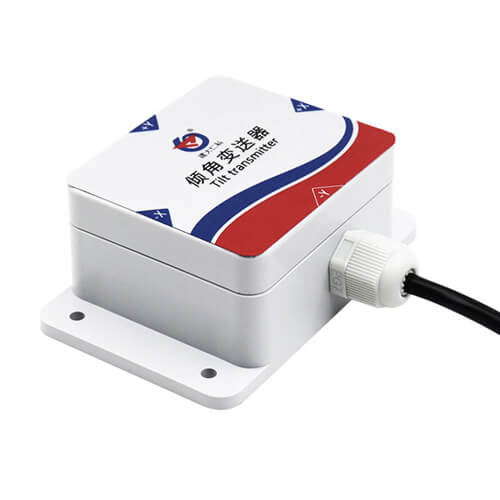
Tilt Sensor & Inclinometer
RS-DIP-*-1-T is a standard industrial-grade tilt sensor designed to measure the slope, angle, or tilt of an object. We offer both dual-axis and three-axis models, with options for digital or analog output signals and multiple installation configurations. These options allow customers to meet various requirements related to measurement range, signal type, and environmental conditions. The housing is made from durable, waterproof materials, enabling the inclination sensor to operate reliably even in harsh environments.
- Model: RS-DIP-*-1-T
- MOQ: 1 PCS
- Delivery date: within 24 hours
- Price: $16~$19
About - Tilt Sensor
This tilt sensor is an instrument used to measure the multi-axis tilt of a reference plane. The inclinometer converts the change of the tilt angle by measuring the static gravitational acceleration, so as to measure the tilt rate and angle of the sensor relative to the horizontal plane. It can easily detect orientation or tilt. It is widely used in industrial inclination measurement and dangerous building monitoring, ancient building protection monitoring, bridge tower inclination measurement, tunnel monitoring, dam monitoring, weighing system inclination compensation, drilling inclination control and other industries. Beautiful appearance and easy installation.
Features
- Equipped with a Kalman filtering algorithm, the tilt sensor delivers more accurate measurement data.
- It offers a wide angle measurement range with excellent signal linearity, making it suitable for most application environments.
- This inclination sensor features a broad measurement range, good linearity, strong anti-interference performance, and long transmission distance.
- Multiple output include RS485, 4-20mA, 0-5V, and 0-10V.
- Free configuration software is provided for address and baud rate settings, data reading, and zero-point calibration.
Parameters
| Output signal | RS485 | 4-20mA/0-5V/0-10V |
| Power supply | 5~30V DC | 10~30V DC |
| Max. power consumption | ≤0.15W | ≤0.15W |
| Component operating environment | -40℃~80℃, 0~95%RH (non-condensing) | -40℃~80℃, 0~95%RH (non-condensing) |
| Measure range | X-axis: -180°~180°, Y-axis: -90°~90°, Z-axis: -180°~180° | X-axis: -90°~90°, Y-axis: -90°~90° |
| Accuracy | X and Y axis: Static accuracy ±0.1°, dynamic accuracy ±0.5°. Z axis: Static accuracy ±0.5°, dynamic accuracy subject to integration error. | X and Y axis: Static accuracy ±0.1°, dynamic accuracy ±0.5° |
| Temperature drift | ±(0.5°~1°), (-40°C ~+60°C) | ±(0.5°~1°), (-40°C ~+60°C) |
| Acceleration range | ±16g | — |
| Response time | <2S | <1S |
| Protection rating | IP65 | IP65 |
| Cable length | Default 60cm, customizable. | Default 60cm, customizable. |
Installation
The default installation orientation of the tilt sensor is horizontal. When vertical installation is required, the vertical installation mode can be configured. The method is as follows: rotate the sensor 90° around the X-axis and place it vertically. In the configuration interface of the upper-computer software, select “Vertical” under the “Installation Orientation” option. After the setting is completed, calibration is required before use. In vertical installation, the X-axis points horizontally to the right, the Y-axis points inward perpendicular to the wall surface, and the Z-axis corresponds to the sensor’s counterclockwise rotation direction.
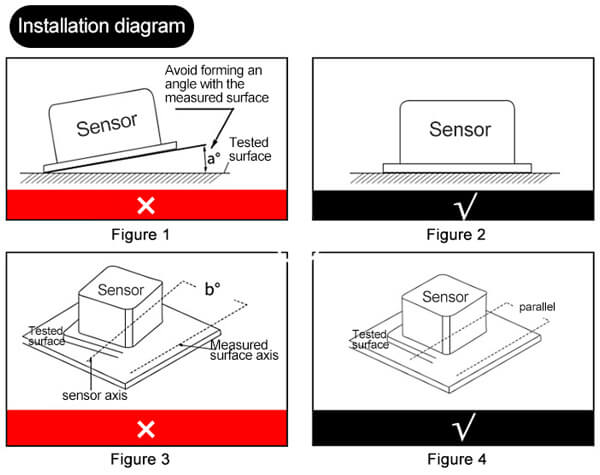
Please install the inclinometer according to the correct installation method. Improper installation will cause measurement errors.
The installation surface of the tilt sensor and the surface to be measured must be fixed tightly and flat. If the installation surface is uneven, it will easily cause the measurement angle error.
The axis of the sensor and the axis to be measured must be parallel, and the two axes should not create an angle as much as possible.
FAQs - Tilt Sensor, Inclinometer
How many outputs does the tilt sensor have?
- Single Axis, Single Output: The sensor responds to tilting about a horizontal axis, relative to downward gravity.
- Dual axis, dual output: The sensor consists of two sensing elements angled at 90 degrees to each other.
What are the types of tilt sensors?
According to the structure and working principle, it can be divided into three types: single-axis single-output, dual-axis dual-output and dual-axis single-output.
How to install the tilt sensor to ensure its best accuracy?
When installing, keep the mounting surface of the sensor parallel to the measured surface and reduce the influence of dynamics and acceleration on the sensor. The inclinometer can be installed horizontally or vertically. Vertical installation is suitable for single-axis tilt sensors, and horizontal installation is used for inclinometers with a range of <60 degrees. The front of the sensor is marked with X and Y direction indicator stickers, which can be referred to during installation.
Which direction do uniaxial and biaxial measurements refer to?
Dual axis can measure roll angle (X direction) and pitch angle (Y direction). When the single axis is selected for horizontal installation, only the flip angle or pitch angle can be measured. If the single axis is selected for vertical installation, only the flip angle can be measured, but the pitch angle cannot be measured.
How can the actual angle of the electronic compass be larger than the measured angle?
Since the two axes of inclination measurement are the most sensitive, when the inclination direction is not parallel to the measurement axis, the actual value will be larger than the measured value, which can also be understood as projection.
The larger the range of the inclinometer sensor, the better?
No, the range size and accuracy will be inversely proportional, the smaller the range, the higher the accuracy.
Where to download the manual of this sensor?
To protect our patented technical parameters, please contact us for manual.
Related Blogs
Table of Contents What is Modbus? Modbus is a serial communication protocol used for communication with Programmable Logic Controllers (PLCs). Because of its open
Table of Contents What is a vibration sensor? Vibration sensor is a device that measure the vibration speed and frequency of mechanical motion and
Measuring tilt angles is an important part of geometric metrology. The range of angle measurement is wide. According to the spatial position of the
Breeding environment monitoring has a great influence on the growth of poultry. Changes in factors such as temperature, humidity, carbon dioxide, and ammonia in
What is a karst cave? The karst cave is a treasure given to mankind by nature and is called a “disposable non-renewable resource” by
Table of Contents Smart buildings are the product of the development of modern science. The smart building system is mainly composed of Internet of
Table of Contents The key to the smart industry lies in the collection of data and information. Sensors are the nerve endings of the
Table of Contents Modern companies are placing an increasing emphasis on the value of collected data. As a result, central data centers, IDCs, and
Table of Contents Have you or your friends ever experienced a burst pipe or indoor flooding? Even if you don’t live in a flood-prone
Table of Contents What is IoT? IoT is the “Internet of things“. It is an extended and expanded network based on the Internet. It
What is an air quality monitor? An instrument used to detect air quality can be called an air quality monitor. However, due to the