Table of Contents We know that the risk of vehicle accidents on the road increases exponentially during heavy rain, fog and snowfall. According to
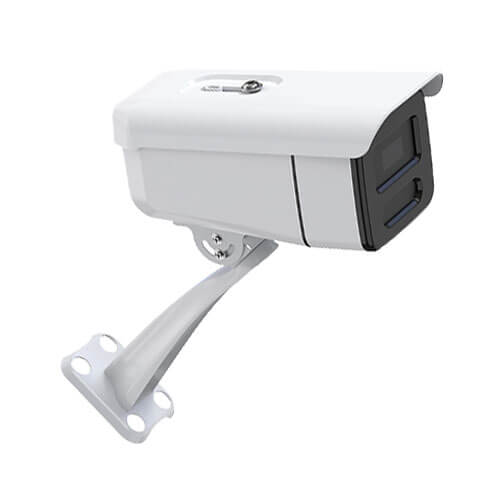
Snow Depth Sensor
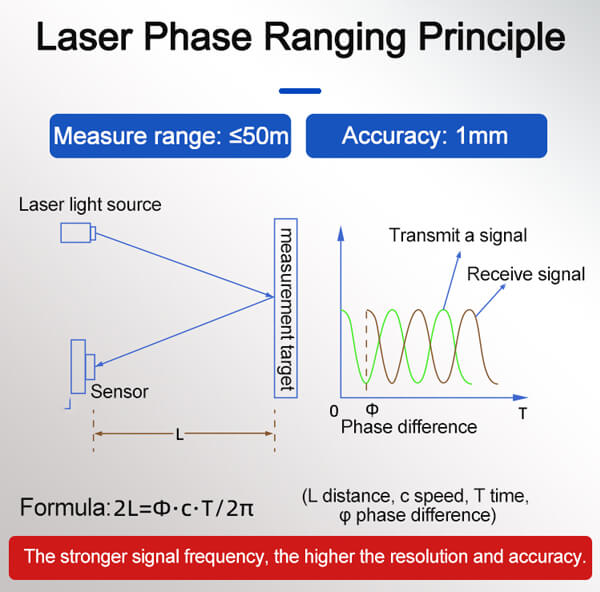
This laser snow depth sensor is a digital snow depth measuring instrument. It works on the phase method laser ranging. The measurement data is uploaded to the remote monitoring platform through RS485/Ethernet/WIFI/LORA, and the user can view the real-time data on the computer or mobile phone.
- Model: RS-LSD-*-1-EX
- MOQ: 1 PCS
- Delivery date: within 24 hours
- Price: $462
About - Snow Depth Sensor
Our snow depth sensor has strong anti-interference capabilities. Based on universal laser ranging technology, temperature compensation ensures laser stability, resulting in high measurement accuracy and excellent stability. It maintains excellent monitoring capabilities even in heavy snow or even blizzards. It can be used in conjunction with other weather sensors from our company to upload real-time snowfall data.
Features
The snow depth is obtained by measuring the unmelted snow at a fixed location, which refers to the vertical depth from the snow surface to the ground, and the unit is centimeters. This could be a constantly changing value as snowfall changes. The RS-LSD-*-1-EX snow depth sensor adopts a waterproof plastic-sprayed shell, which can work outdoors for a long time and is not easily affected by environmental factors. Using advanced non-contact laser ranging technology, the detection distance can reach 50 meters. It has a temperature compensation function to ensure the temperature stability of the laser, and the value is more accurate. Widely used in weather stations, flow monitoring, traffic, aviation monitoring, agricultural production monitoring and other fields.
Maintenance
- Avoid scratching the sensor’s measuring area to maintain external integrity and extend the device’s lifespan.
- Rough handling can damage the internal circuit boards and delicate structures.
- Do not smear or cover the instrument with paint, as this may affect normal operation.
- Secure the device securely during use to prevent damage.
- Regularly check other accessories to ensure proper function.
Datasheets
| Power supply | DC 10-30V |
| Max. power consumption | 0.8W (3.5W when heating) |
| Working environment | -40°C~+50°C, 0%~95% RH (non-condensing) |
| Resolution | 1mm |
| Accuracy | ±1mm |
| Range | 0.05~2.5m |
| Output signal | RS485 (Modbus protocol) |
| Laser type | 635nm,<1mw |
| Laser class | Ⅱ class |
| Single measurement time | 0.05 ~ 1S |
| Spot size | Point spot: 5mm@10m Line spot: 3mm x 150mm@10m |
Why Choose Renke?
Easy installation
The snow depth sensor can automatically measure the angle of inclination, no need to adjust or calibrate the angle when installed. easy and convenient.
IP65 protection
The shell is made of corrosion-resistant material, has good sealing, is waterproof and dustproof, meets the IP65 protection grade, and can work outdoors for a long time.
Automatic heating
Our laser snow depth sensors come with automatic heating. When the temperature is lower than 0°C, the heating function is automatically turned on to prevent the equipment from freezing. So as to ensure that the snow depth sensor can work normally.
High flexibility
This laser snow depth sensor can be installed on a pole alone or used together with other weather sensors. Measure a variety of meteorological parameters, and the data can also be uploaded synchronously.
Multiple power supply
For urban areas or apartments with convenient power supply, it can be connected to the mains 220V power supply. When monitoring in remote mountainous areas or farmland, the mains power supply is inconvenient, and solar power supply can be selected.
Remote control
The measured data can be uploaded to the free cloud platform through wired or wireless signals, through which the data can be viewed and the parameters of the sensor can be adjusted remotely. Administrators can monitor different locations in real time through the cloud platform.
FAQs - Snow Depth Sensor
What is snow depth?
Snow depth is measured using a snow depth sensor. This sensor measures the distance between the sensor and the ground below it. This distance can be obtained by laser ranging technology.
How does the snow depth sensor work?
Install the snow sensor on the pole. The sensor controls a visible, easy-to-measure laser beam and uses the phase-based laser measurement principle to measure the depth of snowfall.
How to check the measured value?
Our company provides customers with a free cloud platform, and you can log in to the background through a computer or mobile phone to view historical and real-time data.
Why is snow depth important?
Snow depth is one of the main items in the study of surface meteorology. Measuring snow depth could add to studies of the water cycle and snowfall, as well as satellite estimates of sea ice thickness. That’s a key metric, especially as climate change intensifies.
What types of snow depth sensor?
There are two common snow depth sensors on the market at present, namely: laser snow depth sensors and ultrasonic snow depth sensors.
How to install the snow depth sensor?
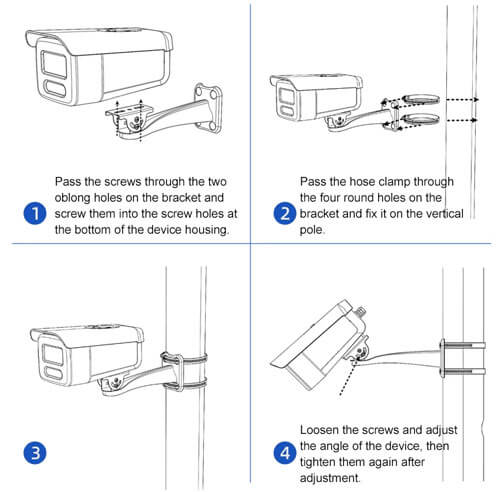
We recommend adjusting the sensor to an angle of 45° to 60° with the horizontal plane and installing it at a height of 2.5m to 3m.
How to perform zeroing?
After installing and connecting the transmitter, zeroing should be performed first. Press and hold the button on the bottom of the device to zero. Wait for 3 seconds, then release it when you hear a beep. The device will automatically zero. A successful zeroing result will result in a long “beep” sound, while an unsuccessful zeroing result will result in a “beep, beep” sound. This step can also be performed using the “485 Parameter Configuration Software.”
Note:
1. After zeroing, ensure the device is not moved to prevent data anomalies. If the device must be moved on-site, re-zeroing is required.
2. When zeroing, ensure that the snow depth monitoring surface is flat to prevent any potholes or weeds that may affect the laser measurement.
What should be paid attention to when using it?
- Adverse measurement conditions (such as excessive ambient light intensity, high or low ambient temperature, weak or strong target reflectivity, or rough or uneven target surfaces) may shorten the measurement range or cause significant errors in the measurement results.
- Because the product is designed with an algorithm to filter out abnormal data, abnormal data will only be updated if it persists. Therefore, if an excessively large data point suddenly appears during reading, the data will not be updated immediately.
What's in the package list?
- Laser snow depth sensor*1
- Certificate of conformity, warranty card, instruction manual, etc.
- Mounting bracket*1
- Mounting hose clamps*2
- USB to 485 converter (optional)
Why can't the sensor connect to the PLC or computer?
- The computer has multiple COM ports, and the selected port is incorrect.
- The device address is wrong, or there are devices with duplicate addresses (factory defaults are all 1).
- Baud rate, parity mode, data bit, stop bit error.
- The host polling interval and waiting time for response are too short, both need to be set above 200ms.
- The 485 bus is disconnected, or the A and B lines are reversed.
- If the number of student sensors is too many or the wiring is too long, the nearby power supply should be added, and a 485 booster should be added, and a 120Ω terminal resistance should be added at the same time.
- The USB to 485 driver is not installed or damaged.
- The snow depth sensor is damaged.
Related Blogs
Long-term rainfall and melting snow have raised water levels and flooded city roads, causing flooding. Frequent and extreme flooding is inevitable and endangers community
Table of Contents The commonly used communication method for data acquisition and control is RS-485. RS-485 is a general communication standard. It can not
The main purpose of environmental monitoring is to provide data on environmental quality and changing trends to ensure the safety of public life and
Table of Contents Accurately measuring rainfall has long been a challenge, owing to its pronounced regional and diurnal variability. The emergence of modern Western
The weather sensors are the sensing end of the weather station and collect various weather-related data. The weather station can obtain the main parameters
Table of Contents What is an anemometer? An anemometer is a meteorological instrument used to measure air velocity and, in many configurations, wind direction.
Agricultural irrigation mainly refers to irrigation operations carried out in agricultural farming areas. Agricultural irrigation methods can generally be divided into traditional surface irrigation,
Table of Contents What is a water level sensor? A water level sensor is a device designed to measure the height of a liquid,