Whether you realize it or not, atmospheric pressure is closely tied to our daily lives and influences global weather patterns and forecasts. Understanding the basics of atmospheric pressure will help you measure it more accurately. Keep reading to learn more.
What is atmospheric pressure?
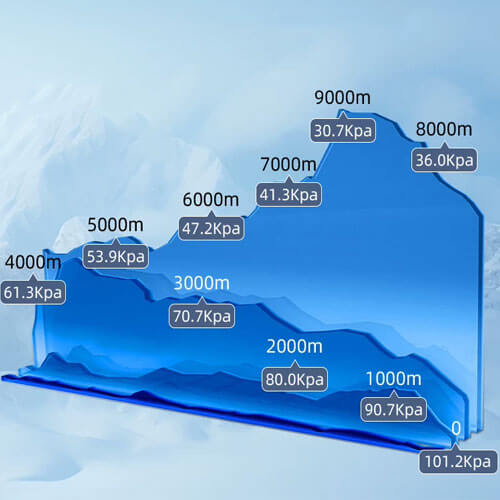
Atmospheric pressure refers to the pressure exerted by the Earth’ s atmosphere on a unit area of a surface at ground level. On Earth, atmospheric pressure decreases with increasing altitude. Internationally, the standard atmospheric pressure is defined as 101,325 pascals (101.325 kPa, equal to 760 millimeters of mercury, or 1,013.25 hPa). This value serves as the benchmark for instrument calibration, unit conversion, and engineering calculations.
The atmospheric pressure at sea level when the temperature is 59°F (15°C) is equal to one atmosphere (Atm); this serves as the reference reading for determining relative atmospheric pressure.
Units and standard values for atmospheric pressure
Atmospheric pressure is typically expressed in units such as atmospheres (atm), pascals (Pa), hectopascals (hPa), millibars (mbar), millimeters of mercury (mmHg), and inches of mercury (inHg). The unit of pressure in the International System of Units (SI) is the pascal (Pa). Standard atmospheric pressure (1 atm) is defined as 101,325 Pa, which is equivalent to 1,013.25 hPa or 1,013.25 mbar under standard atmospheric conditions at sea level. Other unit conversions include:
1 standard atmosphere (atm) = 101,325 pascals (Pa)
1 standard atmosphere (atm) = 1,013.25 hectopascals (hPa)
1 standard atmosphere (atm) = 1,013.25 millibars (mbar)
1 standard atmosphere (atm) = 760 millimeters of mercury (mmHg)
1 standard atmosphere (atm) ≈ 29.9213 inches of mercury (inHg)
How is atmospheric pressure formed?
At the microscopic level, atmospheric pressure arises from the random thermal motion of air molecules. These molecules constantly collide with the surfaces of objects and transfer momentum; the statistical result of these numerous collisions manifests as measurable pressure at the macroscopic level. On a macroscopic level, atmospheric pressure arises from the Earth’ s gravitational pull on the atmosphere at the Earth’ s surface, which in turn exerts pressure on objects on the ground. The pressure per unit area is known as pressure, and the unit of pressure is typically expressed in pascals (Pa) or millibars (mb). At sea level, standard atmospheric pressure is approximately 101,325 Pa or 1,013.25 mb.
Factors affecting atmospheric pressure
- Altitude: This is the most significant factor; the higher the altitude, the thinner the air and the lower the atmospheric pressure. Near the ground, atmospheric pressure generally decreases at a rate of approximately 11-12 kPa for every 1,000-meter increase in altitude. For example, atmospheric pressure in mountainous areas is typically lower than at sea level, which is why altitude sickness occurs.
- Temperature: Under identical conditions, as air temperature rises, the air expands due to heat, its density decreases, and it rises, resulting in lower atmospheric pressure. At the same time, temperature differences between horizontal and vertical layers drive atmospheric circulation, thereby affecting the distribution of atmospheric pressure across different regions.
- Humidity: Increased humidity causes a slight decrease in atmospheric pressure. The core mechanism is that water vapor (molecular weight 18) replaces some of the heavier nitrogen and oxygen molecules, reducing the density of the air.
- Seasonal variations: The impact of seasons on atmospheric pressure stems from the asynchronous rates at which land and oceans warm and cool. Land warms and cools rapidly, while oceans lag behind and exhibit smaller temperature fluctuations; this thermal disparity drives the seasonal reorganization of pressure systems.
Methods for measuring atmospheric pressure
1. Rough measurement method
Atmospheric pressure can be roughly measured using a suction cup, a smooth glass plate or tabletop, a force gauge, and a ruler. To perform the measurement, press the suction cup against a smooth surface and expel as much air as possible to ensure a good seal.
Use the force gauge to pull the suction cup vertically upward, and record the force (F) at the moment it just begins to detach. Next, measure the effective diameter (D) of the suction cup and calculate the area under force: P = 4F / πD². By measuring the force required to lift the suction cup, you can estimate atmospheric pressure.
2. Torricelli’ s experiment
Torricelli’ s experiment is a classic method for measuring atmospheric pressure. To conduct the experiment, first fill a long glass tube(sealed at one end and open at the other) completely with mercury. Plug the open end with your finger, then invert the glass tube into a mercury bath.
When the finger is removed, the mercury inside the tube descends a certain distance under the force of gravity, but it does not flow entirely into the mercury bath; instead, it forms a mercury column of a certain height within the tube. When the mercury column reaches hydrostatic equilibrium, under standard atmospheric pressure conditions, the height of the mercury column is approximately 760 mm, or 76 cm.
According to the principles of hydrostatics, the pressure exerted by the mercury column is in equilibrium with the external atmospheric pressure; therefore, atmospheric pressure can be expressed as p = ρgh.
3. Instrumental measurement
Barometer
A barometer is an instrument specifically designed to measure atmospheric pressure. Based on their operating principles, the two main types of barometers are mercury barometers and aneroid barometers.
A mercury barometer uses atmospheric pressure to cause a column of mercury to rise or fall, and calculates atmospheric pressure by measuring the height of the mercury column. Liquidless barometers utilize atmospheric pressure to cause a slight deformation in a metal chamber; a mechanical structure then converts this deformation into the displacement of a pointer, thereby measuring atmospheric pressure.
The advantages of barometers include an intuitive measurement method and a relatively mature design that does not require complex electronic systems. Liquidless barometers are primarily used to measure pressure in oxygen cylinders and are also manufactured as altimeters for use by mountaineers and in aircraft.
Atmospheric pressure sensor
An atmospheric pressure sensor is a measuring device capable of converting air pressure into an electrical signal. It utilizes the minute deformation or changes in electrical parameters produced by a sensitive element under the influence of atmospheric pressure to convert pressure changes into a measurable electrical signal; this signal is then processed and calibrated to obtain the atmospheric pressure value.
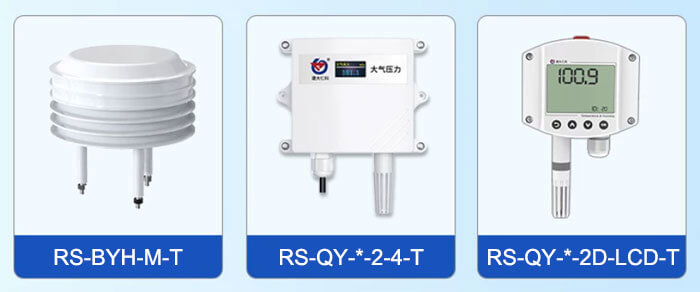
Compared to traditional barometers, they offer advantages such as compact size, light weight, fast response times, ease of digitization, and ease of system integration. They can be directly connected to data loggers, controllers, communication modules, or IoT platforms to enable continuous monitoring, automatic recording, and remote transmission of atmospheric pressure data.
Atmospheric pressure sensors are widely used in applications such as automatic weather stations, environmental monitoring, smart buildings, HVAC systems, industrial automation, drones, aviation equipment, and IoT monitoring systems.
FAQs
How can you predict the weather based on barometer readings?
A barometer measures atmospheric pressure, helping to determine whether weather systems are changing. A reading above 30.20 inHg is generally considered high pressure, which is typically associated with clear skies and calm weather. Barometric pressure readings in the range of 29.80 to 30.20 inHg are considered normal, and normal pressure is associated with stable weather. Barometric pressure readings below 29.80 inHg are generally considered low pressure, and low pressure is associated with warm air and heavy rain.
Why do atmospheric pressure sensor readings fluctuate periodically?
According to NOAA data, atmospheric pressure naturally exhibits regular diurnal variations. Even in the absence of significant weather changes, two relative peaks and two relative troughs naturally occur throughout the day. In low-latitude regions, the amplitude of this diurnal variation averages about 2.5 hPa, while it approaches zero at latitudes north of 60°.
This means that if you are using an atmospheric pressure sensor for continuous monitoring and observe periodic fluctuations of a certain magnitude each day, it does not necessarily indicate a sensor error. These are normal variations in atmospheric pressure.
Why does atmospheric pressure vary with altitude?
As altitude increases, the column of air above a given measurement point gradually becomes shorter, and the total mass of that column decreases accordingly; therefore, the pressure per unit area decreases. At the same time, air density is lower at high altitudes, which is why the air is often described as “thin.” This is also why atmospheric pressure in mountainous regions and during high-altitude flights is significantly lower than at sea level.
How do changes in air pressure affect the weather?
Generally, air pressure readings can tell you whether the weather will be sunny, stormy, or largely unchanged in the near future.
Here are some examples of how to interpret air pressure readings:
When the air is dry, cool, and pleasant, the recorded air pressure tends to rise.
Generally speaking, a drop in air pressure indicates that the weather is deteriorating.
A sudden drop in air pressure usually signals that a storm is approaching.
What happens to the human body under extreme atmospheric pressure?
When exposed to extreme pressure environments, the human body may exhibit a series of physiological reactions. For example, during deep-sea diving, increased ambient pressure raises the partial pressure of nitrogen in the breathing gas, which can cause nitrogen narcosis—resulting in impaired judgment, lack of concentration, and impaired motor coordination.
When a diver ascends rapidly from a high-pressure environment, the nitrogen absorbed into the body may form bubbles due to the rapid drop in pressure, triggering decompression sickness. Symptoms may include joint pain, numbness, dizziness, muscle weakness, and severe neurological symptoms.
Why do your ears feel uncomfortable during takeoff and landing?
During takeoff and landing, external air pressure changes rapidly, while the pressure in the middle ear must gradually equalize with the external pressure through the Eustachian tube. When the pressure on both sides cannot equalize in time, the eardrum is subjected to a pressure differential, causing discomfort such as a feeling of fullness in the ears, ear pain, and temporary hearing loss. This condition is commonly referred to as “airplane ear” and is medically known as barotrauma of the ear.
Do changes in atmospheric pressure affect human health?
Yes. Changes in atmospheric pressure can affect the body’s physiological state, especially when the changes are significant or when a person is sensitive to weather fluctuations. Studies have found that a drop in atmospheric pressure or rapid fluctuations may trigger or exacerbate migraines and headaches in some people.
Changes in atmospheric pressure may also affect physiological conditions such as joint and muscle pain, blood pressure, and sleep; among these, the effects on pain and migraines have been the subject of extensive research. As for joint pain, the extent of the impact varies depending on the type of condition and the individual.
Source from: https://pmc.ncbi.nlm.nih.gov/articles/PMC12617017/

This article was written by the Renke Technical Team, drawing on practical expertise in atmospheric pressure measurement, environmental monitoring, and sensor technology. This article combines established measurement principles with practical considerations to help readers better understand atmospheric pressure and choose appropriate measurement methods and technologies.