From household microwave ovens and water heaters to complex industrial boiler control processes, temperature sensors are indispensable for monitoring. A temperature sensor is an electronic instrument used to measure the temperature of air, liquids, and solids, and it is widely used in various industries and fields.
What are temperature sensors?
A temperature sensor is a device that senses temperature and converts it into a usable output signal (usually an electrical signal). It is the core component of temperature measuring instruments.
Early thermometers were simple mechanical instruments that could only display the degree of hot or cold, such as mercury thermometers. Modern temperature sensors, which appeared after the 1930s, are electromechanical devices that can convert temperature changes into voltage, current, or resistance signals, which are then processed and output as readable numerical values.
video from Youtube @MouserElec
Is a thermostat a temperature sensor?
A thermostat is not simply a temperature sensor. While related to temperature sensors, thermostats are not the same thing. More accurately, a thermostat is a combination of a temperature sensor and a controller. The temperature sensor is just one core component; the thermostat itself completes the closed-loop process from sensing and comparison to control.
How do temperature sensors work?
Temperature sensors work by utilizing the physical or chemical properties of certain substances that change with temperature, converting temperature changes into electrical or other measurable signals. Common working principles include:
- Thermoelectric effect: Utilizing the characteristic that the thermoelectric potential difference between two different metals or semiconductors changes with temperature, converting temperature changes into voltage signals. Common thermoelectric effect sensors include thermocouples.
- Resistant resistance effect: Utilizing the characteristic that the resistance of certain metals or semiconductors changes with temperature, converting temperature changes into resistance signals. Common resistance temperature detectors (RTDs) include platinum resistance thermometers, copper resistance thermometers, and semiconductor thermistors.
- Thermal expansion effect: Utilizing the characteristic that the volume of certain substances changes with temperature, converting temperature changes into displacement signals. Common thermal expansion sensors include bimetallic strips, expansion thermometers, and pressure thermometers.
- Thermal radiation effect: Utilizing the characteristic that the intensity of thermal radiation from an object changes with temperature, converting temperature changes into light signals. Common thermal radiation sensors include infrared thermometers.
Different types of temperature sensors
Currently, based on their working principles, temperature sensors on the market are mainly classified into five types: thermometers, thermocouples, semiconductor-based (IC), resistive temperature detectors (RTDs), and infrared (non-contact) temperature sensors. Below, we will introduce the working principle, characteristics, and applications of each type of temperature sensor in detail.
| Types | RTD (Platinum) | Thermocouple | Thermistor | Semiconductor(IC) | Infrared |
|---|---|---|---|---|---|
| Range | -200~850°C | -270~1820°C | -50~300°C | -55~150°C | -50~3000°C |
| Accuracy | High | Moderate | High locally, strong nonlinearity | Moderate | Moderate |
| Response speed | Moderate | Fast | Relatively fast | Slow | Fast |
| Application | Low to mid temperature precision measurement | High temperature, dynamic measurement | Everyday temperature control | Room temp, low cost, high volume deployment | Non contact, high temperature, long distance |
| Linearity | Fairly good | Poor | Poor | Good | Good |
| Cost | Medium to high | Low to high | Low | Lowest | Medium to high |
Thermistors
Utilizing the characteristic that the resistance of semiconductor materials changes with temperature, they convert temperature changes into resistance signals. They are mainly divided into two categories: NTC (Negative Temperature Coefficient) and PTC (Positive Temperature Coefficient). NTC thermistors are commonly used for temperature measurement, while PTC thermistors are mostly used for protection. Currently, most thermistors on the market are NTC, meaning their resistance decreases as temperature increases. However, a few thermistors are PTC, meaning their resistance increases with temperature.
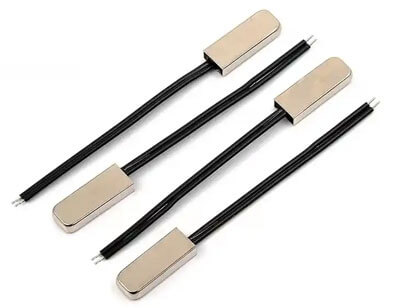
NTC thermistors are mainly sintered from transition metal oxides such as manganese, nickel, cobalt, iron, and copper. The B value and nominal resistance are controlled by adjusting the oxide ratio and sintering process. PTC thermistors are mostly made of barium titanate ceramic, utilizing the resistance abrupt change near the Curie point to achieve switching characteristics.
Two important parameters for NTC thermistors are their resistance at 25℃ and their B constant (25/50℃). If two NTC temperature sensors have the same parameters, their NTC resistance and temperature curves will also be similar, allowing them to be substituted for each other.
Applications: Thermistors are suitable for ambient temperature monitoring, household appliances, and battery protection, especially in the 25~85°C temperature range.
Thermocouples
Thermocouples utilize the property that the thermoelectric potential difference between two different metals or alloys changes with temperature to convert temperature changes into a voltage signal. They are one of the most widely used contact temperature sensors in industry. The IEC 60584 standard assigns seven common calibration designations to thermocouples with different metal combinations: K, J, T, E, R, S, and B. The characteristics of each calibration designation are detailed in the table below:
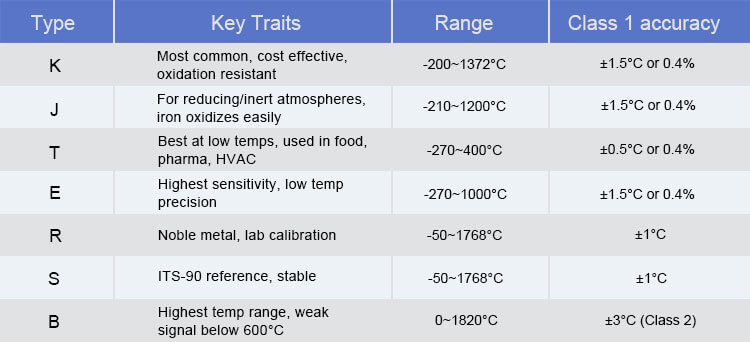
Two different metal wires are welded together at one end to form a hot junction, while the other end remains cold. When the two ends are at different temperatures, a small voltage (thermoelectric potential) is generated; this phenomenon is called the Seebeck effect. Typically, the hot junction contacts the object being measured, and the cold junction connects to the measuring instrument. The greater the temperature difference, the higher the voltage generated. The instrument converts the voltage value into a temperature reading.
Applications: Thermocouples are widely used in high-temperature and dynamic temperature control applications such as metallurgy, boiler and engine monitoring, and are suitable for measuring environments with drastic temperature changes.
Semiconductor-based (IC temperature sensor)
Semiconductor-based temperature sensors are typically integrated into integrated circuits (ICs). These sensors use two diode-like diodes with temperature-sensitive voltage and current characteristics to monitor temperature changes.
They offer advantages such as small size, low power consumption, and ease of integration, providing linear output, but their accuracy is lower in the 1°C to 5°C range. They also exhibit the slowest response time (5 to 60 seconds) over the narrowest temperature range (-70°C to 150°C).
Applications: Semiconductor-based temperature sensors are widely used in IoT environmental monitoring nodes, consumer electronics, battery management systems, and other scenarios requiring moderate accuracy and low-cost mass deployment.
Resistive Temperature Detectors (RTDs)
Resistive Temperature Detectors (RTDs) utilize the property that the resistance of a metal (usually platinum) changes with temperature, converting temperature changes into a resistance signal. Common types include Pt100 and Pt1000, with a temperature range covering -200°C to +850°C. The IEC 60751 standard defines standardized resistance-temperature characteristics and accuracy classes.
RTDs are the most accurate and stable temperature sensors. Their linearity is superior to thermocouples and thermistors. However, RTDs are also relatively slow in response and expensive.
Applications: RTD temperature sensors are suitable for industrial control, scientific research, and medical equipment, typically used in measurement scenarios requiring high accuracy and stable ambient temperatures.
Infrared (non-contact)
Infrared temperature sensors are based on the principle that the infrared energy radiated by an object increases with increasing temperature. By measuring infrared radiation, the sensor can calculate the object’s temperature, conforming to the Stefan-Boltzmann law.
Many industrial infrared sensors operate in the wavelength range of 8-14 µm. Their measurement accuracy depends on surface emissivity, distance and spot ratio, viewing angle, reflected radiation, and atmospheric conditions. Infrared sensors have extremely fast response times and are suitable for measuring moving, rotating, hard-to-reach, or high-temperature targets.
Applications: Infrared temperature sensors are suitable for applications requiring non-contact temperature measurement, such as monitoring in high-temperature industries like steel and glass, and in human body thermometers.
What applications use temperature sensors?
Temperature sensors have a wide range of applications, covering multiple fields such as industry, automotive, medical, home appliances, agriculture, meteorology, and emerging technologies.
Industry
In industrial production, temperature sensors are used for temperature control in chemical reactions, monitoring of steel smelting furnaces, and monitoring of motor winding and bearing temperatures.
Automotive
In automotive thermal management systems, temperature sensors are core sensing components, applicable to engine monitoring, battery management systems, and in-vehicle air conditioning systems. Demand is growing fastest in the new energy vehicle and energy storage sectors, as battery pack temperature monitoring directly affects safety and lifespan.
Medical
Primarily used for body temperature measurement, internal temperature control of medical equipment, and monitoring of surgical patients’ body temperature.
Home appliances
Used for temperature monitoring and thermal management in equipment such as air conditioners, refrigerators, microwave ovens, and washing machines.
Agriculture
Temperature sensors can monitor the temperature of the growing environment for crops and control the automatic activation of ventilation and heating equipment in greenhouses.
Meteorology
Temperature sensors measure atmospheric and ocean temperatures, providing basic data for weather forecasting.
Artificial intelligence
Temperature sensors are needed in areas such as robotics, artificial intelligence, data centers, and flexible electronics.
What is the difference between the temperature sensor and the temperature transmitter?
A temperature sensor is a sensitive element that detects temperature changes and is only responsible for converting temperature changes into electrical signals (such as resistance or voltage); it does not have signal processing capabilities. A temperature transmitter, on the other hand, amplifies and linearizes the raw signal output from the sensor, converting it into a standardized signal that can be directly integrated into industrial control systems.
What are the functions of a temperature sensor?
The core function of a temperature sensor is to detect temperature changes and convert them into usable electrical signals so that the system can perform measurements, display data, or perform automatic control.
Which is the most accurate temperature sensor?
Resistance temperature detectors (RTDs) are the most accurate temperature sensors. Compared to thermocouples or thermistors, platinum resistance thermometers offer significantly better accuracy, linearity, stability, and repeatability.
How many types of RTD sensors are there?
RTD sensors are classified according to the construction of their temperature sensing elements. There are two main types: thin-film and wire-wound. The type of RTD sensor used depends on its intended application and specific conditions.
RTD configurations include two-wire, three-wire, and four-wire options:
- Two-wire: Used when the lead length is short enough that resistance does not affect accuracy.
- Three-wire: This configuration adds an RTD probe to carry the excitation current, thus providing a method to compensate for lead resistance.
- Four-wire: This configuration eliminates lead resistance by using separate force and sensing wires, and is the most accurate configuration.
How do you test a temperature sensor?
The temperature sensor is tested by measuring the resistance or voltage with a multimeter to determine whether there is a short circuit or open circuit. Then, ice water and boiling water are used as known temperature points to roughly measure the accuracy. In industrial applications, a constant temperature bath or dry block furnace is used in conjunction with a standard sensor for multi-point comparison and calibration. At the same time, response time and long-term stability can be measured as supplementary indicators.

The Renke Technical Team consists of experienced engineers and technical specialists in sensor technology and environmental monitoring. Drawing on years of experience in sensor development, system integration, and real-world monitoring applications, the team shares practical insights into measurement principles, sensor selection, and monitoring technologies to help readers better understand and apply sensing solutions.