Infrared radiation is everywhere in our daily life, from the infrared energy emitted by the sky, to the natural radiation of the human body, and even to distant planets in outer space. It exists in different forms throughout the universe. Atmospheric infrared radiation originates from the scattering of sunlight by the atmosphere and from the Earth’s own thermal emission, showing distinct characteristics between day and night. The human body, as a natural infrared source, continuously emits and absorbs infrared radiation. This radiation not only helps regulate body temperature, but also carries important information related to life processes.
As early as 1800, the British astronomer William Herschel discovered infrared radiation while using a prism to separate sunlight into seven colors. He found that in the dark region beyond red light, the temperature was unexpectedly higher. Repeated experiments confirmed the existence of an invisible “heat ray” beyond the red end of the visible spectrum, which was later named infrared radiation.
This discovery significantly expanded human understanding of the electromagnetic spectrum. Infrared radiation is an electromagnetic wave with wavelengths between visible light and microwaves, typically ranging from about 0.75~1000 μm. Together with gamma rays, X rays, ultraviolet radiation, visible light, microwaves, and radio waves, it forms the complete electromagnetic spectrum.
Basic principles of infrared radiation
All objects with a temperature above absolute zero (-273.15 °C) continuously emit infrared radiation. Infrared radiation is essentially a form of electromagnetic wave with wavelengths approximately ranging from 0.75~1000 micrometers, which lies beyond the visible spectrum of the human eye.
Infrared radiation shares the same fundamental nature as radio waves and visible light and can be divided by wavelength into near-infrared, mid-infrared, far-infrared, and extreme-infrared bands. It occupies the portion of the electromagnetic spectrum between radio waves and visible light and represents one of the most widespread forms of electromagnetic radiation in nature. Infrared emission arises from the inherent random motion of molecules and atoms in all objects, which continuously radiate thermal infrared energy. The more vigorous the molecular and atomic motion, the greater the emitted energy; conversely, slower motion results in lower radiation energy.
Characteristics of infrared radiation
1. All objects emit infrared radiation
As long as an object’s temperature is above absolute zero, its surface will actively emit infrared radiation.
2. Higher temperature means stronger radiation
The emitted radiant energy increases rapidly as temperature rises and is approximately proportional to the fourth power of the absolute temperature, as described by the Stefan-Boltzmann law.
3. Wavelength depends on temperature
Objects at different temperatures have different peak emission wavelengths. For example, the human body and objects at ambient temperature (around 300 K) radiate most strongly in the long wave infrared band of 8~14 μm, while high temperature mechanical equipment emits more prominently in the mid wave infrared range of 3~5 μm.
Is infrared radiation thermal radiation?
Infrared radiation and thermal radiation are not the same concept, but they are closely related.
These two concepts are connected, yet clearly different. Infrared radiation refers to electromagnetic radiation with wavelengths roughly between 0.7 micrometers and 1000 micrometers. It only describes a wavelength range and does not specify how the radiation is generated. Thermal radiation, by contrast, emphasizes the source. It is electromagnetic radiation produced by the temperature of an object, and its intensity and spectral distribution are determined by that temperature.
Their relationship lies in the fact that for objects at ambient or high temperatures, most of the emitted thermal radiation falls within the infrared region. Therefore, in industrial and scientific applications, the infrared radiation we detect is usually thermal radiation. This overlap is what allows infrared technology to be used for temperature measurement, thermal imaging, and heating processes. In many practical scenarios, infrared radiation is the form in which thermal radiation appears.
However, infrared radiation is not always thermal radiation. For example, light emitted by infrared LEDs or infrared lasers also lies in the infrared band, but it is not generated by temperature, so it does not carry thermal information and does not directly indicate the temperature of an object. This highlights the difference between the two: infrared radiation defines wavelength, while thermal radiation refers to energy produced by temperature.
What are the applications of infrared radiation?
Infrared radiation in sensor technology
In sensor technology, infrared radiation provides a non-contact means of obtaining physical information, making temperature measurement, gas detection, flame recognition, and human presence sensing possible. The core function of an infrared sensor is to convert invisible infrared radiation into measurable electrical signals or digital data, which are then processed, calibrated, and analyzed to achieve accurate perception of the environment or target.
Infrared sensors mainly utilize two categories of physical properties of infrared radiation.
The first is the relationship between an object’s self-emitted radiation and its temperature. Any object with a temperature above absolute zero emits infrared radiation. The intensity and spectral distribution of this radiation follow Planck’s blackbody radiation law and are influenced by the emissivity of the material. Based on this principle, the infrared temperature sensor measure temperature by detecting the infrared energy emitted by objects, while the PIR motion sensor detect changes in the long wave infrared radiation emitted by the human body to determine the presence of people.
The second is the selective absorption of specific infrared wavelengths by gases and chemical substances. Many molecules exhibit distinct vibrational-rotational absorption peaks in the mid-infrared region. Infrared gas analyzers and non-dispersive infrared (NDIR) CO₂ sensors utilize this principle by measuring the attenuation of infrared light at specific wavelengths as it passes through a gas sample, thereby determining gas type and concentration. In industrial applications, wavelength-selective optical filters, modulated light sources, and high sensitivity detectors are typically used to enhance selectivity and stability and to reduce the influence of environmental interference.
Different infrared wavelength bands determine the application scenarios of sensors. Short wave infrared (SWIR) and mid wave infrared (MWIR) are commonly used for high temperature target detection and flame recognition, while long wave infrared (LWIR) is widely applied in human detection, environmental thermal imaging, and equipment temperature monitoring. Engineers can select different types of infrared sensors according to the target object, temperature range, and environmental conditions.
Infrared radiation in thermography
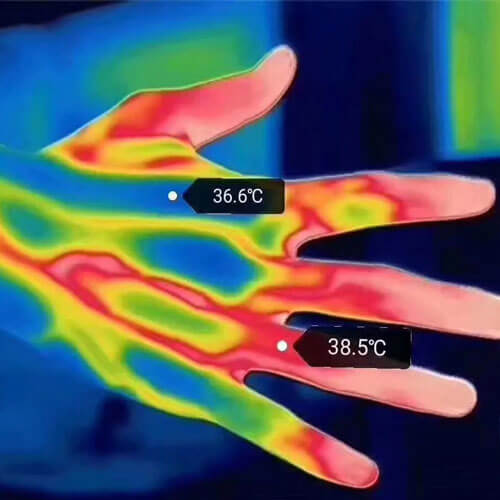
Thermal imaging technology is essentially the process of making invisible heat visible to the human eye. By capturing infrared signals and converting temperature information into visual images, it allows people to directly “see” the thermal distribution of objects. Whether it is pedestrians in the dark, hidden mechanical faults, or heat leakage points in building walls, thermal imaging reveals details that visible light cannot capture.
All objects continuously emit infrared thermal energy due to the motion of their molecules, creating a temperature field on their surfaces, commonly referred to as a “thermal image.” Infrared diagnostic technology captures this emitted infrared energy to measure the surface temperature and the distribution of the temperature field, enabling assessment of the device’s heating conditions.
Thermal imaging technology is widely used in industry, security, and medicine. In industrial applications, thermal cameras can monitor equipment surface temperature in real time and identify overheating bearings, pipeline leaks, or electrical abnormalities, helping to prevent failures and accidents. In the security field, thermal imagers can track human activity and detect intruders at night or in complex environments. In medical applications, infrared thermal imaging can be used to detect localized temperature anomalies, such as inflammation, abnormal blood flow, or postoperative recovery conditions, providing doctors with a visual diagnostic reference.
Infrared radiation in heating and drying
The thermal energy of infrared radiation can be used to heat objects in a non contact and highly efficient way. After infrared rays penetrate the surface of an object and are absorbed, molecular vibrations increase, converting energy into heat and rapidly raising the temperature. This method is well suited for fragile, volatile, or surface sensitive materials, such as plastics, rubber, and coating curing.
Beyond industrial heating, infrared heating technology has also been extended to medical therapy. Far infrared hot compress devices or infrared heating beds gently warm human tissues, promoting blood circulation and relieving muscle soreness and tension. In the food industry, infrared radiation efficiently transfers energy to the surface and subsurface of food, enabling rapid heating and moisture evaporation while largely preserving color and taste.
How to measure infrared raidation?
If the human eye could perceive infrared light, the world would reveal countless features invisible under normal visible light conditions. People and objects in complete darkness could be seen clearly, individuals with higher body temperatures could be instantly detected, and weak points within object structures would be visible. In reality, however, the human eye can only sense visible light, so infrared energy must be converted into a detectable form, this is the role of an infrared detector. It transforms the energy of infrared radiation into measurable signals.
Applications of Infrared Detectors Across Different Wavelengths
In practical use, infrared detectors are generally categorized by detection wavelength into short wave infrared (SWIR), mid wave infrared (MWIR), and long wave infrared (LWIR), covering the short, medium, and long atmospheric windows.
Short wave infrared detectors operate in the 1.0~3.0 μm range. Under conditions such as a full moon or clear starry sky, most spectral radiation from moonlight falls within the SWIR band, including emissions from high-temperature objects and reflections from the natural environment. SWIR detectors can operate at relatively high temperatures and have lower cooling costs.
Mid wave infrared detectors cover the 3.0~5.0 μm range. MWIR systems are typically used for targets with temperatures above 300 K, such as exhaust plumes or shipborne detection.
Long wave infrared detectors operate in the 8.0~14 μm range, making them advantageous for lower temperature targets, long atmospheric transmission paths, or special atmospheric conditions. For example, a target at 300 K has a blackbody radiation peak around 10 μm, and as the temperature decreases, the peak wavelength shifts longer. LWIR detectors are highly effective at seeing through natural or artificial interference, but LWIR focal plane arrays are expensive due to the narrow bandgap of long wave materials and the complex fabrication processes required.

This article was written by the Renke Technical Team. The team focuses on collecting, analyzing, and addressing real customer challenges, and shares practical solutions through technical articles to help other users solve similar problems. Renke is a trusted sensor manufacturer with more than 15 years of hands on experience in hardware and software research and development. The company designs and produces a wide range of environmental monitoring sensors that are widely deployed across global markets. Supported by extensive field application experience and continuous technological innovation, we provide reliable and experience based insights into the development of Internet of Things and sensor technologies.