


Table of Contents Water leak detection is designed to detect and repair leaks in pipes, equipment or building structures in a timely manner to prevent
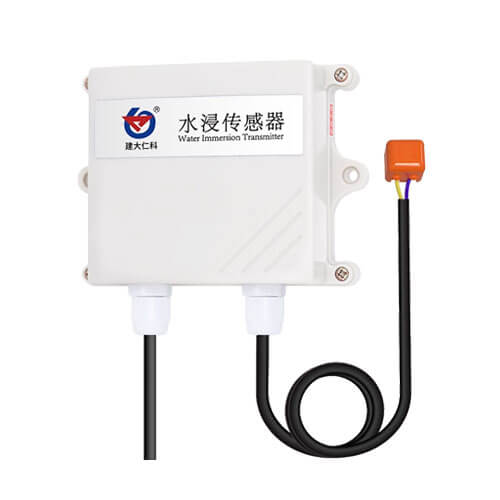
Industrial Water Leak Detector
RS-SJ-*-2-*-T is an industrial-grade water leak detector featuring an ABS waterproof enclosure with an IP65 protection rating. It is designed to detect water on floors, around pipelines, and beneath raised flooring systems. The sensor utilizes a unique alternating-current detection technology, which effectively prevents electrolysis and device degradation, significantly extending the service life of the sensor. As a dedicated manufacturer, we offer customization options and support for secondary development.
- Model: RS-SJ-*-2-*-T
- MOQ: 1 PCS
- Delivery date: within 24 hours
- Price: $19~$25
About - Water Leak Detector
Our water leak detectors use alternating-current technology to measure the inductive characteristics of accumulated water, enabling accurate identification of leak events and even differentiation between purified water and tap water (default detection is based on tap water, please specify if purified water detection is required). The AC-based detection method eliminates electrode electrolysis and polarization even during long-term immersion, does not rely on specialized electrodes, and delivers extended service life with minimal false alarms.
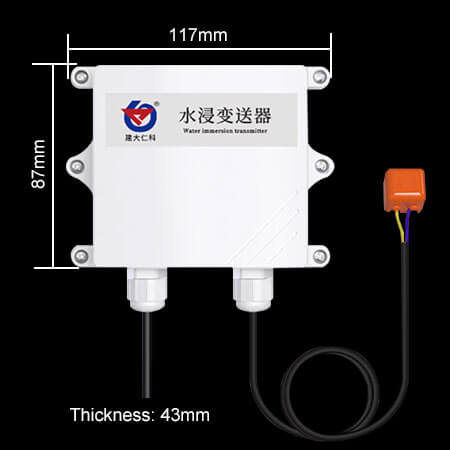
RS-SJ-*-2-*-T
This wall-mounted water leak detector is suitable for hotels, data centers, libraries, warehouses, and other facilities. It incorporates a proprietary AC detection technology that prevents sensitivity degradation caused by prolonged electrode operation. The sensor supports both RS485 and dry-contact signal outputs, and an optional OLED display provides clear visual indication of leak status. The external leak detection electrode can be extended up to 2,600 meters, and the device also supports water leak cables up to 2,600 meters in length. With its waterproof housing and high protection rating, the sensor is designed for long-term operation in humid, dusty, and otherwise harsh conditions.
RS-SJ-*-4*-T
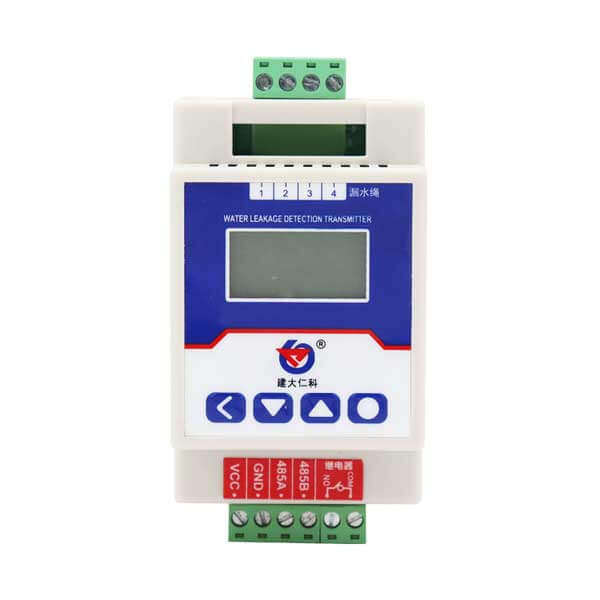
This DIN rail mounted water leak sensor is designed for data centers, equipment cabinets, and other environments. It uses a proprietary AC sampling technology that keeps the electrodes sensitive over long periods, prevents polarization, and ensures stable performance. The sensor provides an RS485 communication interface with the Modbus RTU protocol, allowing easy integration into SCADA systems or PLCs. It includes one relay normally open output for direct connection to on site equipment. Installation follows the standard DIN 35 mm rail method for quick and simple mounting. The upgraded model features a built in buzzer alarm and a reset button for added convenience.
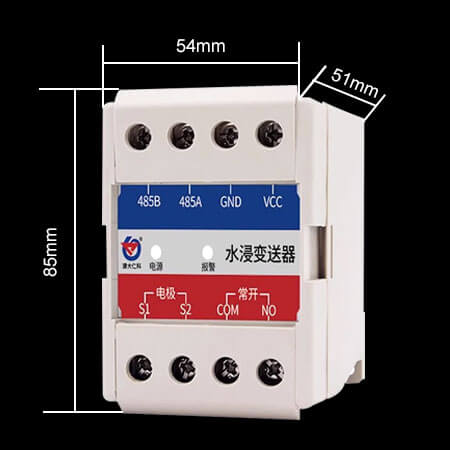
Parameters
| Power supply | DC10~30V | |
|---|---|---|
| Maximum power consumption | Relay output | 1.2W(Wall-mounted type), 0.5W(Rail-mounted type) |
| RS485 output | 0.4W(Wall-mounted type), 0.1W(Rail-mounted type) | |
| Detection target | Tap water, purified water | |
| Circuit operating environment | -20℃~+60℃, 0%RH~95%RH(non-condensing) | |
| Output signal | Relay output | Normally open contact |
| RS485 output | ModBus-RTU protocol | |
| Relay load capacity | 250VAC 1A/30VDC 1A | |
Installation notes
The device supports a wide input voltage range of 10~30 V. When wiring the RS485 signal lines, ensure that the A and B lines are not reversed, and verify that device addresses on the same bus do not conflict.
If the water leak detector is model RS-SJ-N01-4H-T, the buzzer will sound continuously for one second when powered on. When water is detected, the buzzer will issue an alarm. Press and hold the button for one second to silence the buzzer. The buzzer will resume alarming the next time a new water leak is detected.
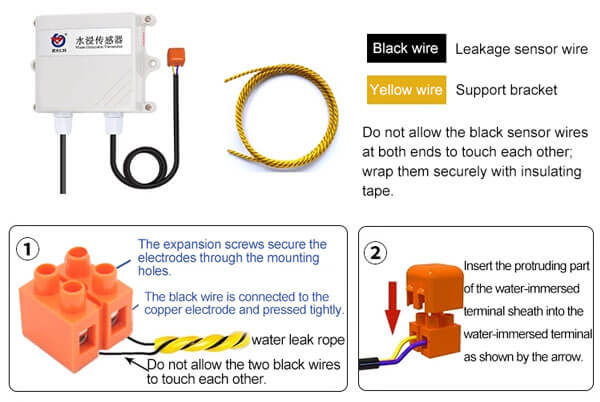
For customers using our cable-type water leak detector together with the leak detection rope, please note that the black wire on the rope is the sensing wire and the yellow wire is the support wire. Do not allow the black sensing wires at both ends of the rope to touch each other. After securing the water leak terminal, slide the terminal cover onto the connector following the direction indicated by the arrow.
The leak detection rope uses a plug-in connector design and supports cascading extensions. Multiple sections can be quickly connected without complex wiring. This allows users to expand the detection range with flexibility. The rope features strong water resistance and reliable sealing, ensuring more accurate measurements.
FAQs - Water Leak Detector
1. What are the advantages of Renke water leak detectors?
- Built-in waterproof sealing strip isolates the internal components from the external environment, providing strong protection against moisture and water ingress.
- The cable outlet uses a PG7 waterproof connector, preventing circuit damage and ensuring device safety.
- The probe is encapsulated in waterproof silicone, allowing reliable operation in harsh environments over long periods.
- The PCB is treated with a protective coating to safeguard the circuitry against moisture, dust, and corrosion.
2. What is the working principle of a water leak detector?
Our water leak detectors use alternating-current technology to measure accumulated water, enabling accurate detection of leak events. Under normal conditions, the two probe electrodes are insulated by air. When water comes into contact, the two sensing lines are bridged, causing a change in current, and the sensor outputs a dry-contact signal.
3. What should I do after water leakage is detected?
First find out the leaking location, then close the main valve, repair the leaking place, clean up the stagnant water, and finally open the main valve.
4. Can the water leak detector be used normally after detecting water leakage?
You can continue to use the sensor after cleaning up the accumulated water of the water leak detector.
5. How to view data?
The leak detection rope is designed to detect conductive liquid leaks. When connected to our environmental monitoring host, any liquid intrusion along the rope triggers an alarm. Data can be viewed in real time via the cloud platform.
6. How to wire the water leak detector?
Wall-mounted RS485 model:
Brown wire –Power positive (10-30VDC)
Black wire–Power negative
Yellow wire–485-A
Blue wire–485-B
Wall-mounted switch output model:
Brown wire–Power positive (10-30VDC)
Black wire–Power negative
White wire (or green wire)–Relay normally open contact
DIN rail RS485 model:
V+–Power positive (10-30VDC)
GND–Power negative
S1 and S2–Water leak probes
485-A/OUT–485-A
485-B/COM–485-B
DIN rail switch output model:
V+–Power positive (10-30VDC)
GND–Power negative
S1 and S2–Water leak probes
485-A/OUT and 485-B/COM–Relay normally open contact
7. What detection methods are used in contact water leak detectors?
Contact water leak detectors use two monitoring methods: point-type leak detection and cable-type leak detection.
8. What is included in the package list?
- Wall-mounted water leak detector * 1
- Self-tapping screws * 2
- Plastic anchors * 2
- Certificate of conformity, warranty card, wiring manual
9. Why Can’t the water leak detector connect to a PLC or computer?
Possible reasons include:
1. The computer has multiple COM ports and the wrong port is selected.
2. Device address is incorrect or there are duplicate addresses (all devices default to 1).
3. Incorrect baud rate, parity, data bits, or stop bits.
4. Polling interval and response wait time on the host are too short; both should be set to 200 ms or more.
5. RS485 bus is disconnected, or the A and B lines are reversed.
6. Too many devices or overly long wiring; consider local power supply, using an RS485 repeater, and adding a 120 Ω termination resistor.
7. USB-to-RS485 driver is not installed or is malfunctioning.
8. Device is damaged.
10. Where can I download the manual of the water leak detector?
To protect the patented technical parameters, please contact us for a manual.
Related Blogs
Long-term rainfall and melting snow have raised water levels and flooded city roads, causing flooding. Frequent and extreme flooding is inevitable and endangers community safety.
Table of Contents Smart buildings are the product of the development of modern science. The smart building system is mainly composed of Internet of Things
Natural disasters such as floods and heavy rains pose threats to lives and property around the world. Without a proper flood monitoring system, these natural
Table of Contents The key to the smart industry lies in the collection of data and information. Sensors are the nerve endings of the smart
Table of Contents Modern companies are placing an increasing emphasis on the value of collected data. As a result, central data centers, IDCs, and similar
Table of Contents Have you or your friends ever experienced a burst pipe or indoor flooding? Even if you don’t live in a flood-prone area,
Table of Contents What is IoT? IoT is the “Internet of things“. It is an extended and expanded network based on the Internet. It combines
Table of Contents What are industrial sensors and actuators? Industrial sensors are devices that can convert physical or chemical quantities in the environment into electrical