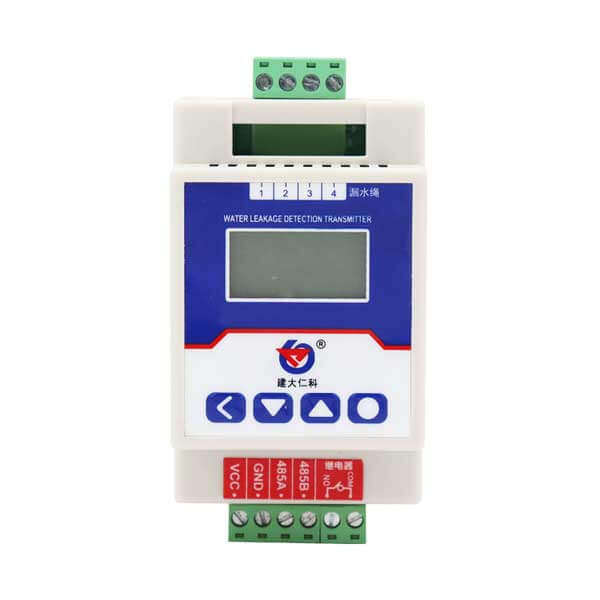
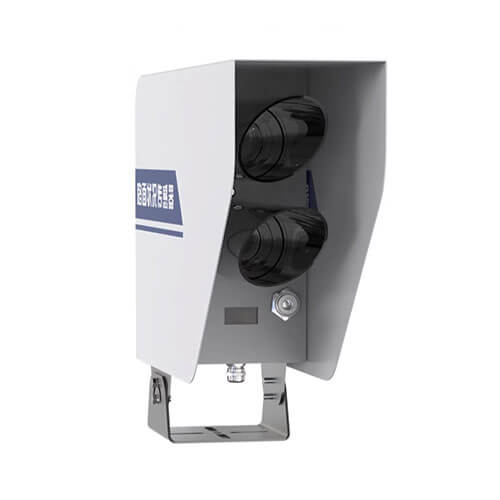
This is a positioning water leakage detector that uses the standard Modbus RTU protocol and is compatible with leak detection ropes ranging from 5 to 200 meters. When the rope detects a leak, the device immediately triggers an alarm and activates the relay, which can be connected to external audible and visual alarms. The LCD screen displays the leak location in real time.
The RS-SJ-DW-N01R01-1-T positioning water leakage detector is specifically designed for computer rooms, data centers, and other dry environments. It provides real-time monitoring to determine whether a leak has occurred and displays the exact leak location immediately. When a leak is detected, the device triggers an alarm and deactivates the relay without delay.
Features
The positioning water leakage detector uses the standard Modbus RTU protocol and can be connected to integrated monitoring terminals for centralized management. It can operate as a standalone unit or be networked with PLCs and other controllers. The device has a compact form factor and occupies minimal space. It features a 128*64 high-resolution LCD screen that can flash during alarms, ensuring clear visibility even in dark environments. The relay supports user-selectable open or closed modes, allowing flexible configuration with different audible and visual alarm systems. This water leakage detector includes multifunction keys that allow manual configuration of alarm delay, screen flashing behavior, leak detection time, backlight timeout, resistivity settings, and cable break detection time. It is suitable for leak monitoring in data centers, telecom base stations, and libraries.
Parameters
Power supply
10~30V DC
Power
0.35W
Positioning display
LCD screen
Accuracy
±(0.5%+0.5m of the leaky rope length)
Relay load capacity
250V 10A
Serial interface
Standard ModBus-RTU communication
Operating environment
-30~60℃, 10~95%RH (non-condensing)
Storage environment
-20~50℃, 10~95%RH (non-condensing)
Installation method
35mm DIN rail mounting
Use
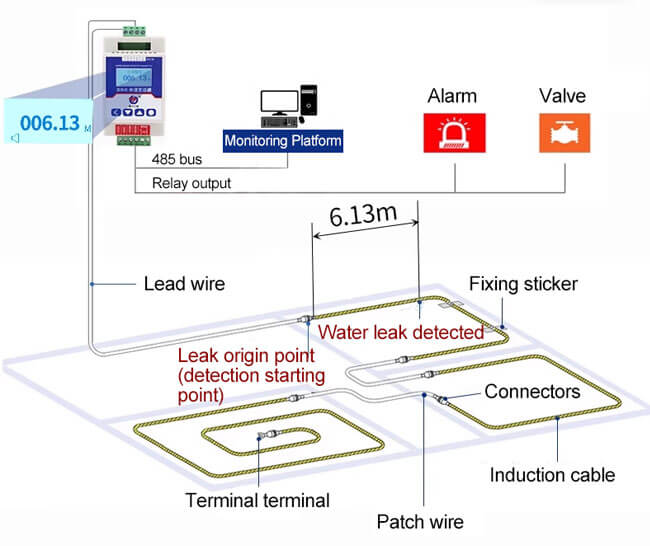
This positioning water leakage detector can be directly mounted on a 35 mm DIN rail. It can operate as a standalone unit without connecting the RS485 output, or it can be integrated as a detection point within a larger system. The leak detection rope is connected to the lead-out cable, and the lead-out section does not participate in leak detection. The zero point for leak detection begins at the junction between the rope and the lead-out cable, and the detection length does not include the jumper cable. The detector can be connected to external alarm devices or control switches as needed.
Our positioning water leakage detector should not be used in the following environments:
1. Strong electromagnetic interference environments such as large substations or areas with heavy-duty motors. Intense electromagnetic fields may affect the internal electronic components and signal transmission within the leak detection rope, resulting in inaccurate readings, false alarms, or missed alarms.
2. High-temperature, high-humidity, and corrosive gas environments such as electroplating workshops or chemical raw material warehouses. The presence of corrosive gases like sulfuric acid or hydrochloric acid, combined with high humidity, can accelerate corrosion of the detection rope, degrade its conductivity and sensing performance, and shorten its service life.
3. Severe oil contamination environments such as automotive repair pits or oil storage areas in refineries. Heavy oil buildup can adhere to the surface of the leak detection rope and penetrate its structure, impairing conductivity and potentially damaging the rope.
Long-term rainfall and melting snow have raised water levels and flooded city roads, causing flooding. Frequent and extreme flooding is inevitable and endangers community safety.
Table of Contents Smart buildings are the product of the development of modern science. The smart building system is mainly composed of Internet of Things
Natural disasters such as floods and heavy rains pose threats to lives and property around the world. Without a proper flood monitoring system, these natural
Table of Contents Modern companies are placing an increasing emphasis on the value of collected data. As a result, central data centers, IDCs, and similar
Table of Contents What are industrial sensors and actuators? Industrial sensors are devices that can convert physical or chemical quantities in the environment into electrical