In our daily lives and at work, we typically use terms like “bright” or “dim” to intuitively assess the lighting conditions around us. In reality, however, the brightness of a lighting environment can be determined not only through human perception but also objectively and accurately expressed through specific numerical values.
“Illuminance” is the metric used to objectively quantify the brightness of a lighting environment. Illuminance is a critical factor affecting workplace safety and work efficiency, and it is clearly defined in laws and relevant standards.
This article will begin with the basic concept of “what illuminance is” and provide a detailed introduction to its units and measurement methods.
What is illuminance?
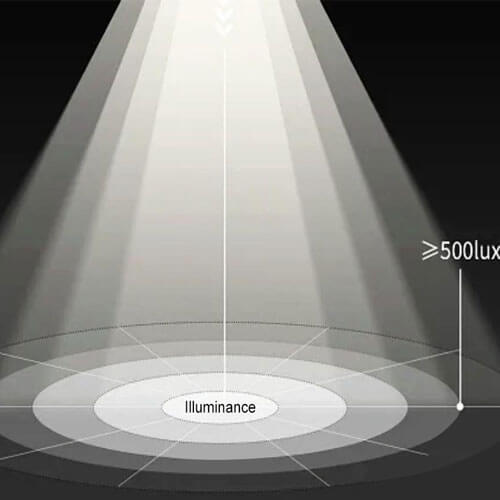
Illuminance is an indicator of the amount of light shining on a surface, reflecting the actual degree to which that surface is illuminated. It’s important to note that it doesn’t indicate how bright the light fixture itself is, but rather measures the brightness of an actual activity or work area such as a desktop, floor, or workbench.
In daily life, we usually use “bright” or “dim” to judge the surrounding lighting environment. However, this judgment relies heavily on personal perception and is therefore a relative evaluation. Different people may have different perceptions and judgments about what constitutes appropriate brightness.
Furthermore, a person’s perception of brightness is not entirely dependent on illuminance; it is also influenced by factors such as physical condition, reflected light from surrounding objects, and the overall brightness of the environment. Therefore, even under the same illuminance conditions, different environments or different people may experience different perceptions of brightness.
Unit of illuminance—lux
“lx” (sometimes written as “Lux” or “LUX” in markings) is the unit of illuminance. When the luminous flux obtained over an area of 1 square meter is 1 lumen, its illuminance is 1 lux. 1 lux = 1 lm/m² = 1 cd × sr/m².
Other commonly used optical units
There are several units for representing light. Besides lux, the unit for measuring illuminance, there are the following:
Luminous Flux (lm: lumen)
A unit that represents the “total amount” of light emitted by a light source. The brightness listed on the packaging of electric light bulbs or LED lighting is typically expressed in lumens.
Luminous Intensity (cd: candela)
A unit of measurement for the intensity of light in a specific direction. It is used to describe how bright light emitted in a particular direction is from sources with a distinct directionality, such as flashlights and spotlights. Generally, the higher the luminous intensity value, the stronger the light output from the source in that direction.
Luminance (cd/m²: candela per square meter)
A unit of measurement for the amount of light emitted per unit area in a specific direction. It reflects the extent to which light travels from a light source or the surface of an object in a certain direction and enters the human eye. For example, the luminance of a TV screen, monitor, or the sky can all be expressed using luminance. Simply put, luminance primarily describes “how bright an object appears when viewed from a certain direction.”
As mentioned above, there are various units of light, each representing a different aspect of light. It is very important to distinguish and use these units according to their intended purpose.
Types of illuminance and their differences
Even illuminance can be categorized into different types based on the direction of the illuminated surface. Among these, the most common are “horizontal illuminance,” “normal illuminance,” and “vertical illuminance.” The main difference between the three lies in the direction of the illuminated surface.
Horizontal Illuminance
This refers to the illuminance when light shines on a horizontal surface such as a table or floor. It primarily reflects the degree of illumination of a horizontal surface by light from above. In offices, classrooms, factories, and other similar locations, it is commonly used to evaluate the brightness of work and reading areas and whether they meet the lighting needs of daily tasks.
Normal Illuminance
This refers to the illuminance when light shines on a surface perpendicularly. When light shines perpendicularly on a surface, the angle between the light ray and the illuminated surface is 90°, allowing the light to act more fully on the surface. Therefore, under the same light source conditions, the illuminance usually reaches its maximum. It is commonly used for illuminance calculations, optical analysis, and theoretical comparisons under different lighting conditions.
Vertical Illuminance
This refers to the illuminance when light shines on a vertical surface such as a wall, a person’s face, or an exhibit. It primarily reflects the degree of illumination of a vertical surface by light from the front or side. It is closely related to the visibility of people’s faces, objects, etc. For example, in offices, shopping malls, exhibition spaces, and other similar locations, it is used to evaluate whether facial expressions are clear, whether exhibits are easily identifiable, and the visual effect of the space.
How is illuminance measured?
An Lux meter and a light sensor are the two most common methods.
An Lux meter is an instrument specifically designed to measure illuminance. It typically consists of a photodetector, a signal processing circuit, and a display unit. When light strikes the instrument’s light-sensitive probe, the photodetector converts the received light signal into an electrical signal, which is then processed and directly displayed as the current illuminance value.
It is characterized by ease of use and intuitive measurement, typically requiring no additional data acquisition equipment. It is suitable for on-site testing and acceptance inspections in settings such as offices, classrooms, factories, warehouses, roads, exhibition spaces, and architectural lighting.
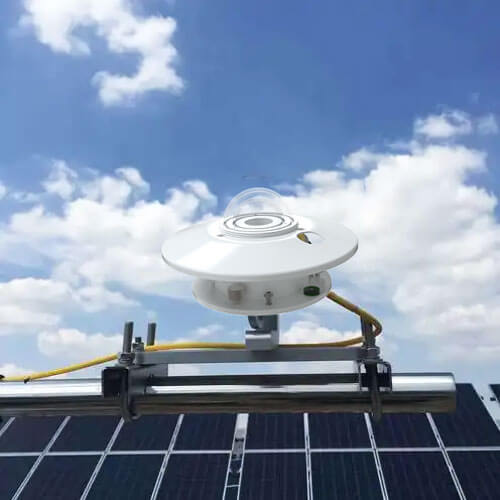
Light sensors are more focused on continuous monitoring and data collection of ambient light. They detect ambient light through photodetectors, convert the light signals into electrical signals, and then output them via analog or digital interfaces. Depending on the product design, light sensors can output analog voltage or current, or transmit data through digital interfaces such as RS485, I2C, and UART.
Light sensors typically need to be used in conjunction with data loggers, controllers, or monitoring systems; therefore, they are better suited for installation in fixed locations for long-term, continuous monitoring. For example, in smart lighting, greenhouses, industrial production, and environmental monitoring systems, light sensors can be used to collect real-time ambient illuminance data and transmit it to control systems or cloud platforms.
The Impact of Illumination
The impact of insufficient illumination
Decreased work efficiency: In low-illuminance environments, the contrast between visual objects such as text, components, and steps and their surroundings may decrease, increasing the difficulty of identification. The International Commission on Illumination (CIE) points out that illuminance affects the accuracy and speed of visual tasks, and the more detailed the task, the higher the requirements for lighting conditions. Insufficient illuminance can lead to decreased reading speed, difficulty in detecting small defects, and extended work time, thus affecting overall work efficiency.
Increased risk of falls and accidents: Workplace brightness is not only related to the clarity of visual tasks but also closely related to occupational safety. Article 604 of the Occupational Safety and Health Regulations stipulates minimum illuminance standards for different workplaces, one of the purposes of which is to ensure that workers can promptly identify hazards in their surroundings. When illuminance is insufficient, steps, obstacles on the ground, etc., may be difficult to spot, increasing the risk of tripping and falls. In factories, warehouses, and other locations, if personnel cannot clearly see the work area or vehicle routes, the risk of collisions with equipment such as forklifts may also increase.
The effects of excessive illumination
Glare: Glare refers to the discomfort or decreased visibility caused by a strong difference in brightness within the field of vision. The International Commission on Illumination (CIE) classifies it into “Discomfort glare” and “Disability glare.” Therefore, higher illuminance is not always better. When local areas are too bright or the difference between light and dark is too great, it may disrupt the eye’s adaptation and reduce contrast sensitivity, making people feel like they “can’t see clearly.”
Eye fatigue, discomfort, and stress: In high-illuminance environments, the pupils continuously constrict and the retina is constantly stimulated by strong light, easily causing fatigue and potentially contributing to psychological stress. The lighting environment affects the worker’s concentration, motivation, and comfort.
Is illuminance the same as brightness?
No, they are not the same.
Light on a surface is called illuminance. It is the flux received per unit area and the unit is the lux (lx). For instance, if the sun is shining on the ground, or a light is on an office desk, what we measure is the illuminance on the desk or the ground. Light meters are used to measure illuminance.
Luminance means the brightness of an object or the amount of light it radiates toward an observer from a particular direction. Strictly speaking, the photometric quantity corresponding to luminance is “luminance”, in units of cd/m2 (candela per square meter). For instance, the luminous surface of light fixtures, light reflected on walls, the luminous surface of LED displays can be talked about.
How do you take measurements with a lux meter?
The Lux meter must be held at right angles to surface measured (or parallel to the surface measured if measured surface is horizontal). Any inclination will lead to misreading. If assessing brightness over a whole area do not measure just 1 point but multiple points. Partition the measurement space into a grid, measure at each point in the grid and average the measures.
How do you convert between lux and foot-candles?
1 foot candle is about equal to 10.76 lux. In the U.S., foot-candles are more widely used than lux, with the exception of other parts of the world.
What is the approximate illuminance in common environments?
Sunlight can reach a level of up to 100,000 lux on a sunny day, from several thousand to tens of thousands of lux on a cloudy day, and to 300 or 500 lux in an office, and 0.1 to 1 lux on a night with a full moon.
What is the difference between illuminance and irradiance?
It is weighted by the sensitivity of the human eye and is measured in lux. Irradiance is the radiant energy per unit area of light and is measured in watts per square meter (W/m²) and is often measured by a pyranometer.

The Renke Technical Team focuses on sensor technology, environmental monitoring, and light measurement applications. The team shares practical technical knowledge based on experience in sensor development and monitoring systems, covering illuminance measurement, light sensors, and related sensing technologies.