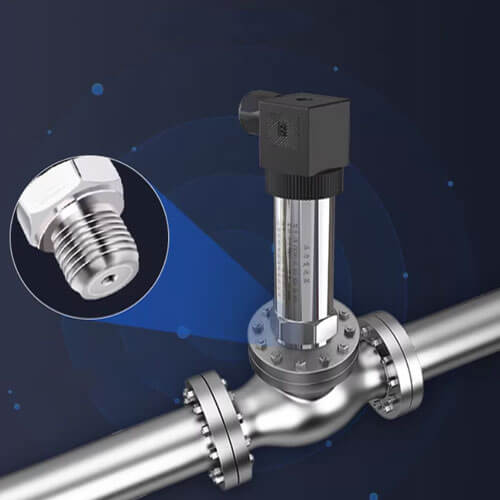
A pressure transducer is a device that measures the pressure of a gas or liquid and converts it into an electrical signal. This signal can be read by instruments such as controllers, monitoring systems, or computers to display pressure values or support automatic control.
In most designs, a sensing element inside the device responds to applied pressure and converts the mechanical change into an electrical output, such as a voltage, current signal (commonly 4-20 mA), or digital signal.
How do pressure transducers work?
The working principle of a pressure transducer is typically based on the strain gauge, piezoelectric, or capacitive principle to sense pressure. The transducer converts the pressure of a liquid or gas into a usable electrical signal, which is then amplified and conditioned so it can be read by monitoring systems or control devices. Key components of a pressure transducer include the sensing element, diaphragm, strain gauge, amplifier and signal conditioning circuitry.
Three types of pressure transducers
Pressure transducers are generally classified according to the reference point used for pressure measurement. The three most common types are gauge pressure transducers, absolute pressure transducers, and differential pressure transducers. Each type is designed for specific measurement conditions and industrial applications.
1. Gauge pressure transducers
Gauge pressure transducers measure pressure relative to the surrounding atmospheric pressure. In this design, the sensing element is exposed to atmospheric pressure on one side and the measured medium on the other. The output signal therefore represents the difference between the measured pressure and atmospheric pressure. When the measured pressure equals atmospheric pressure, the output reading is zero.
For example, in a water pipeline monitoring system, a gauge pressure transducer can measure the pressure inside the pipe relative to the surrounding air, helping operators detect blockages, leaks, or pump failures.
2. Absolute pressure transducers
Absolute pressure transducers measure pressure relative to a perfect vacuum (zero pressure reference). Unlike gauge sensors, the reference side of the sensing element is sealed with a vacuum chamber during manufacturing.
This means the measurement is independent of atmospheric pressure changes, making it suitable for applications where environmental pressure variations would affect measurement accuracy.
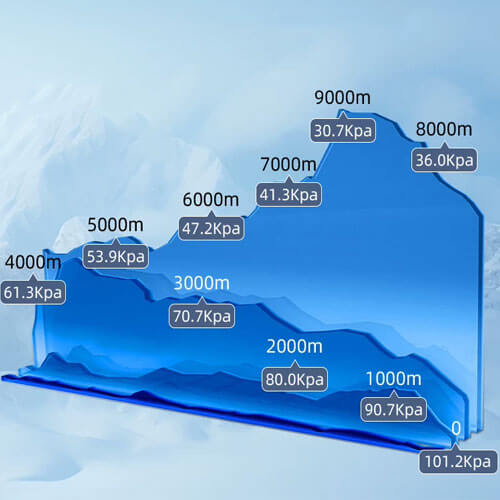
For instance, in meteorological monitoring equipment, an absolute pressure transducer measures atmospheric pressure directly, which is an important parameter for weather forecasting and altitude calculations.
3. Differential pressure transducers
Differential pressure transducers measure the difference in pressure between two separate points. These sensors have two pressure ports, allowing them to compare pressures simultaneously and output the pressure difference.
Instead of measuring pressure relative to atmosphere or vacuum, the sensor directly measures:
Differential Pressure=P1-P2
For example, in HVAC systems, differential pressure transducers are used to monitor air filter conditions. As the filter becomes clogged, the pressure difference across the filter increases, providing an early indication that maintenance or replacement is required.
Pressure sensor vs Transducer: How to choose?
The core difference between a pressure sensor and a pressure transducer lies in their functional scope. The former is a basic sensing element, while the latter is an integrated signal-processing device. They can exist independently or be combined into a single unit.
A pressure sensor converts the physical quantity of pressure into a detectable electrical signal, with its primary role being sensing. Its output is usually a weak raw signal, such as a millivolt-level voltage, which requires external amplification and calibration before secondary devices can recognize it. Common types include piezoresistive pressure sensors, piezoelectric pressure sensors, and MEMS pressure sensors, widely used in applications with simple signal-processing requirements or limited space, such as micro detection modules in medical devices or pressure monitoring units in consumer electronics.
A pressure transducer, built upon a pressure sensor, integrates signal amplification, filtering, calibration, temperature compensation, and protocol conversion modules, with its core role being standardized output. It converts the sensor’s raw signal into a 4-20 mA standard current, 0-10 V standard voltage, or digital output via protocols like HART or RS485. No additional circuitry is required for direct connection to PLCs or DCS systems. Pressure transducers offer strong anti-interference capability, high stability, and remote configuration. Typical examples include intelligent flange-mounted transducers and wireless pressure transducers, which are ideal for long-distance transmission in complex industrial environments.
1. Structural differences
A pressure sensor has a simple structure. Its core consists of a sensing element (such as a piezoresistor, piezoelectric crystal, or ceramic diaphragm) and basic packaging, without any signal-processing circuitry. For example, a silicon piezoresistive pressure sensor generates resistance changes in a Wheatstone bridge under applied pressure, producing a millivolt-level signal proportional to pressure. Without temperature compensation, it is easily affected by environmental temperature, causing noticeable accuracy fluctuations. A piezoelectric pressure sensor relies on the piezoelectric effect to generate charge signals, making it suitable only for dynamic pressure measurement and incapable of detecting static pressure.
A pressure transducer, on the other hand, has a more complex structure. It consists of the sensor core, signal-processing circuitry, housing, and process connections. Internally, it integrates programmable amplifiers, A/D converters, microprocessors, and modules for lightning and electromagnetic protection. These allow the sensor signals to be linearized, calibrated, and temperature-compensated (for example, high-temperature silicone oil filling can adapt to environments from -40℃~150℃). Some intelligent transducers also support remote configuration and self-diagnostics, such as range adjustment and device monitoring via the HART protocol. Their metal capacitive sensor cores often include one-way overload protection, making them suitable for harsh industrial environments such as petrochemical or metallurgical applications.
2. Signal differences
The two differ significantly in output signal, accuracy, and environmental adaptability:
Output signal
A pressure sensor outputs non-standard signals, such as 0-100 mV voltage or 0-1 mA current. Its transmission distance is short (typically ≤10 m) and is easily affected by electromagnetic interference. A pressure transducer, however, outputs standardized signals. The 4-20 mA two-wire signal is the industrial standard, with transmission distances up to 1000 m. Shielded cables with single-end grounding (ground resistance ≤4 Ω) effectively resist interference. Some transducers support both digital and analog outputs, making them compatible with industrial IoT system integration.
Accuracy
Pressure sensors typically have an accuracy of ±0.5%FS~±1%FS, while high precision models can reach ±0.1%FS, but external calibration is required to meet industrial control requirements. Pressure transducers, equipped with internal calibration modules, generally achieve higher accuracy. Intelligent models can reach ±0.2%FS, with a maximum turndown ratio of 40:1 and better long-term stability, with annual drift ≤0.1%FS.
Environmental adaptability
Pressure sensors usually have an IP65 protection rating, with limited high temperature and corrosion resistance, often requiring additional protective measures. Pressure transducers feature explosion-proof and corrosion-resistant designs, with protection ratings up to IP67. Some models support Ex d/IIC T6 explosion-proof certification, enabling direct use in high temperature, high humidity, and corrosive environments.
3. Application differences
Pressure sensors are suitable for:
- Small device integration, such as tire pressure monitoring in new energy vehicles or portable pressure meters.
- Secondary development scenarios, where technicians need to design their own signal amplification circuits to achieve customized accuracy.
- Low-cost applications, such as simple pressure monitoring in consumer devices, typically priced under $70.
Pressure transducers are suitable for:
- Industrial automation control systems, such as pressure monitoring in petrochemical pipelines or boiler pressure regulation in the power industry.
- Long-distance transmission scenarios, such as distributed pressure acquisition in rail transit or smart buildings.
- Harsh operating conditions, including continuous operation in high temperature or high vibration environments. Intelligent transducers can reduce maintenance costs through self-diagnosis functions.
4. Maintaining differences
Pressure sensors require additional calibration equipment and are more susceptible to environmental damage, with annual maintenance costs around 20% of the purchase price. Pressure transducers are more stable, require less maintenance, and replacing the sensor element does not affect overall performance. Annual maintenance costs can typically be kept below 5% of the purchase price.
In the industry, “pressure sensor” and “pressure transducer” are often used interchangeably mainly because most end users care more about the function (measuring pressure) than the internal structure. From a marketing and sales perspective, “sensor” is a more familiar and searchable term, so manufacturers and platforms tend to use it to refer to almost all pressure-measuring products, including complete transducers. In addition, many modern products highly integrate sensing elements and signal-conditioning circuits, which further blurs the boundary between sensors and transducers in everyday usage.
Effects of temperature on pressure transducers
Ambient temperature changes can affect the performance of pressure transducers in several ways:
Material expansion
The housing and internal components of a pressure transducer are usually made of metal or plastic. These materials expand or contract with temperature changes, which may cause mechanical stress or changes in gaps, affecting sensor accuracy and stability.
Electronic component performance changes
Temperature variations affect the performance of electronic components such as resistors, capacitors, and semiconductors. These changes can cause signal drift, gain variations, and increased noise, impacting measurement results.
Medium viscosity changes
For pressure transducers measuring liquids or gases, the viscosity of the medium changes with temperature. Changes in viscosity can affect the sensor’s response time and measurement accuracy.
Temperature compensation techniques
To minimize the effects of ambient temperature on pressure transducers, the following compensation methods are commonly used:
Hardware compensation
Temperature sensors can be integrated into the transducer design, and hardware circuits can adjust the output signal in real time to counteract temperature-induced effects.
Software compensation
Software algorithms are also commonly used. This typically involves storing temperature-pressure calibration data in the transducer’s microcontroller and adjusting the output signal based on the real-time temperature.

Renke Technical Team
This article was written by the Renke Technical Team. The team focuses on collecting, analyzing, and addressing real customer challenges, and shares practical solutions through technical articles to help other users solve similar problems. Renke is a trusted sensor manufacturer with more than 15 years of practical experience in hardware and software development. With extensive expertise in pressure measurement, system integration, and real world industrial applications, Renke pressure sensors have received widespread recognition in the market. Our products are designed to maintain stability, accuracy, and long term reliability in harsh environments, helping users achieve efficient and dependable monitoring.