
Table of Contents What are weather instruments? Weather instruments are specialized tools used to observe and measure atmospheric conditions, such as temperature, humidity, wind speed,
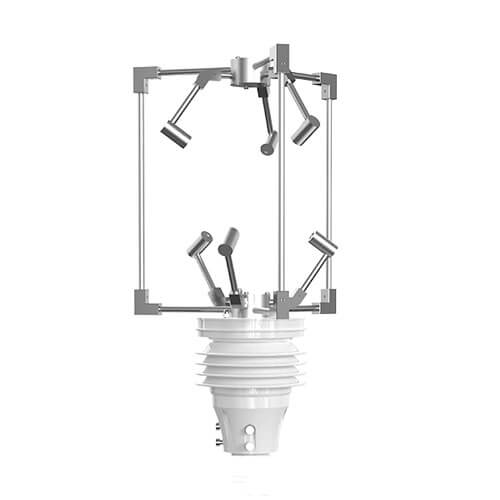
3D Ultrasonic Anemometer
The 3D ultrasonic anemometer is a three-axis wind sensor with no moving parts. It features a fully solid-state design that completely eliminates mechanical wear and tear. The device consists of three pairs of opposing ultrasonic transducers supported by stainless steel components, enabling precise measurement of both horizontal and vertical wind speed and direction. To meet diverse application needs, we offer four signal output options: RS485, 4-20mA, 0-5V, and 0-10V.
- Model: RS-CFSFX-*-3D-T
- MOQ: 1 PCS
- Delivery date: within 24 hours
- Price: $629
About - 3D Ultrasonic Anemometer
The 3D ultrasonic anemometer operates based on acoustic measurement principles. It emits ultrasonic pulses and determines wind speed and direction by measuring the time difference between transmission and reception. Gust and peak value measurements are unaffected by inertia, ensuring exceptionally high accuracy. Each transmitting and receiving sensor undergoes comprehensive wind tunnel testing and calibration to guarantee precise wind data output.
Features
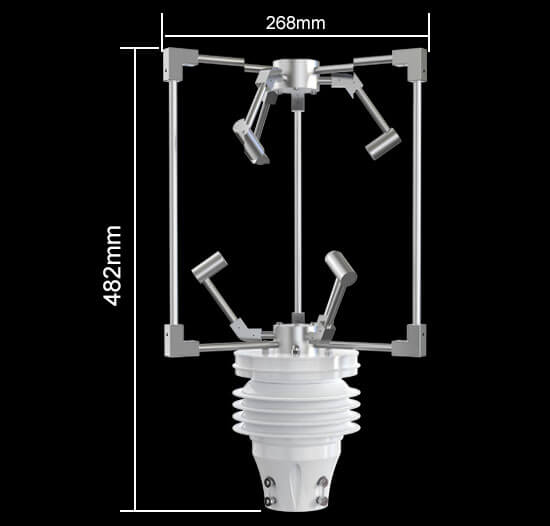
Our 3D ultrasonic anemometer utilizes six ultrasonic probes that continuously transmit and receive sound waves within a three-dimensional plane. By calculating the time differences in ultrasonic propagation through the air, the instrument accurately determines wind speed and direction. It features no threshold for start-up wind speed and can simultaneously measure instantaneous values of wind speed, wind direction, sound velocity, and acoustic temperature.
The device is built with a robust, corrosion-resistant metal housing to ensure reliable performance under various environmental conditions. Its stable structural design minimizes maintenance and calibration requirements during regular operation. This versatile instrument is widely used in navigation, environmental monitoring, airports, ports, laboratories, agriculture, and transportation sectors.
Video
This 3D ultrasonic anemometer can simultaneously monitor the wind speed in the X, Y, and Z axes, as well as the wind direction in the horizontal and vertical directions, and accurately capture the dynamics of the wind field. In addition, the sensor can also measure the instantaneous value of sound speed and sound temperature, providing users with comprehensive data support. For more information about 3D ultrasonic anemometers, please contact us.
Datasheets
| Power supply | 10V~30V DC | |
|---|---|---|
| Max. power consumption | 1.2W (RS485) | |
| Measure range | Wind speed | 0~60 m/s |
| Wind direction | 0~359° | |
| Sound speed | 300~370 m/s | |
| Sound temperature | -40°C~60°C | |
| Accuracy | Wind speed | ±0.2m/s (0~5m/s), ±2%FS±0.2m/s (>5m/s) |
| Wind direction | ±2° | |
| Sound speed | ±0.5% | |
| Sound temperature | ±0.5℃ | |
| Resolution | Wind speed | 0.01m/s |
| Wind direction | 0.1° | |
| Sound speed | 0.01m/s | |
| Sound temperature | 0.01℃ | |
| Operating environment | -40°C~60°C, 0%~100% RH | |
| Wind resistance | 75 m/s | |
| Response time | 1s | |
| Protection rating | IP66 | |
| Output signal | RS485/4-20mA/0-5V/0-10V | |
Advantages
No measurement limitations
The 3D ultrasonic anemometer has no start-up wind speed limitation, allowing it to operate accurately even at zero wind speed. With no directional restrictions, it achieves full 3D measurement capability. Whether in gentle breezes or strong gales, it precisely captures wind dynamics, providing reliable data support for meteorological forecasting, environmental monitoring, and other applications.
Rugged and durable
Built with a robust structure, the 3D ultrasonic anemometer features six ultrasonic probes supported by stainless steel components. This configuration enhances the rigidity of the instrument while offering protection for the transducers. The arrangement of the transducers ensures that all measurements are taken within a common volume, thereby improving overall measurement effectiveness and consistency.
High precision
Equipped with high-accuracy three-dimensional probes, the anemometer offers a wide measurement range, excellent linearity, and outstanding waterproof performance. It achieves a wind speed accuracy of ±0.2 m/s, a wind direction accuracy of ±2°, a sound velocity accuracy of ±0.5%, and an acoustic temperature accuracy of ±0.5°C. Utilizing advanced acoustic phase compensation technology, the sensor delivers rapid response and ensures precise, reliable measurement results.
Wide measurement range
Our 3D ultrasonic anemometer measures wind speed along the X, Y, and Z axes, as well as horizontal and vertical wind direction, sound velocity, sound temperature, and total wind speed. It captures comprehensive, multidimensional meteorological data in a single measurement, eliminating the need for multiple instruments and significantly improving measurement efficiency and data completeness.
Free data platform
For single-point or multi-point monitoring, the anemometer can be connected to our environmental monitoring host, which collects and uploads data to Renke’s free cloud platform. Users can log in to the platform to store and download historical data, or remotely monitor real-time data via mobile app or computer access.
Extended service life
The supporting columns are made of high-quality metal that is resistant to deformation and corrosion. The instrument can withstand wind speeds up to 75 m/s in outdoor environments. Its surface is waterproofed to achieve an IP66 protection rating. The unique structural design effectively prevents dust accumulation and icing, greatly extending the overall service life of the sensor.
FAQs - 3D Ultrasonic Anemometer
What is the working principle of the 3D ultrasonic anemometer?
The core technology of the 3D ultrasonic anemometer is the ultrasonic time-difference method. The instrument emits ultrasonic pulses and precisely measures the time it takes for sound waves to travel through the air between the transmitting and receiving transducers. When wind is present, sound waves travel faster in the downwind direction and slower in the upwind direction. By analyzing measurements from multiple directions, the sensor accurately calculates wind speed and direction in three-dimensional space.
What are the advantages of the 3D ultrasonic wind sensor’s measurement method?
The entire wind measurement system contains no mechanical or rotating components, enabling non-inertial measurement. This allows the sensor to accurately capture high-frequency gust fluctuations in natural wind, providing precise and dynamic wind data.
What is the package list?
3D ultrasonic anemometer x 1
Certificate of conformity & Warranty card
How to wire?
RS485 Signal Output:
The device supports a wide voltage power input range of 10-30V DC. When connecting the RS485 signal lines, ensure that the A/B lines are not reversed, and that multiple devices on the same bus have unique addresses to avoid communication conflicts.
Brown wire: Power positive (10-30V DC)
Black wire: Power ground (GND)
Green wire: RS485-A
Blue wire: RS485-B
What data can this 3D ultrasonic anemometer output?
- Total wind speed: The resultant wind speed calculated from three-axis vector synthesis, representing the actual wind velocity.
- X-Axis wind speed: Wind speed along the X-axis (east-west direction).
- Y-Axis wind speed: Wind speed along the Y-axis (north-south direction).
- Z-Axis wind speed: Wind speed along the Z-axis (vertical direction).
- Horizontal wind direction: Wind direction in the horizontal plane, ranging from 0° to 360°, where 0° represents north and values increase clockwise, with 90° indicating east.
- Vertical wind direction: 0° represents upward, and 180° represents downward airflow.
- Sound velocity: The propagation speed of ultrasonic waves in the air.
Acoustic temperature: The ambient air temperature derived from the speed of sound propagation.
How to select the output mode?
The 3D ultrasonic anemometer allows you to choose between averaged output or real-time data output.
Vector Averaging: When calculating the average wind speed, the method accounts for wind direction, and when calculating the average wind direction, it considers wind speed. This means the two averaged variables—wind speed and wind direction—are evaluated in combination with the other measured variable. Vector averaging is particularly suitable for applications such as tracking and assessing pollutant dispersion.
Scalar Averaging: Wind speed and wind direction are averaged independently, producing results consistent with traditional mechanical anemometers. Scalar averaging is suitable for scenarios where only wind vector variables related to energy generation are important, and wind direction is less critical.
Note: Selecting either method affects the data output rate.
What are the applications of 3D ultrasonic anemometers?
Meteorological monitoring – Accurate wind measurement for weather observation and forecasting.
Climate measurement networks – Integration into networks for long-term climate data collection.
Wind farms – Optimizing turbine performance and assessing wind energy potential.
Marine research – Monitoring wind conditions in oceans and coastal areas.
Experimental development – Research and development requiring precise wind measurements in laboratories or field experiments.
Popular Wind Sensors
Related Blogs
Table of Contents What is the wind speed and direction? Wind is a physical quantity that represents the movement of air currents. It has both
Table of Contents The Automated Weather Station (AWS) is an important tool for meteorologists, environmentalists and other weather enthusiasts. It provides comprehensive data on weather
Table of Contents The commonly used communication method for data acquisition and control is RS-485. RS-485 is a general communication standard. It can not only
The main purpose of environmental monitoring is to provide data on environmental quality and changing trends to ensure the safety of public life and property.
Table of Contents What is an anemometer? An anemometer is a meteorological instrument used to measure air velocity and, in many configurations, wind direction. In
Table of Contents How wind sensor work? Wind speed sensor working principle Wind speed sensor is a physical device used to measure wind speed. The