

Table of Contents Dissolved Oxygen (DO) indicates the oxygen in water that has been dissolved. It is measured in terms of mass (in milligrams
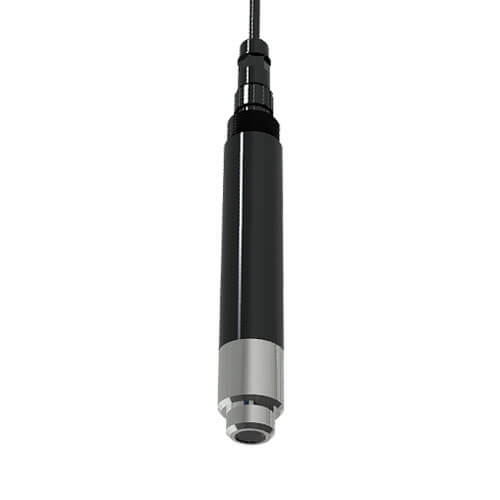
Dissolved Oxygen Sensor
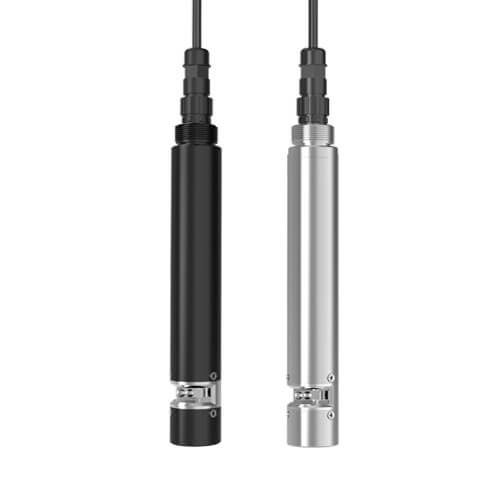
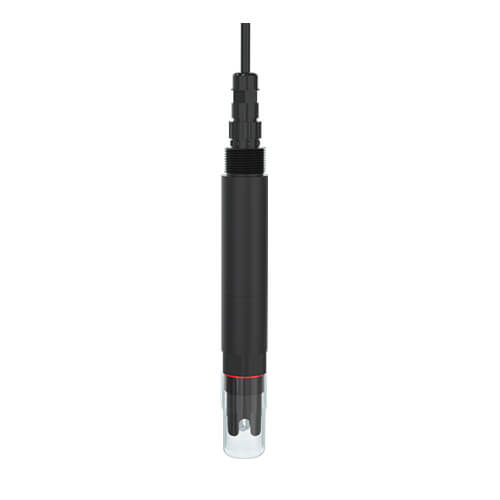
Our RS-LDO*-N01-2-20-T dissolved oxygen sensor is a device for measuring the concentration of dissolved oxygen in water. It adopts the principle of fluorescence measurement, does not consume oxygen, and does not require electrolytes. The dissolved oxygen measurement range is 0~20mg/L. Built-in temperature transmitter with automatic temperature compensation function.
- Model: RS-LDO*-N01-2-20-T
- MOQ: 1 PCS
- Delivery date: within 24 hours
- Price: $84
About - Dissolved Oxygen Sensor
Our dissolved oxygen sensor features a measurement range of 0~20 mg/L (0-200% saturation) and supports adjustable Modbus communication address and baud rate settings. It is equipped with a high-quality imported fluorescent membrane and does not require stirring or water movement for accurate dissolved oxygen measurements. Data can be conveniently viewed through a free cloud platform. The calibration function provides a simpler and more convenient way to calibrate. It can be widely used in water treatment, aquaculture, rivers, lakes, and seawater quality monitoring industries.
DO sensor features
Dissolved oxygen sensors can be used in a wide variety of applications – surface water, groundwater, aquaculture, wastewater, and more! Renke provides affordable dissolved oxygen sensors to be used for freshwater or seawater monitoring project. Our dissolved oxygen sensors use a fluorescence-based measurement principle; they do not consume oxygen, require no warm-up time, so they can be used instantaneously. Additionally, the membrane head is replaceable, which reduces your maintenance costs.
DO sensor parameters
| Power supply | DC 10~30V |
|---|---|
| Signal output | RS485 |
| Power consumption | 0.2W |
| Working principle | Fluorescence Method |
| Measure range | 0~20mg/L (0~200% saturation) |
| Measure error | ±0.3 mg/L; ±0.5°C (25°C) |
| Resolution | 0.01mg/L; 0.1%; 0.1℃ |
| Response time | ≤60s |
| Operating conditions | 0~40℃ |
| Fluorescent film lifespan | 1 year under normal use |
| Protect class | IP68 |
| Pressure resistance | 0.6MPa |
| Electrode wire length | Default 5m |
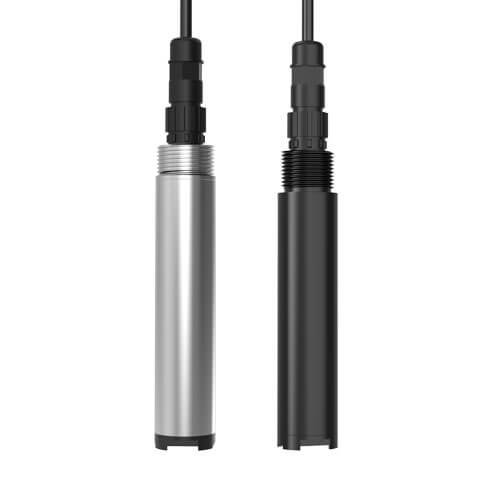
| Shell material | Standard type: Corrosion-resistant plastic, stainless steel; Economy type: Corrosion-resistant plastic |
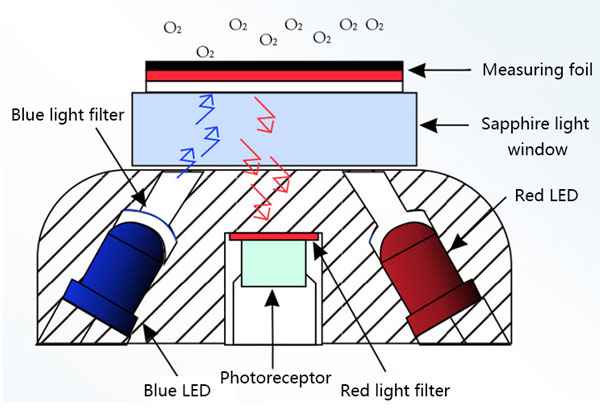
DO sensor working principle
Fluorescence Dissolved Oxygen: Based on the quenching principle of active fluorescence by specific substances in physics.
By measuring the phase difference between the excited red light and the reference light, and comparing it with the internal calibration value, the concentration of oxygen molecules can be calculated.
Compared to polarography, fluorescence measurement does not require the consumption of oxygen in water, and it has a faster response time, stronger anti-interference ability, and more accurate measurement results.
Dissolved oxygen sensor calibration
1. Zero oxygen standard solution preparation
In a place without wind and direct sunlight, take purified water (distilled water or deionized water) deep enough to cover the stainless steel part of the electrode. For every 95 g of water, add 5 g of anhydrous sodium sulfite. Stir thoroughly until fully dissolved to obtain a 5% sodium sulfite solution. Let it stand for 1 hour to ensure that the oxygen in the solution is completely consumed. If conditions allow, a trace amount of cobalt chloride can be added as a catalyst.
2. 100% oxygen environment preparation
In a place without wind and direct sunlight, take purified water (distilled water or deionized water) deep enough to cover the stainless steel part of the electrode. Use an air pump to continuously aerate the water for 1 hour, then let it stand for 30 minutes to obtain air saturated water.
Alternatively, use a sealed container, take a small amount of water, and shake it vigorously for 30 seconds to obtain air saturated with water vapor. During calibration, keep the fluorescent membrane about 1 cm above the water surface, ensuring the membrane is moist but without water droplets.
3. In the configuration tool, find the Dissolved Oxygen option under the Water Quality Sensor tab.
4. Place the dissolved oxygen sensor in the 100% oxygen environment. After the dissolved oxygen reading stabilizes, click the Full Scale Calibration button to complete the 100% oxygen saturation calibration.
5. Then place the dissolved oxygen sensor into the zero oxygen standard solution. Gently stir to speed up the response, then let it stand. After the dissolved oxygen reading stabilizes, click the Zero Calibration button to complete the zero oxygen calibration.
Note:
In each calibration environment, the dissolved oxygen sensor should be left stationary for a sufficient amount of time to ensure that the device temperature is the same as the ambient temperature.
FAQs - Dissolved Oxygen Sensor
Why does a negative value appear when measuring 0% oxygen? Is this normal?
A negative value is normal. During calibration, the value recorded corresponds to the fluorescence lifetime at 0 percent oxygen. In actual measurement, this value can fluctuate, and long term use may also introduce drift.
In practice, it is possible to apply a limit and force all values below zero to be displayed as zero. However, if this is done, users with their own calibration requirements would not be able to judge whether the 0 percent oxygen value is truly stable during calibration.
What should be noted when using a dissolved oxygen sensor?
Avoid using it in organic solvents, and do not clean the membrane cap with organic solvents. The fluorescent membrane uses an embedding method to fix the fluorescent material within the film. Organic solvents can cause the fluorescent material to leach out.
What is the role of salinity and atmospheric pressure?
Our product actually measures dissolved oxygen saturation in percent. The dissolved oxygen concentration is calculated from this value using salinity, atmospheric pressure, temperature, and other constants. Changes in salinity and atmospheric pressure affect the dissolved oxygen concentration at the same saturation level. The general trends are: higher salinity results in lower dissolved oxygen concentration, and higher atmospheric pressure results in higher dissolved oxygen concentration.
How to install a dissolved oxygen sensor?
The sensor should be fixed and installed below the liquid surface. During installation and use, avoid impact or scratching of the fluorescence membrane head, and prevent the membrane head from being covered by bottom sediments. Remove the rubber protective cap before use. The dissolved oxygen electrode is equipped with an NPT 3/4 thread and can be used with our waterproof pipe. Feed the cable through the pipe, then screw the sensor into the threaded port of the waterproof pipe.
How to maintain a dissolved oxygen sensor?
For the outer surface of the electrode: Rinse with tap water and gently wipe with a soft, damp cloth. For stubborn contamination, a small amount of household detergent may be added to tap water for cleaning.
For the outer surface of the optical (fluorescent) cap: Rinse the sensor’s optical window with clean water to remove surface contaminants. If wiping is necessary, use a soft cloth and wipe gently. Do not scrape or apply excessive force, as this may damage the fluorescent membrane and result in inaccurate measurements.
If dust or moisture has entered inside the optical (fluorescent) cap. Unscrew the optical cap and rinse the inner surface of the cap and the instrument’s optical glass window with tap water. If oily contaminants are present, clean with tap water mixed with a small amount of household detergent. After cleaning, thoroughly rinse off any detergent residue, then dry all cleaned surfaces with a lint-free soft cloth. Finally, place the components in a dry environment and allow any remaining moisture to fully evaporate.
What is the dissolved oxygen concentration when measuring in air, and how does it change with temperature?
Under normal conditions, humid air is considered to represent 100% dissolved oxygen saturation. The dissolved oxygen concentration varies with temperature: as temperature increases, the dissolved oxygen concentration at saturation decreases. This is because higher temperatures intensify molecular motion, making oxygen molecules more likely to escape from the water.
Other Water Quality Sensors
Related Blogs
Table of Contents Water quality parameters are indicators used to assess the condition and trends of aquatic environments. Monitoring is essential for various water
Table of Contents What is conductivity in water? Conductivity in water is the ability of water to conduct electricity. It is primarily related to
What is dissolved oxygen? Dissolved oxygen (DO) refers to molecular oxygen dissolved in water. The unit is mg/L, which means how many milligrams oxygen
Long-term rainfall and melting snow have raised water levels and flooded city roads, causing flooding. Frequent and extreme flooding is inevitable and endangers community
Table of Contents Everyone knows that the choice of water quality sensors is very important. In water measurement, the ph sensor is one of
Natural disasters such as floods and heavy rains pose threats to lives and property around the world. Without a proper flood monitoring system, these
Table of Contents Water is the source of life, integral to every aspect of human production and daily living. In many scenarios, ensuring health
Table of Contents Have you or your friends ever experienced a burst pipe or indoor flooding? Even if you don’t live in a flood-prone
Table of Contents What is IoT? IoT is the “Internet of things“. It is an extended and expanded network based on the Internet. It
Table of Contents What is a water level sensor? A water level sensor is a device designed to measure the height of a liquid,