
Table of Contents Modern agriculture is already operating at a data driven and automated level, where irrigation, greenhouse control, and field management are increasingly executed
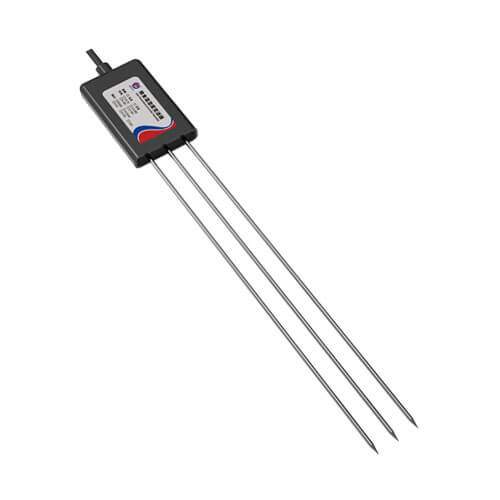
Grain Moisture Sensor
Our grain moisture sensor is designed to measure the humidity inside grain piles. Its 230 mm long steel probe can be inserted into bulk organic solid materials, enabling long term continuous monitoring. It is one of the core sensors in modern grain condition monitoring systems and is widely used for wheat, corn, rice, soybeans, tea leaves, and other crops.
- Model: RS-LSWS-N01-1-T
- MOQ: 1 PCS
- Delivery date: within 24 hours
- Price: $42
About - Grain Moisture Sensor
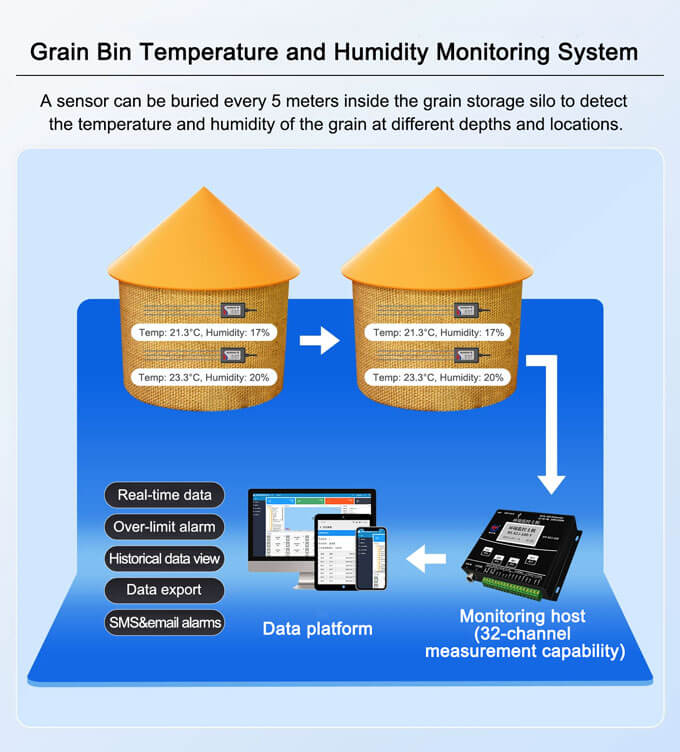
Monitoring temperature and humidity inside grain is a key aspect of grain storage management. During storage, excessive moisture often causes grain to heat up, leading to spoilage and deterioration. Only by maintaining both temperature and humidity within appropriate ranges can long term safe storage be ensured. Our grain moisture sensor can accurately monitor temperature and humidity inside grain piles. It can be used for grain storage safety management, mold risk warning, ventilation control, and intelligent grain storage systems.
Features
Our grain moisture sensor is a high precision moisture detection device designed for grain storage, purchasing, and processing applications. It can accurately and quickly measure the moisture content of common grain crops such as wheat, corn, rice, and soybeans, with a measurement range of 7%~40%, meeting the requirements of different grain types.
A built in thermistor enables real time temperature measurement inside grain piles. Based on FDR measurement technology, the sensor determines the dielectric constant of organic materials and uses internal algorithms to calculate the moisture content of the bulk material, enabling stable, continuous, and long term monitoring of both temperature and humidity inside the pile.
Its wide voltage power supply and low power consumption design, combined with a robust structure and clear usage guidelines, ensure long term reliable operation even in harsh environments.
Parameters
| Power supply | DC 10~30V | |
|---|---|---|
| Maximum power consumption | 0.2W (12V power supply) | |
| Operating temperature | -40℃~80℃ | |
| Humidity | Range | 0-40% |
| Resolution | 0.1% | |
| Accuracy | ±3% (25℃) | |
| Temperature | Range | -40℃~80℃ |
| Resolution | 0.1℃ | |
| Accuracy | ±0.5℃ (25℃) | |
| Protection rating | IP68 | |
| Probe material | Corrosion-resistant custom electrode | |
| Sealing material | Black flame-retardant epoxy resin | |
| Default cable length | 2m, (can be customized) | |
| Dimensions | 46*15*303mm | |
| Output signal | RS485 (ModBus protocol) | |
Optional
Compared with traditional rough estimation methods that rely on human experience, our grain moisture sensor enables standardized and automated moisture detection, effectively reducing human error. It adopts a steel probe insertion measurement method, offering simple operation and fast response, and is suitable for grain storage warehouses, purchasing sites, and feed mills.
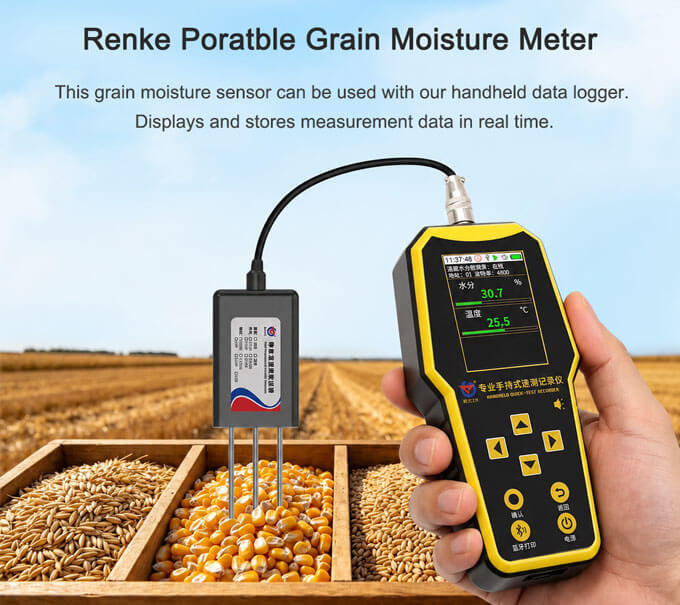
This grain moisture sensor can be used with our handheld data logger. This portable grain moisture meter is easy to carry and move, and can collect data from different measuring points in real time. It integrates measurement, display, storage, and analysis. Our handheld data logger is equipped with a 2.8-inch LCD screen, allowing for quick on-site data retrieval without wiring. It offers long battery life, capable of operating continuously for over 8 hours.
| Grain moisture sensor measurement types and moisture content tables | |||||
|---|---|---|---|---|---|
| Cottonseed | Wheat | Corn | Grains | Soybeans | Rapeseed |
| 11%~40% | 10%~40% | 11%~40% | 10%~40% | 10%~40% | 7%~40% |
| Peanuts | Sorghum | Sesame | Flour | Rice | Feed |
| 8%~40% | 8%~40% | 8%~40% | 8%~40% | 8%~40% | 8%~40% |
FAQs - Grain Moisture Sensor
Why is moisture measurement important for grain storage?
Moisture content is one of the most critical factors in determining grain stability. If moisture is too high, it increases the risk of mold growth, fungal contamination, insect infestation, and even spontaneous heating during storage. If it is too low, it may affect grain quality and processing yield. Accurate moisture measurement ensures safe storage conditions, reduces post-harvest losses, and helps maintain market value.
What is the ideal moisture content for stored grains?
The ideal moisture level depends on the type of grain. For example, wheat and rice are generally safe for long-term storage at around 12-14 percent moisture, while corn is typically stored at 13-15 percent depending on climate conditions. Oil-rich grains like soybeans often require slightly lower moisture levels. These values are used as practical thresholds to prevent biological activity during storage.
How accurate are grain moisture sensors?
Accuracy depends on sensor technology, calibration quality, and grain type. High-quality industrial sensors typically achieve accuracy within ±0.5 percent moisture content under controlled conditions. However, real-world accuracy can vary due to grain temperature, density, and heterogeneity. Proper calibration for specific grain varieties is essential to maintain reliable results.
How to use a grain moisture sensor?
- Insert the steel probe correctly: At the selected testing point, hold the steel probe perpendicular to the grain surface and ensure it is fully inserted into the grain pile.
- Read the data after stabilization: Once the steel probe is fully inserted, wait a few seconds for the reading to stabilize before proceeding with continuous moisture detection.
- Minimize measurement errors: Avoid moving the steel probe during the detection process. For the same detection area, it is recommended to take multiple measurements and calculate the arithmetic mean to improve the reliability of the results.
Can one sensor measure different types of grains?
Most advanced grain moisture sensors support multiple grain modes. Users can switch settings for wheat, corn, rice, barley, and others. However, accuracy improves when the sensor is specifically calibrated for each grain type, because structural and compositional differences affect measurement response.
How deep should an insertion grain moisture probe be placed?
When taking measurements, the steel probe must be fully inserted into the grain. For silos, we recommend installing probes at multiple heights to capture the moisture distribution throughout the entire grain pile.
What maintenance does a grain moisture sensor require?
Maintenance typically includes periodic cleaning of the probe surface to prevent dust or residue buildup, inspection of cables and connectors, and recalibration at defined intervals. In harsh environments, protective housings may also need checking to ensure proper sealing against moisture and dust ingress.
Can grain moisture sensors integrate with automation systems?
Yes. Our grain moisture sensors feature RS485 output and use the standard Modbus protocol. This allows them to integrate with PLC systems, SCADA platforms, and intelligent warehouse management systems, enabling real-time data logging, alarms, and automated control of drying or ventilation equipment.
What should be considered when choosing a grain moisture sensor?
Key factors include measurement accuracy, supported grain types, environmental durability, installation method, and system integration capability. For industrial use, resistance to dust, pressure, and temperature variation is critical. It is also important to consider whether the sensor supports long-term calibration stability and whether it fits the specific workflow of harvesting, storage, or processing operations.
Why choose Renke grain moisture sensors?
- High precision: High measurement accuracy, fast response time, and excellent interchangeability, capturing even the slightest changes in temperature and humidity in real time.
- Corrosion resistance: The probe is made of alloy materials, offering excellent corrosion resistance. It can withstand strong external impacts and is highly durable.
- IP68 protection rating: The entire housing is vacuum-potted and sealed, preventing moisture and dust from entering and ensuring excellent water resistance.
- Wide voltage range: Resistant to voltage fluctuations for more stable operation, making it suitable for the complex power environments found in grain silos.
- 0.2W low power consumption: Energy-efficient and power-saving, with low network load for multi-point networking, enabling long-term, stable online monitoring.
Popular Agricultural Sensors
Related Blogs
Table of Contents In the field of gas monitoring, carbon dioxide gas concentration is a critical parameter. CO2 sensors are used in industrial, agricultural, and
Table of Contents In the fields of electrical engineering and electronics, we frequently encounter various analog signals such as voltage and current. In nature, analog
Table of Contents Composition of soil The composition of soil can be categorized into three phases: solid, liquid, and gaseous. Solid phase Mineral particles: This
Table of Contents What is Hydrology? Hydrology refers to the various phenomena of water changes and movement in nature. It studies the formation, circulation, spatial
Table of Contents The Internet of Things (IoT) is one of the hottest technology words in the past few years, which can collect, share, analyze