

Table of Contents Have you noticed this interesting phenomenon? When using gas detectors, different gases have different concentration units. For

Oxygen Transmitter
This is our proprietary wall-mounted oxygen transmitter, which features a built-in high-precision oxygen sensor and offers fast response times and strong resistance to interference. It is suitable for applications requiring real-time monitoring of oxygen concentration, such as warehouses, workshops, chemical plants, and livestock farms.
- Model: RS-O2-*-2-*-T
- MOQ: 1 PCS
- Delivery date: within 24 hours
- Price: $50
About - Renke Oxygen Transmitters
Under normal conditions, the oxygen concentration in the air is approximately 21%. Both oxygen deficiency and enrichment can impact human health, making real-time monitoring of oxygen levels critically important. Our oxygen sensor is a device used to monitor oxygen concentration and is widely applied in storage warehouses, chemical plants, livestock farms, and confined spaces. Our RS485-type oxygen sensor features a measurement range of 0-30% VOL, while the analog version measures 0-25% VOL, with a typical accuracy of ±2%FS and a service life of up to 24 months.
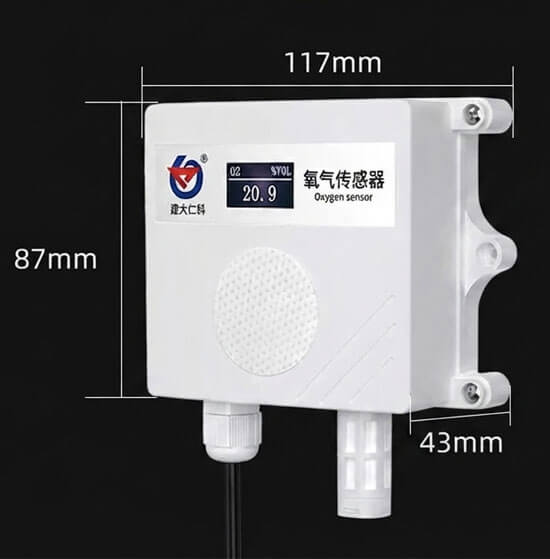
Wall mounted oxygen transmitter
The housing of this wall-mounted oxygen transmitter is made of a high-molecular-weight waterproof material, ensuring the product’s airtightness and water resistance. The waterproof, breathable membrane allows gas molecules to diffuse through while effectively blocking smoke, dust, and water vapor, thereby protecting the oxygen sensor from damage. Internal temperature and humidity sensors can be integrated to enable simultaneous measurement of temperature, humidity, and oxygen. Additionally, an optional OLED display is available, allowing users to view readings directly on-site.
Our oxygen sensor utilizes electrochemical sensing technology, offering high sensitivity and excellent stability. It delivers high measurement accuracy, with a tolerance of ±2% FS, and repeatability within 1%. An optional extension probe is available for measuring oxygen concentrations in locations such as underground utility tunnels, storage tanks, reactors, tunnels, and ship holds.
Wall mounted oxygen transmitter parameters
| Parameters | RS485 | 0-5V/0-10V/4-20mA |
|---|---|---|
| Power supply | 10~30V DC | 10~30V DC |
| Power consumption | 0.12W | 0.25W |
| Measure range | 0~30%VOL | 0~25%VOL |
| Accuracy | ±2%FS | ±2%FS |
| Resolution | 0.1%VOL | 0.1%VOL |
| Working environment | -20~50℃, 5~95%RH non-condensing | |
| Pressure range | 90~110kPa | 90~110kPa |
| Stability | ≤5% signal value/year | ≤5% signal value/year |
| Response time | ≤10s | ≤10s |
| Warm-up time | ≥5min | ≥5min |
| Zero drift (-20~40℃) | ±0.3%VOL | ±0.3%VOL |
| Repeatability | ≤1% | ≤1% |
Wall mounted oxygen transmitter types
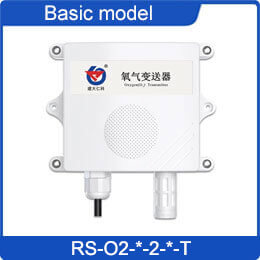
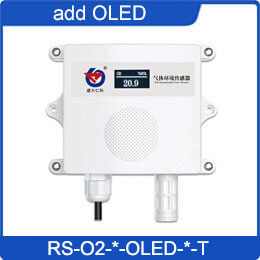
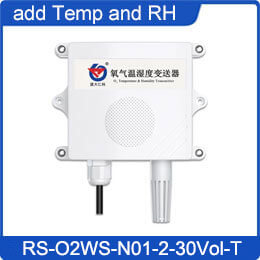
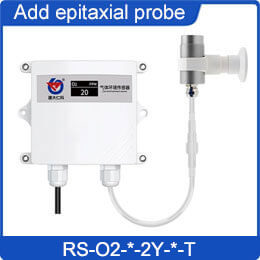
Duct mounted oxygen transmitter
This is our duct mounted oxygen transmitter, specifically designed to measure oxygen concentration in various pipelines. It features flange mounting, ensuring simple operation and a secure installation. The housing features a waterproof design with a high protection rating, enabling long-term use in harsh environments. The internal circuitry is designed to resist interference, allowing it to withstand strong electromagnetic interference from sources such as on-site variable frequency drives. Measurement accuracy is within ±3% FS, with repeatability within 1%. It is suitable for applications requiring oxygen concentration monitoring, such as manufacturing, underground mining, chemical processing, and pharmaceuticals. An optional OLED display is available for viewing readings directly on-site.
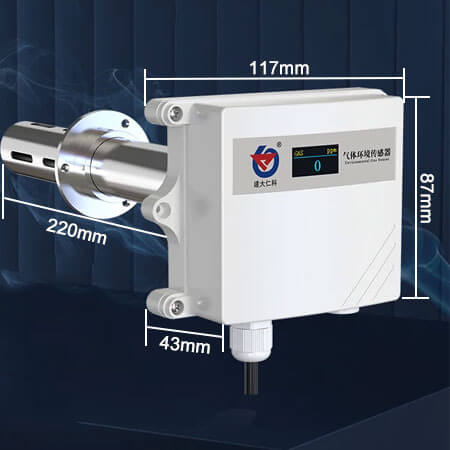
Duct mounted oxygen transmitter
| Output signal | RS485 | 4-20mA/0-5V/0-10V |
|---|---|---|
| Power supply | 10~30V DC | 10~30V DC |
| Power consumption | 0.12W | 0.25W |
| Measuring range | 0~30%VOL | 0~25%VOL |
| Accuracy | ±2%FS | ±2%FS |
| Resolution | 0.1%VOL | 0.1%VOL |
| Operating environment | -20~50℃, 5~95%RH (non-condensing) | -20~50℃, 5~95%RH (non-condensing) |
| Pressure range | 90~110kPa | 90~110kPa |
| Stability | ≤5% signal value/year | ≤5% signal value/year |
| Response time | ≤10s | ≤10s |
| Warm-up time | ≥5min | ≥5min |
| Zero drift (-20~40℃) | ±0.3%VOL | ±0.3%VOL |
| Repeatability | ≤1% | ≤1% |
FAQs - Renke Oxygen Transmitter
1. What is an oxygen sensor?
An oxygen gas sensor is an instrument used to detect and measure the concentration of oxygen in the environment. It converts the oxygen content into an electrical signal that can be read and analyzed by monitoring devices or control systems. This type of sensor is widely used in fields such as industrial safety, environmental monitoring, medical equipment, smart agriculture, boiler combustion control, and automotive exhaust treatment.
2. What is the working principle of an oxygen sensor?
Oxygen gas sensors operate based on several principles, including electrochemical, fluorescence quenching, and zirconia methods.
- Electrochemical sensors generate an electrical current through the reaction between oxygen and an electrolyte. The magnitude of the current is proportional to the oxygen concentration.
- Fluorescence quenching sensors determine oxygen levels by measuring the effect of oxygen on the fluorescence lifetime of a luminescent material.
- Zirconia sensors detect oxygen concentration based on the migration of oxygen ions through zirconia ceramic at high temperatures.
3. What is the lifespan of an oxygen sensor?
The lifespan of an oxygen sensor depends on its type and the operating environment:
Electrochemical sensors: Typically last between 12 to 24 months.
Fluorescence optical sensors: Approximately 5 years.
Zirconia sensors: Can last up to 10 years.
Harsh conditions such as high temperatures, low humidity, or exposure to contaminants may significantly shorten the sensor’s service life.
4. How to properly store an oxygen sensor?
Oxygen sensors should be stored in a cool, dry, and dark environment, avoiding high temperatures (not exceeding 60°C) and extremely dry conditions. Electrochemical sensors should remain sealed when not in use, as some models may require a small amount of oxygen to maintain internal calibration. If refrigerated, the sensor should be allowed to return to room temperature before use to ensure accurate readings.
5. How often should an oxygen sensor be calibrated?
It is recommended to calibrate the oxygen sensor every 6 months. However, the exact frequency should be determined based on usage intensity and environmental conditions. In environments with high humidity, large temperature fluctuations, or the presence of contaminants, more frequent calibration is advised.
6. What factors can affect the accuracy of an oxygen sensor?
Key factors that may impact sensor accuracy include:
Significant fluctuations in temperature and humidity
Evaporation or depletion of the electrolyte
Sensor poisoning from contaminants such as hydrogen sulfide or ammonia
External electromagnetic interference
Regular maintenance and calibration can effectively minimize these influences and ensure stable performance.
7. How to determine if an oxygen sensor is faulty?
Common signs of sensor malfunction include:
Zero drift
Prolonged response time
Decreased sensitivity
False alarms or missed detections
If any of these issues occur, calibration or sensor replacement should be carried out promptly.
8. What is the response time of an oxygen sensor?
The response time varies depending on the sensor type:
Electrochemical sensors: Typically 10 to 30 seconds
Fluorescence optical sensors: Around 5 seconds
Zirconia sensors: Approximately 1 to 2 seconds
Environmental conditions may also affect the response time.
9. How often should oxygen sensors be replaced?
This depends mainly on the working environment. Under normal conditions, it is typically replaced every 2 to 3 years. In harsh environments with high humidity or other gaseous contaminants, its service life may be reduced to 8 to 12 months.
10. Why choose Renkeer oxygen transmitter?
Renkeer is a professional sensor manufacturer with 15 years of experience in R&D, production, and sales. We offer customization services for product appearance and branding. Regarding sensor software, we support our customers’ secondary development and provide free sample programs to facilitate integration.
11. What is the shipping packing list?
Oxygen Transmitter * 1
Self-tapping Screws * 2
Expansion Plugs * 2
Product Certificate, Warranty Card, Wiring Instructions, etc.
Popular Gas Transmitters
Related Blogs
Table of Contents What is TVOC? Is it a gas? TVOC refers to Total Volatile Organic Compounds, which is one
Table of Contents The Internet of Things (IoT) is one of the hottest technology words in the past few years,
Table of Contents What is air quality sensor? An air quality sensor is a device used to detect the concentration
Table of Contents Ammonia is the most dominant alkaline gas in the atmosphere and plays an important role in aerosol
Table of Contents Biologists estimate that the human nose can distinguish on the order of ten thousand odor types, while
Air is a precious natural resource. But air pollution is increasing due to industrial production and human activities. At present,
Table of Contents Carbon dioxide is a gaseous compound produced by the reaction of carbon and oxygen. Its chemical formula