




Table of Contents In the field of gas monitoring, carbon dioxide gas concentration is a critical parameter. CO2 sensors are used in industrial, agricultural,
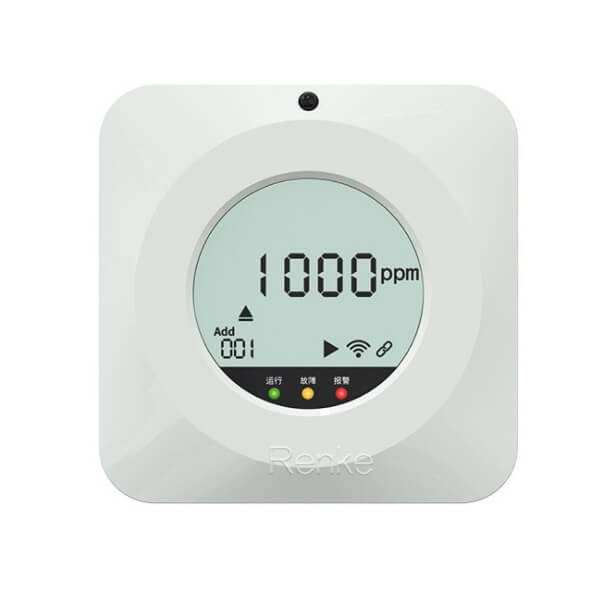
Single Gas Monitor
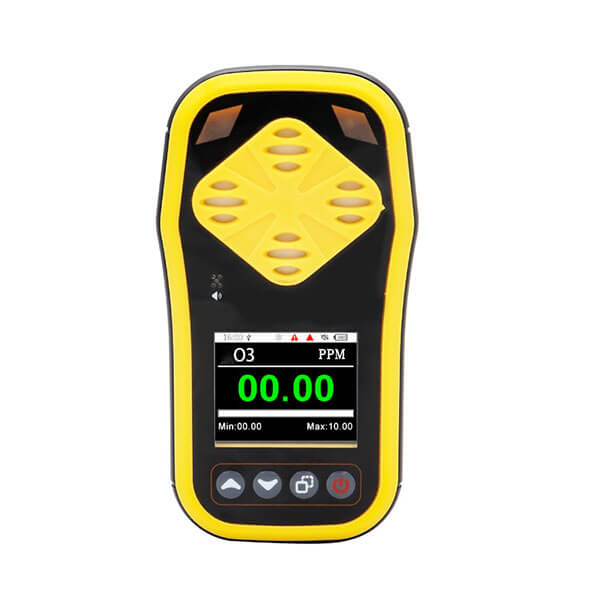
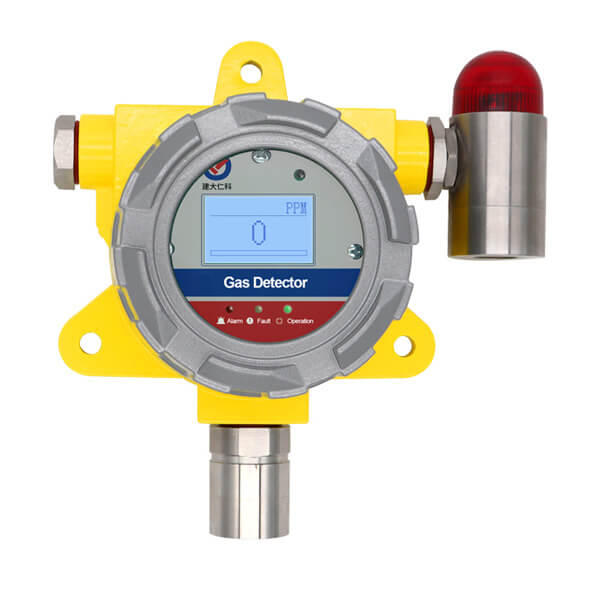
This single gas monitor is an environmental gas concentration monitor independently developed by our company. It is used to detect the gas concentration parameters in the air environment. When the concentration exceeds the preset alarm value, it will emit sound and light. Alarm signal to remind users to take safety measures in time to prevent explosion and poisoning accidents.
- Model: RS-*-*-*-C-T
- MOQ: 1 PCS
- Delivery date: within 24 hours
- Price: $32~$314
About - Single Gas Monitor
This intelligent gas monitor uses infrared remote control technology, allowing parameter adjustments without disassembly. Its elegant design makes it suitable for indoor or office environments. We offer RS485, 4-20mA, 0-5V, and 0-10V signal output options. This single-gas monitor is available in multiple gas types, such as O2, H2S, CO, NO2, SO2, H2, NH3, PH3, O3, and CO2.
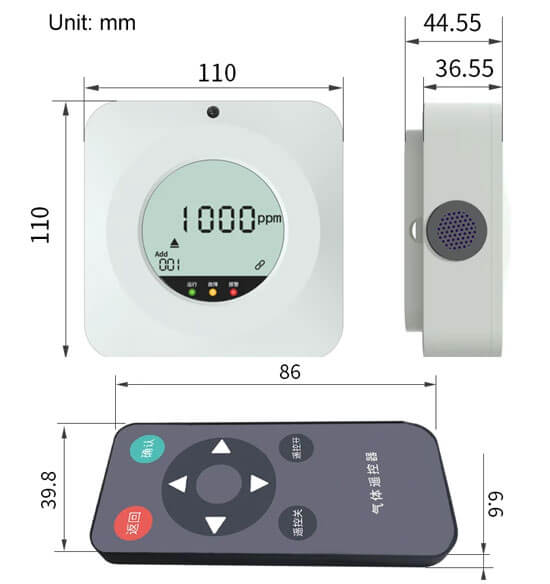
RS-*-*-*-C-T features
This single gas monitor is equipped with a high-quality electrochemical sensor from a leading brand, featuring high sensitivity and strong resistance to interference. Combined with our company’s proprietary compensation algorithm and multi-stage standard gas calibration technology, it offers high accuracy, excellent stability, and a long service life. This monitor uses infrared remote control technology, allowing users to easily adjust alarm thresholds, alarm sounds, and debugging codes. We offer a selection of gas monitors for O2, H2S, CO, NO2, SO2, H2, NH3, PH3, O3, CO2, and other gases, and can customize the measurement range according to your needs. This gas monitor features an LCD display for convenient on-site reading of real-time values. It is designed for wall-mounted installation, making setup simple and convenient. Output options include RS485, 4-20mA, 0-5V, and 0-10V.
RS-*-*-*-C-T parameters
| Power supply | 10~30V DC | |
|---|---|---|
| Average power consumption | 0.6W (24VDC) | |
| Output signal | 4-20mA/0-5V/0-10V/RS485 | |
| Repeatability | NH3/H2/CO (1000ppm)/H2S/NO2/SO2/O3/PH3 | ≤2% |
| CO (2000ppm) | ≤3% | |
| O2 | ≤1% | |
| Stability | CO (1000ppm)/H2S/H2/NO2/SO2/NH3/PH3 | ≤2% signal value/month |
| O3 | ≤7% signal value/year | |
| CO (2000ppm)/O2 | ≤5% signal value/year | |
| CO2 | < 5%F·S or <10% of reading per year | |
| Operating temperature | H2/CO/H2S/NO2/SO2/O2/NH3/PH3/O3/CO2 | -10~50℃ |
| Operating humidity | NH3/H2/CO/H2S/NO2/SO2/O3/PH3 | 15~90%RH (Non-condensing) |
| O2 | 5~95%RH (Non-condensing) | |
| CO2 | 0~95%RH (Non-condensing) | |
| Working pressure | NH3/H2/CO(1000ppm)/H2S/SO2/O2/O3/PH3 | 90~110kPa |
| NO2 | 91~111kPa | |
| CO(2000ppm) | 80~120kPa | |
| Preheating time | NH3/H2/CO/H2S/NO2/SO2/O3/O2/PH3 | ≥5min |
RS-*-*-*-C-T applications
During multi-point monitoring, gas monitors at different locations can use our company’s monitoring host to centrally upload measurement data to the cloud platform, enabling remote monitoring. Once gas concentrations exceed the threshold, the device will trigger an audible and visual alarm. It operates on a wide DC voltage range of 10-30 V, making it compatible with a variety of on-site DC power sources. Our gas monitors are widely used in industries such as natural gas pipelines, petrochemicals, metallurgy, tunnels, coal mining, and semiconductors to detect gases that may be harmful to human health.
Optional gas types and parameters
| Gas name | Optional range | Resolution | Precision | Zero drift | Response |
|---|---|---|---|---|---|
| O2 | 0-30 %VOL | 0.1 %VOL | ±2%FS | ±0.3%VOL | ≤10S |
| H2S | 0-100 ppm | 1 ppm | ±2ppm or ±10% | ±5ppm | ≤35S |
| CO | 0-1000 ppm | 1 ppm | ±5ppm or ±10% | ±3ppm | ≤30S |
| 0-2000ppm | 1 ppm | ±5ppm or ±10% | ≤±10ppm | ≤30S | |
| NO2 | 0-20 ppm | 0.1 ppm | ±5%FS | ≤±0.5ppm | ≤30S |
| 0-2000 ppm | 1 ppm | ±5%FS | ≤±20ppm | ≤60S | |
| SO2 | 0-20 ppm | 0.1 ppm | ±5%FS or ±10% | ≤±0.5ppm | ≤45S |
| 0-2000 ppm | 1 ppm | ±5%FS or ±10% | ≤±4ppm | ≤70S | |
| H2 | 0-1000 ppm | 1 ppm | ±5%FS | ≤±10ppm | ≤70S |
| NH3 | 0-50 ppm | 0.1 ppm | ±8% | ≤±2ppm | ≤90S |
| 0-100 ppm | 1 ppm | ±8% | ≤±2ppm | ≤90S | |
| O3 | 0-100ppm | 1 ppm | ±6%FS(@50ppm,25℃,50%RH) | ≤±0.5ppm | ≤30S |
| CO2 | 0-2000ppm | 1ppm | ±(50ppm+ 3%F·S) @(25℃,400~2000ppm) | / | ≤30S |
| CO2 | 0-5000ppm | 1ppm | ±(50ppm+ 3%F·S) @(25℃,400~5000ppm) | / | ≤30S |
| CO2 | 0-10000ppm | 1ppm | ±(50ppm+ 3%F·S) @(25℃,400~10000ppm) | / | ≤30S |
FAQs - Single Gas Monitor
How do I wire this single-gas detector?
RS485 Model:
Number 1 connects to the positive power supply (10-30 V DC); number 2 connects to the negative power supply; number 3 connects to 485-A; number 4 connects to 485-B.
Analog Model:
Number 1 connects to the positive power supply (10-30 V DC), labeled ACC; number 2 connects to the negative power supply, labeled GND; number 3 connects to the positive gas signal, labeled AO; number 4 connects to the negative gas signal, labeled GND.
Where should this gas monitor be installed?
The device should be installed in a location free from impact, vibration, and strong electromagnetic interference, and where it is easily accessible for maintenance. The clearance between the installation site and surrounding process piping or equipment should be no less than 0.5 m.
Depending on the specific substance being detected, the following installation locations are recommended:
- Carbon monoxide: 0.5 m to 1.0 m above the emission source
- Hydrogen sulfide: 0.5 m to 1.0 m below the emission source
- Ammonia: Within 2.0 m above the emission source
- Sulfur dioxide: 0.3 m to 0.6 m from the bottom of the measurement space
- Nitrogen dioxide: 0.3 m to 0.6 m from the bottom of the measurement space
- Ozone: 0.3 m to 0.6 m from the bottom of the measurement space
- Carbon dioxide: 0.3 m to 0.6 m from the bottom of the measurement space
- Phosphine: 0.5 m to 1.0 m below the release source
- Oxygen: 0.5 m to 1.0 m below the release source
How do you install a single gas monitor?
First, drill holes at the mounting points and secure the mounting base to them. Once the mounting bracket is secured, snap the gas detector into the mounting base.
What should you keep in mind during installation?
To ensure proper use of the product and prevent malfunctions, do not install it in the following locations:
1. Areas directly exposed to steam or cooking fumes.
2. Areas with high airflow, such as air intakes, exhaust fans, or doorways.
3. Areas with high levels of moisture or water droplets (relative humidity: ≥95% RH or areas where condensation may form).
4. Areas where temperatures exceed the device’s operating range.
5. Locations with strong electromagnetic fields.
What's included in the packing list?
Smart gas monitor *1
Installation screws *2 packs
Infrared remote control *1
Product certificate of conformity
Warranty card
Related Blogs
Table of Contents Did you know that most people spend about 90% of their time indoors? While we often worry about outdoor air pollution,
Table of Contents Have you noticed this interesting phenomenon? When using gas detectors, different gases have different concentration units. For example, the unit for
Table of Contents What is ozone? Ozone gas is a trace gas in the atmosphere. At room temperature and pressure, ozone is colorless at
Table of Contents What is air quality sensor? An air quality sensor is a device used to detect the concentration of pollutants in the
Table of Contents Smart buildings are the product of the development of modern science. The smart building system is mainly composed of Internet of
Table of Contents The key to the smart industry lies in the collection of data and information. Sensors are the nerve endings of the
We all know that the chemical properties of ozone are extremely active. Its energy when it is free produces strong oxidation in an instant,
What is air quality monitoring? Air quality monitoring refers to the continuous measurement of pollutants present in the air at specific locations. To monitor