


Table of Contents Carbon monoxide is a colorless and odorless toxic gas at room temperature. People cannot perceive its presence through smell. Therefore, carbon monoxide
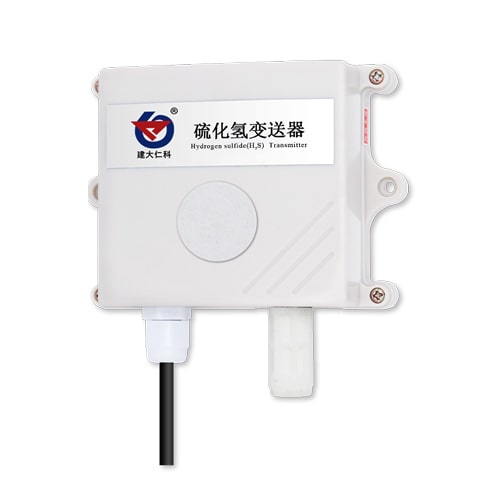
H2S Sensor
The RS-H2S-*-*-100P-*-T H2S sensor is wall-mounted, the housing is dust-proof and waterproof, with a long using life. IP65 protection grade, can work normally in harsh environments. There is a temperature and humidity probe at the bottom to support measuring temperature, humidity and hydrogen sulfide at the same time. It is suitable for parking lots, garages, workshops, chemical plants, greenhouses, closed living places and other occasions.
- Model: RS-H2S-*-*-100P-*-T
- MOQ: 1 PCS
- Delivery date: within 24 hours
- Price: $33.5~$44
About - H2S Sensor
Hydrogen sulfide is a colorless, odorous, flammable gas, which is irritating and suffocating, it is harmful to the human body. Renke hydrogen sulfide sensor adopts electrochemical principle, which is sensitive in response and strong in anti-interference ability. In order to meet the requirements of different places, we provide four types: wall-mounted H2S sensors, duct type H2S sensors, portable H2S detectors and fixed H2S detectors. Our wall-mounted H2S sensor offers selectable RS485, 4-20mA, 0-5V, and 0-10V signal outputs.
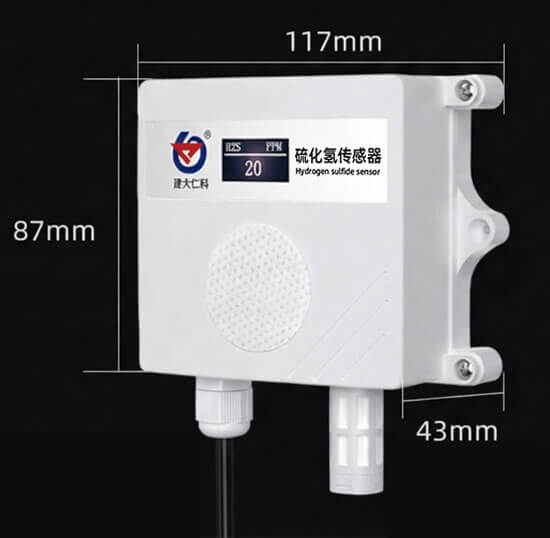
RS-H2S-*-*-100P-*-T
The RS-H2S-*-*-100P-*-T series is a wall-mounted hydrogen sulfide transmitter with a built-in high-precision electrochemical sensor, offering sensitive response and strong anti-interference capabilities. It boasts high measurement accuracy within ±10% and repeatability within 2%. The default measurement range is 0-100ppm, but other ranges can be customized. A high-quality OLED display can be added for convenient real-time data viewing. Field power supply is a wide 10~30V DC power supply, adaptable to various DC power sources. Its wall-mounted waterproof housing facilitates easy installation and provides high protection for harsh environments. For use in high-temperature, high-humidity, or confined spaces, an extended probe can be upgraded (probe cable is 80cm by default, customizable).
RS-H2S-*-*-100P-*-T parameters
| Power supply | 10~30V DC |
|---|---|
| Power consumption | 0.12W (RS485), 0.25W (Analog) |
| Measuring range | 0~100ppm |
| Accuracy | ±2ppm or ±10% |
| Resolution | 1ppm |
| Operating environment | -20~50℃, 15~90%RH non-condensing |
| Pressure range | 90~110kPa |
| Stability | ≤2% signal value/month |
| Hydrogen sulfide zero drift (-20~40℃) | ±5ppm |
| Repeatability | ≤2% |
| Lifespan | ≥24 months |
| Response time | ≤35s |
| Warm-up time | ≥5min |
| Output signal | RS485/4-20mA/0-5V/0-10V |
RS-H2S-*-*-100P-T
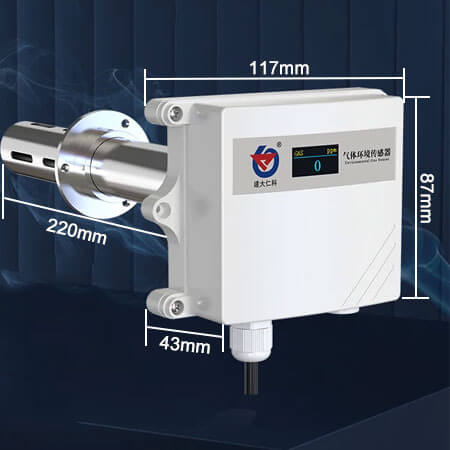
The RS-H2S-*-*-100P-T series is a ducted hydrogen sulfide sensor designed specifically for measuring the concentration of hydrogen sulfide gas in enclosed pipelines. It enables 24/7 uninterrupted online monitoring. Its internal anti-interference circuitry allows it to withstand various electromagnetic interferences, such as those generated by field frequency converters. The only difference between the ducted H2S sensor and the wall-mounted H2S sensor is their appearance; please refer to the wall-mounted H2S transmitter section for specific product parameters. The price of the ducted hydrogen sulfide sensor is: $44 without display, $55 with display. All models support RS485, 4-20mA, 0-5V, and 0-10V signal output options.
FAQs - H2S Sensor
What is the best range for an H2S gas sensor?
The optimal range for an H2S sensor depends on your detection scenario. Currently, the industry standard range is 0-100 ppm, which covers occupational exposure limits and most leakage conditions, making it the most versatile choice.
What is the difference between 0-10 ppm and 0-100 ppm H2S sensors?
The main difference between 0-10 ppm and 0-100 ppm sensors lies in their measurement range and detection accuracy: a smaller range provides more accurate measurement of low-concentration gases, suitable for trace detection; a larger range offers wider coverage, but resolution and accuracy at low concentrations are usually slightly lower.
How often should an H2S sensor be calibrated?
The basic calibration cycle for an H2S sensor is generally no more than one year, with a general recommendation of calibrating every 3 to 6 months. The specific frequency depends on the equipment type, usage scenario, and applicable standards; a fixed value should not be followed.
Where should a hydrogen sulfide transmitter be installed?
The hydrogen sulfide sensor should be installed in a location free from impact, vibration, and strong electromagnetic interference, and easily accessible for maintenance. The clearance between the installation site and surrounding process piping or equipment should not be less than 0.5m. It is recommended that the transmitter be installed 0.5m to 1.0m below the release source.
What precautions should be taken when installing a hydrogen sulfide transmitter?
To ensure proper use of this equipment and prevent malfunctions, please do not install it in the following locations:
- Locations directly affected by steam or fumes.
- Locations with high airflow, such as near air inlets, exhaust fans, or doors.
- Locations with high moisture content or water droplets (relative humidity ≥95%RH or locations where condensation may occur).
- Locations exceeding the equipment’s operating temperature range.
- Locations with strong electromagnetic fields.
How to wire a hydrogen sulfide transmitter?
- RS485 type output:
Brown wire to positive power supply (10~30V DC), black wire to negative power supply, yellow wire to 485-A, blue wire to 485-B. - Analog type output:
Brown wire to positive power supply, black wire to negative power supply, blue wire to positive hydrogen sulfide signal, green wire to negative hydrogen sulfide signal.
What is the difference between electrochemical and MOS H2S sensors?
Electrochemical H2S sensors detect gas through chemical reactions, while MOS sensors detect changes in electrical resistance. Electrochemical sensors typically offer better selectivity and lower power consumption, while MOS sensors are often more cost-effective but more sensitive to environmental changes.
How long does an H2S transmitter last?
Our hydrogen sulfide transmitters have a normal lifespan of 3-5 years.
What gases can interfere with an H2S transmitter?
H2S transmitters based on different measurement principles are susceptible to different types of interference. Common interfering gases include SO2, NO2, H2, CO, Cl2, O3, CH3SH, and NH3. Reducing gases (SO2, H2, CO) will cause readings to be too high, while oxidizing gases (NO2, Cl2, O3) will cause readings to be too low.
Can an H2S transmitter be used in high humidity environments?
The transmitter can function normally as long as there is no condensation at the measurement location. However, when the humidity exceeds 95% or condensation is present, a pretreatment system or a moisture-resistant sensor is required.
Related Blogs
Table of Contents Ammonia is the most dominant alkaline gas in the atmosphere and plays an important role in aerosol nucleation. It is also the
Table of Contents Biologists estimate that the human nose can distinguish on the order of ten thousand odor types, while dogs can identify hundreds of
Monitoring hazardous gases in the surrounding environment is fundamental to ensuring workplace safety. Many gases, such as carbon monoxide, hydrogen sulfide, etc., are difficult to
Table of Contents Carbon dioxide is a gaseous compound produced by the reaction of carbon and oxygen. Its chemical formula is CO2. A carbon dioxide
Table of Contents The key to the smart industry lies in the collection of data and information. Sensors are the nerve endings of the smart
We all know that the chemical properties of ozone are extremely active. Its energy when it is free produces strong oxidation in an instant, which
Why is a gas detector necessary? In the industrial production process, the leakage of flammable, toxic and harmful gases often occurs, which will cause serious
What is an air quality monitor? An instrument used to detect air quality can be called an air quality monitor. However, due to the extensive