

Table of Contents Smoke from combustion is an upward motion and will quickly drift to the ceiling. The smoke alarm can detect fire through
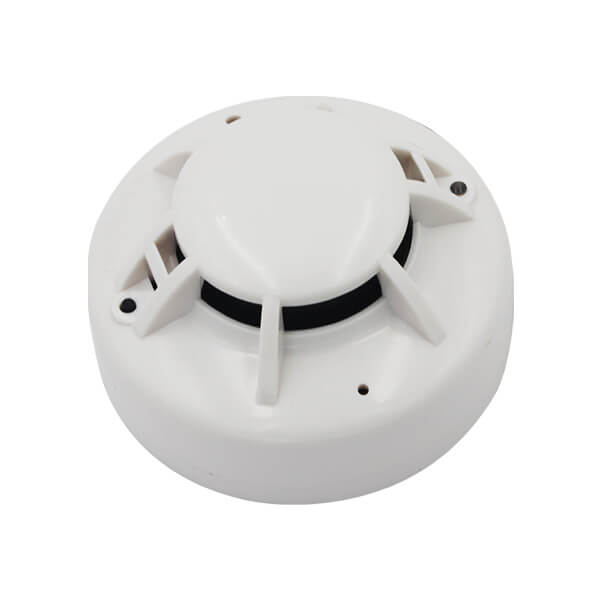
Smoke Detector RS485
It is a device that uses the photoelectric principle to detect the smoke generated during a fire. The accuracy of photoelectric smoke detectors usually does not cause so many false alarms. This smoke detector is installed through wiring, which avoids the late-night call caused by battery replacement. The alarm uses photoelectric smoke devices and excellent production technology, stable work, simple installation, no need to debug.
- Model: RS-YG-*-T
- MOQ: 1 PCS
- Delivery date: within 24 hours
- Price: $33.5
About - Smoke Detector
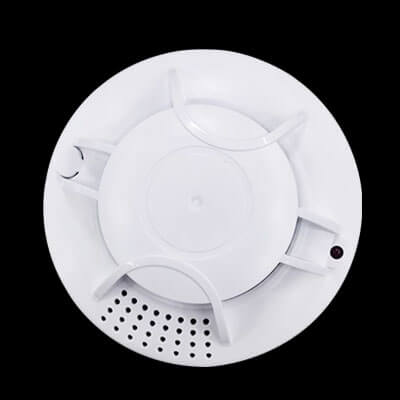
Our smoke detector is designed to identify smoke generated during a fire. It uses a flame-retardant ABS housing that resists high temperatures and corrosion, providing strong protection for the built-in photoelectric sensing element. The mesh-style detection window prevents insects and dust from entering and interfering with normal operation. The device includes an internal buzzer that emits a loud alarm when smoke is detected. With surface-mount technology, it offers strong resistance to EMI and RFI interference. Our smoke detector supports RS485 output and the Modbus protocol, making it suitable for integration and secondary development.
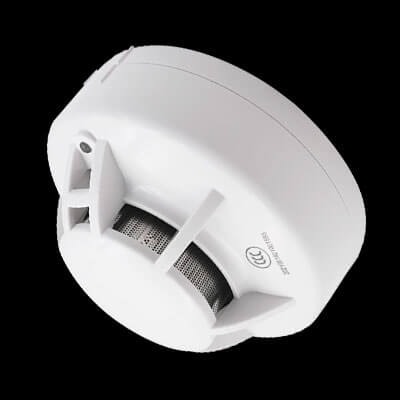
RS-YG-*-T
-N01 Power supply options: DC10-28V
-R01 Power supply options: DC9-28V
Static power consumption: 0.12W
Alarm power consumption: 0.7W
Alarm sound level: ≥80dB
Signal output: RS485/Normally open contact
Operating environment: -10℃~50℃, ≤95% (non-condensing)
Execution standard: GB4715-2024
Housing material: ABS
Smoke sensitivity: 1.06±0.26%FT
Relay contact output capacity: 24VDC 1A
RS-YG2-N01-T
Power supply: DC 10-30V
Static power consumption: 0.12W
Alarm power consumption: 0.7W
Alarm sound level: ≥80dB (within 3m)
Signal output: RS485
Operating environment: -10℃~50℃, ≤95% (non-condensing)
Compliant standard: GB20517-2006
Housing material: ABS
Wiring interface: Screwless terminal (4P)
Circuit board terminal markings: V is positive power supply (10-30V DC), G is negative power supply, A is 485-A, B is 485-B.
Application
Our smoke detector uses the 485 connection method, once installed, it can be used normally, avoiding the trouble of removing the cover and replacing the battery. It is an industrial-grade fire detector. This smoke alarm is suitable for a wide range of layouts and requires no maintenance in the later period. It can be widely used in shopping malls, hotels, shops, warehouses, computer rooms, residential buildings, and other places for fire safety detection.
FAQs - Smoke Detector
Why buy a smoke detector?
As the number of users of smoke detectors continues to increase, the number of deaths caused by residential fires is also declining. Studies have shown that in the event of a fire, the chances of escape for people in residences with smoke alarms installed will be 50% higher than that of residences without installations. It is necessary to install an alarm in every bedroom.
What are the types of smoke alarms?
There are 2 types of smoke alarm technology-ionization and photoelectric. Ionization smoke alarms usually have a stronger response to flame burning (such as pan fires or smoke produced during cooking). Photoelectric alarms are usually more sensitive to smoldering fires, such as cigarettes, overheating of electrical wires, or high temperatures similar to space heaters.
Where to install smoke detector?
The smoke detector installs inside and outside the sleeping area. Install a smoke sensor for every 60 square meters indoors (the specific area depends on the coverage of the smoke sensor), and install the smoke sensor 0.5-2.5 meters above the important equipment. The smoke sensor in the corridor is installed every 15 meters.
How to clean smoke detector?
The smoke alarm should be cleaned every 3 years, and the cleaning should be done by professional technicians. Usually, you can wipe the shell with a soft cloth.
How does a fire alarm work?
Renke smoke alarm adopts photoelectric smoke sensing principle design, built-in smoke sensor, and photoelectric smoke device. Smoke moves upwards. When it rises to the bottom of the ceiling and enters the inside of the alarm, the smoke particles will scatter part of the light beam to the photosensitive element. The denser the smoke, the more light is scattered on the photosensitive element. When the light beam scattered on the sensor reaches a certain level, the buzzer will sound an alarm. At the same time, the sensor converts the light signal into an electric signal and transmits it to the automatic fire alarm system to prompt a fire.
How to install smoke detector?
When installed on a ceiling, the smoke detector should be positioned near the center. For sloped or irregular ceilings, the detector must be installed at a certain distance below the roof surface. When the slope is less than 30°, a distance of about 0.2 m is recommended; when the slope is greater than 30°, the recommended distance increases to 0.3-0.5 m.
Our smoke detector is intended only for supervised areas and is not suitable for the following environments:
1. Locations where smoke is normally present
2. Areas with heavy dust, mist, steam, oil vapor, or corrosive gases
3. Places with relative humidity above 95%
4. Areas with air flow speeds above 5 m/s
5. Locations close to fluorescent lighting fixtures
For the RS-YG-*-T model, drill two 5 mm mounting holes spaced 60 mm apart on the ceiling.(For the RS-YG2-N01-EX model, drill two 5 mm holes spaced 72 mm apart.) Use expansion anchors and self-tapping screws to secure the detector base to the ceiling.
How to wire a smoke detector?
Using the RS-YG-*-T as an example:
RS485 output:
The device can be powered with a DC input of 10-28 V. If the site voltage is unstable, it is recommended to use a lower voltage to protect the device and prevent damage caused by excessive voltage. When wiring the 485 signal lines, ensure that the A and B lines are not reversed, and verify that no device addresses conflict on the same bus.
Brown wire: Power positive (10-28 V DC)
Black wire: Power negative
Yellow wire: 485-A
Blue wire: 485-B
Switch output:
The device can be powered with a DC input of 9-28 V. If the site voltage is unstable, using a lower voltage is recommended to protect the device and avoid damage from overvoltage. Connect the power wires to terminals 3 and 4 on the base. The relay dry-contact output wires should be connected to terminals 1 and 2 on the base.
Attach the smoke detector to the base in the correct orientation, press it down, and rotate clockwise to lock it in place. The device will operate once power is supplied.
Related Blogs
Table of Contents The commonly used communication method for data acquisition and control is RS-485. RS-485 is a general communication standard. It can not
Table of Contents Smart buildings are the product of the development of modern science. The smart building system is mainly composed of Internet of
Table of Contents The key to the smart industry lies in the collection of data and information. Sensors are the nerve endings of the
Table of Contents Modern companies are placing an increasing emphasis on the value of collected data. As a result, central data centers, IDCs, and
Table of Contents If you are away from home, or out on business, keeping an eye on the temperature and humidity inside your house,
Why is a gas detector necessary? In the industrial production process, the leakage of flammable, toxic and harmful gases often occurs, which will cause
Table of Contents What is IoT? IoT is the “Internet of things“. It is an extended and expanded network based on the Internet. It
The smoke alarm can accurately sense the smoke generated by the fire in the initial stage of the fire, and quickly alarm people. Smoke