

Table of Contents Over the past few years, large language models have demonstrated remarkable reasoning and generative capabilities. They can write code, analyze data,
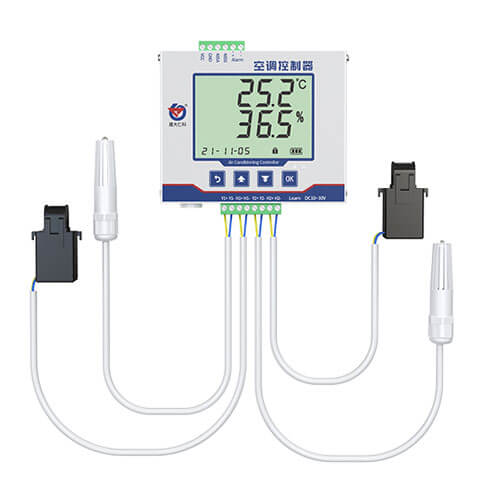
Air Conditioner Controller
This wall-mounted air conditioner controller enables precise control of the air conditioner by learning infrared codes. It complies with the standard Modbus protocol, features a built-in Bluetooth chip, and can be configured using either computer software or a mobile app.
- Model: RS-KTCF-N01-*-T
- MOQ: 1 PCS
- Delivery date: within 24 hours
- Price: $51~$70
About - Air Conditioner Controller
Renke air conditioning controllers are widely used in projects involving the monitoring of air conditioning operating status and energy-saving management, making them the ideal choice for efficient, intelligent air conditioning management. When paired with current transformers, their functionality can be further expanded to include features such as automatic restart upon power restoration, intelligent temperature control, timer control, and dual-unit switching control.
This air conditioner controller features a sheet metal housing with an elegant appearance that better aligns with industrial aesthetics and practical standards compared to similar controllers on the market. It is also equipped with pluggable terminal blocks for convenient wiring. The RS-KTCF-N01-*-T can learn 60 sets of button functions. Equipped with a 485 interface, it can control air conditioners via the Modbus-RTU protocol as an alternative to a remote control. The Modbus communication address is configurable, and the baud rate is adjustable. A single host unit can remotely control the timed on/off operation of two air conditioning units and remotely collect temperature data from the location where the air conditioning controller is installed. Our air conditioner controller can automatically turn the air conditioner on or off based on preset minimum or maximum temperature thresholds, and can be optionally equipped with relay outputs to trigger high-temperature or low-temperature alarms. The controller is equipped with power-off protection, retaining settings during a power outage, and can be configured to automatically restart the air conditioner upon power restoration. It comes with an external infrared sensor, and the infrared transmitter extension cable can reach up to 5 meters. It also features the ability to monitor the air conditioner’s operating status.
Parameters
- Power supply: DC 10~30V
- Power consumption: 0.3W
- Operating environment: -20℃~+60℃, 0%RH~95%RH (non-condensing)
- Communication interface: RS485 (standard ModBus-RTU protocol)
- Communication baud rate: 2400, 4800, 9600 (adjustable)
- Infrared port: Can learn 99% of remote controls and successfully control the air conditioner.
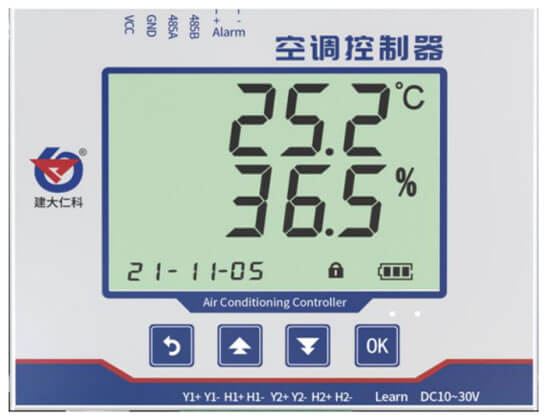
| No. | Description | Remarks |
|---|---|---|
| VCC | Power supply positive terminal | These two terminals are the power supply inputs; simply connect them to a 10~30 V DC power source. |
| GND | Power supply negative terminal | |
| 485A | RS485 communication line A | RS485 communication lines A and B. |
| 485B | RS485 communication line B | |
| Alarm | + | Reserved |
| – | ||
| Y1+ | Connect to the positive terminal of the infrared LED. | Connect to the positive terminal of the external infrared LED. If using our company’s LED cable, connect the yellow wire. |
| Y1- | Connect to the negative terminal of the infrared LED. | Connect to the negative terminal of the external infrared LED. If using our company’s LED cable, connect the blue wire. |
| H1+ | Current transformer positive terminal | First current transformer |
| H1- | Current transformer negative terminal | |
| Y2+ | Connect to the positive terminal of the infrared LED | Connect to the positive terminal of the external infrared LED. If using our company’s LED cable, connect the yellow wire. |
| Y2- | Connect to the negative terminal of the infrared LED | Connect to the negative terminal of the external infrared LED. If using our company’s LED cable, connect the blue wire. |
| H2+ | Current transformer positive terminal | Second current transformer |
| H2- | Current transformer negative terminal | |
| Learn | Infrared learning receiver | When the controller is in learning mode, align the infrared transmitter’s emitter port with the infrared learning receiver port. |
| DC10~30V | Power supply port | Only one of these ports can be connected; both cannot be connected simultaneously. |
Remote and Automatic Control System
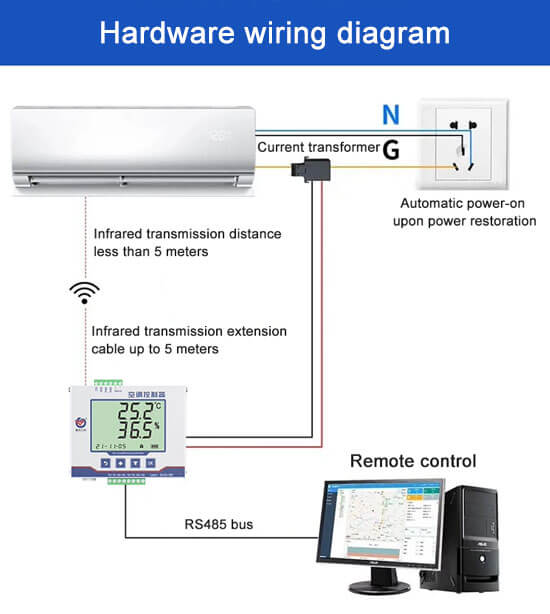
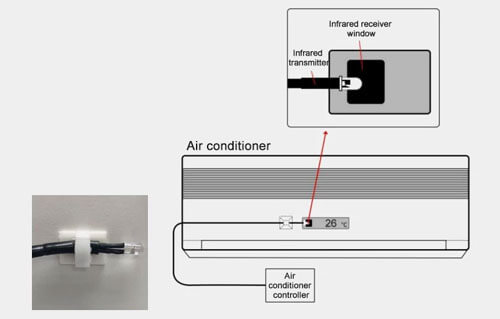
The air conditioner controller communicates with the main unit via a 485 bus. The air conditioner controller’s infrared transmitter extension cable can reach up to 5 meters. By connecting the live wire or neutral wire of the air conditioner to a current transformer, the controller can detect the air conditioner’s current and, consequently, determine its on/off status. The air conditioner controller can control two air conditioners simultaneously.
1. Remote control
In remote control mode, both infrared transmission channels send the same command simultaneously. In this mode, the controller does not detect the air conditioner’s on/off status or determine whether the operation was successful. The power-on auto-start function is part of the remote control functionality; if enabled, when the controller loses and then regains power, it will send the “Custom 20” command until the air conditioner starts.
2. Automatic control
In automatic control mode, timer control and rotation control functions are available. If a current transformer is connected, the air conditioner controller can detect the actual status of the air conditioner and determine whether the operation was successful. If the operation fails, an alarm will sound, and a power-on command will be sent every 15 seconds until control is successful.
The device compares the current temperature with the preset upper and lower temperature limits. If the current temperature exceeds the preset upper limit, it sends a command to turn on the unit and switch to cooling mode; if the current temperature falls below the preset lower limit, it sends a command to turn on the unit and switch to heating mode; if the current temperature falls within the preset range, it sends a command to turn off the unit. If the rotation control function is enabled, the controller will manage the two air conditioning circuits according to the preset rotation interval. The timer function and the rotation function are independent of each other; the air conditioner controller can operate in only one of these two modes at a time.
When setting parameters for timer control, each channel has four time slots that can be configured. The air conditioner controller determines whether the unit is within an operating time slot based on the four set time slots. If it is not within an operating time slot, the controller sends a shutdown command; if it is within an operating time slot, the controller compares the current temperature with the set upper and lower temperature limits and then sends a command to turn on heating or cooling.
Related Blogs
Table of Contents Before the advent of AIoT, traditional monitoring systems primarily relied on a “passive data collection + manual judgment” model. This process
Table of Contents When a single GPU’ s power consumption skyrockets past 1,000 W, and when the power of a single rack surges to
Table of Contents “IoT devices” is one of the most familiar terms in the tech world today. From the smartwatch on your wrist to
Table of Contents Modern agriculture is already operating at a data driven and automated level, where irrigation, greenhouse control, and field management are increasingly
Table of Contents During operation, mechanical equipment (such as motors, pumps, and fans) vibrates due to imbalances, wear, loosening of internal parts, or changes
Table of Contents Vibration monitoring is an effective method for assessing the condition of mechanical equipment and performing fault diagnosis. By installing vibration sensors
Table of Contents Have you ever faced unexpected equipment failures that forced production to halt? Or struggled with high repair costs and unplanned downtime?
Table of Contents What is Heat Flux? Heat flux, also known as heat flow density, refers to the amount of heat transferred per unit