


Table of Contents “IoT devices” is one of the most familiar terms in the tech world today. From the smartwatch
Optical Water Leak Sensor
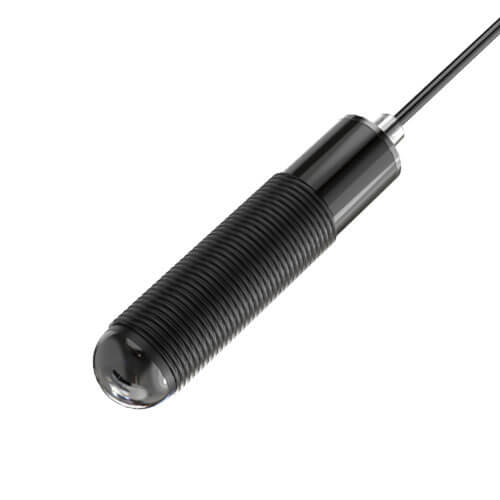
Our optical water leak sensor uses optical technology to detect liquid leaks. It can monitor not only tap water and purified water, but also alcohol, gasoline, antifreeze, insulating liquids, and acidic or alkaline liquids. With high sensitivity, a compact size, and wide application versatility, it is suitable for various leak detection scenarios.
- Model: RS-SJ-*-5-T
- MOQ: 1 PCS
- Delivery date: within 24 hours
- Price: $16
About - Optical Water Leak Sensor
Optical water leak sensors are widely used in many fields, such as IDC data centers, factories, hotels, warehouses, and oil depots. In practical applications, optical water leak sensors are usually integrated with alarm systems or control systems. When a leak is detected, they can automatically trigger an alarm or control the corresponding equipment to take corrective action.
Features
This optical water leak sensor operates based on the principle of optical refraction. It can detect leaks when the probe is immersed in liquid up to 1mm deep, offering greater compatibility than traditional leak detection products. Its high sensitivity allows it to detect even minute leaks in real time.
The sensor supports both switch output and RS485 communication, allowing quick integration into IoT monitoring systems for remote monitoring and early warning. Its housing adopts a fully sealed waterproof and dustproof design, enabling long term operation in environments with moisture, dust, or oil contamination.
With an integrated structure and no moving mechanical parts, the water leak sensor is easy to maintain and provides a long service life. It can be used to detect a variety of liquids, including water, oil, acidic solutions, and alkaline solutions.
Parameters
| Power supply | DC10~30V | |
|---|---|---|
| Power consumption | RS485 type | 0.04W (DC12V) |
| Switch type | 0.1W (DC12V) | |
| Detection items | Alcohol, tap water, purified water, acidic or alkaline water, gasoline, antifreeze, etc. | |
| Circuit operating environment | -20℃~+60℃, 0%RH~95%RH (non-condensing) | |
| Output signals | Relay output | Normally open contact |
| RS485 output | ModBus-RTU protocol | |
| Relay load capacity | 60VDC 0.5A | |
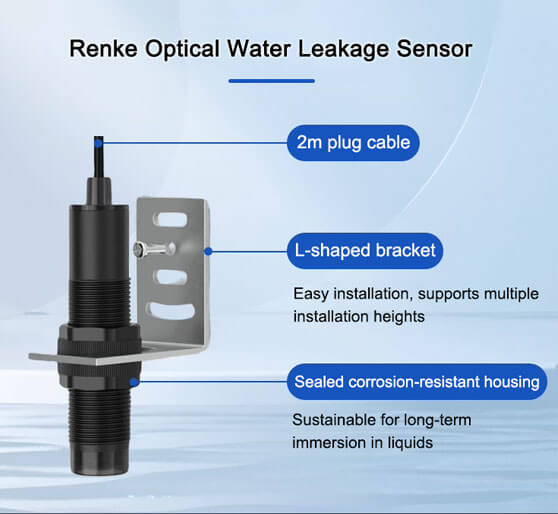
| Cable length | Plug-in cable, total length 2 meters | |
| Equipment dimensions | 77*18mm | |
Advantages
- Low false alarm rate: Compared with traditional probe type sensors, optical water leak sensors are less susceptible to interference from humidity, dust, or condensation, significantly reducing unnecessary alarms and false alerts.
- Wide media compatibility: Optical water leak sensors can accurately detect a variety of liquids, including corrosive chemicals, insulating oils, and acidic or alkaline liquids commonly found in chemical processing and energy storage applications.
- Compact size: The sensor’s small footprint allows it to be installed in confined spaces such as server cabinets, pipe interlayers, and beneath precision equipment, making integration into different systems easy and convenient.
- Fast response time: Based on optical sensing technology, the water leak sensor responds quickly and can detect leaks and trigger alarms within a very short period.
- Excellent stability: The fully sealed design minimizes the impact of environmental factors on internal electronic components, ensuring long term stability, reliability, and consistent performance.
Installation
Choosing a suitable installation location is fundamental to ensuring accurate water leakage detection by the sensor. When using the optical water leak sensor, it is important to ensure that it operates in a low light environment to minimize optical interference. In addition, the sensor should be installed at low lying locations where leaked liquid is most likely to accumulate, allowing more effective leak detection.
FAQs - Optical Water Leak Sensor
What is an optical water leak sensor?
An optical water leak sensor is a device that detects the presence of water using infrared light instead of conductive probes. It monitors changes in light reflection caused by contact with liquid and sends an alarm signal when a leak is detected.
How does an optical water leak sensor work?
When light rays are emitted from the sensor probe and encounter the water surface, the light’s propagation path changes, causing a change in the light signal received by the sensor. By monitoring this change, an optical water leak sensor can accurately determine the water level or whether a leak exists.
How to wire an optical water leak sensor?
We offer two output options: RS485 and switch output.
RS485 version wiring:
Brown wire: Power positive (10~30 VDC)
Black wire: Power negative
Yellow wire: RS485-A
Blue wire: RS485-B
Switch output version wiring:
Brown wire: Power positive (10~30 VDC)
Black wire: Power negative
Yellow wire and blue wire: Relay normally open (NO) contacts.
What do the LED indicator statuses of the optical water leak sensor mean?
LED flashes once every 5 seconds: No liquid detected (dry condition)
LED flashes rapidly: Liquid detected (leak condition)
LED remains continuously on: Device fault or abnormal status
How to install the optical water leak sensor?
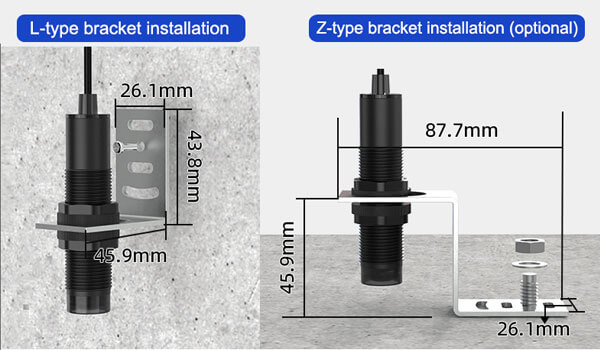
We provide either an L-shaped or Z-shaped mounting bracket to help install and secure the sensor:
- Use the supplied expansion screws to fix the L-shaped or Z-shaped bracket to a wall, beam, or floor.
- Secure the sensor to the mounting bracket using the two supplied φ18 nuts.
- Ensure that the sensor probe is positioned vertically downward.
How can I view the data?
Single-point monitoring:
The sensor data can be uploaded to the user’s own software system through an RS485 to USB converter for viewing and analysis.
Multi-point monitoring:
Multiple sensors can be connected to our environmental monitoring host, which supports up to 32 monitoring channels. The host collects and uploads all data to our free cloud platform, allowing users to view real-time data from all monitoring points in a centralized interface.
What's in the package list?
- Optical water leak sensor * 1
- Self-tapping screws * 2
- Expansion plugs * 2
- L-shaped bracket * 1
- Certificate of conformity and warranty card
- Z-shaped bracket (optional)
- USB to 485 converter (optional)
What is the difference between an optical water leak sensor and a conductive leak sensor?
A conductive leak sensor detects water through electrical conductivity between metal probes. An optical leak sensor uses infrared light and does not rely on water conductivity.
Therefore, optical sensors can detect non-conductive liquids, while conductivity sensors may have difficulty detecting these liquids.
Popular Safety Sensors
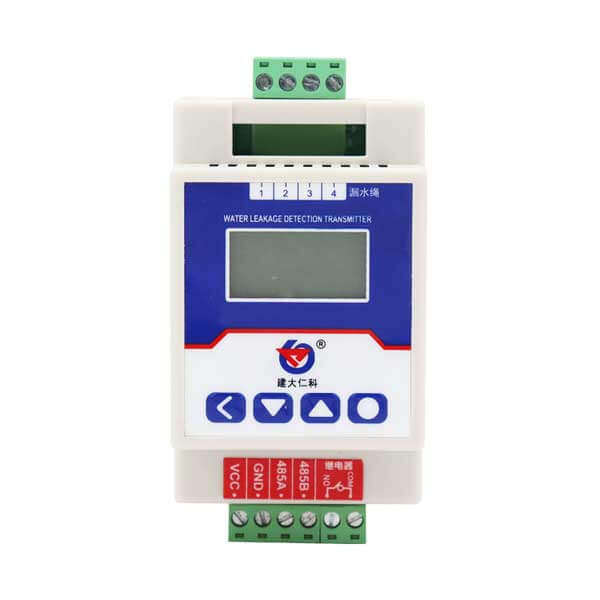
Positioning water leak detector
Related Blogs
Table of Contents During operation, mechanical equipment (such as motors, pumps, and fans) vibrates due to imbalances, wear, loosening of
Table of Contents Have you ever faced unexpected equipment failures that forced production to halt? Or struggled with high repair
Table of Contents In daily life, industrial production, and laboratory research, the terms “distilled water” and “purified water” are often
Table of Contents Water leak detection is designed to detect and repair leaks in pipes, equipment or building structures in
Table of Contents The commonly used communication method for data acquisition and control is RS-485. RS-485 is a general communication
Table of Contents Have you or your friends ever experienced a burst pipe or indoor flooding? Even if you don’t
Table of Contents What is a water level sensor? A water level sensor is a device designed to measure the