


Table of Contents Are you curious about inclinometers? This article will take an in-depth look at the principles, types, and applications of inclinometers. Whether
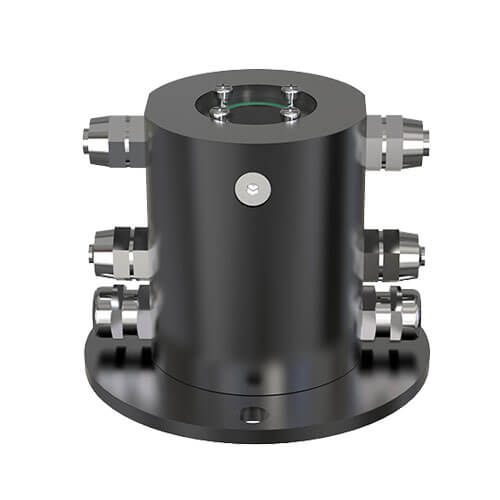
Hydrostatic Settlement Cell
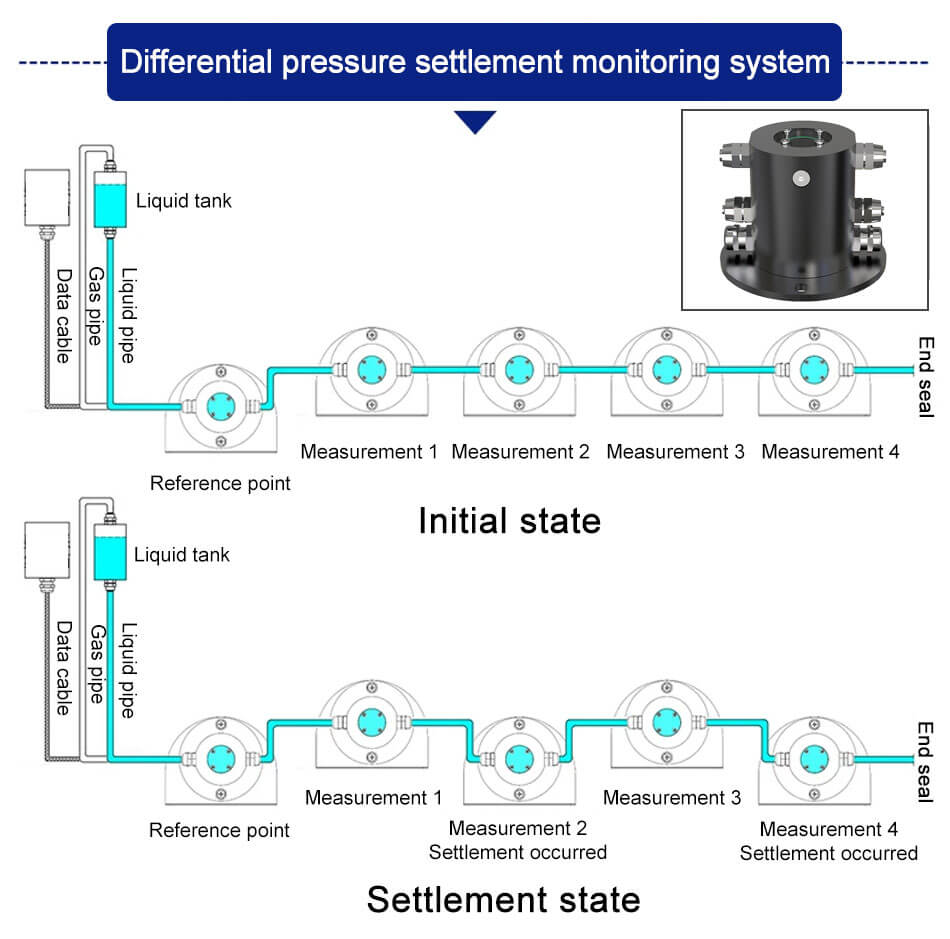
These settlement cells are high-precision differential pressure hydrostatic level transmitters based on the principle of communicating vessels. By measuring the level variations of various monitoring points relative to a reference point, the system reflects changes in ground settlement. This setup enables long distance, automated, and continuous monitoring, providing reliable data support for engineering safety assessments.
- Model: RS-STA-YC-N01-1-*-T
- MOQ: 1 PCS
- Delivery date: within 24 hours
- Price: $105
About - Settlement Cell
The settlement unit is the “sensory nerve” of the automated settlement monitoring system, responsible for “seeing” and “feeling” settlement. They are in direct contact with the monitored structures (such as bridges, dams, and railways) and can utilize different measurement principles to keenly capture minute settlement deformations. It is generally used to monitor vertical displacement changes in soil and pile bodies in areas such as earth rock dams, embankments, building foundations, mines, foundation pit excavation, geotechnical slopes, tunnels, and building walls.
Features
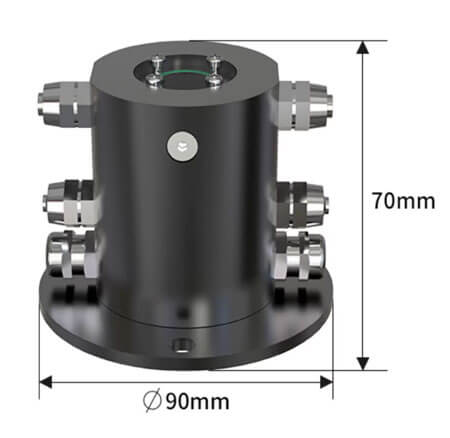
Our settlement cell utilizes a differential pressure measurement principle and consists of components such as a liquid storage tank, a protective cover, and interconnecting air and water pipes. Based on the principle of connected vessels, the liquid flows freely through the connecting pipes. By measuring the pressure difference between each monitoring point and the reference point, and utilizing the linear relationship between pressure difference and the height of the liquid level (△P=ρ*g*△h), the system determines the change in liquid level at each point relative to the reference point. This allows for the accurate reflection of structural deformation and enables high precision monitoring of building settlement.
Features
High Precision
Equipped with a high-precision pressure sensor chip, the Renke settlement cells can monitor minute changes in ground subsidence (Accuracy: 0.1% FS, Resolution: 0.01mm). When a level change occurs between the monitoring point and the reference point due to ground settlement, the unit detects this change in real-time and rapidly converts it into an electrical signal, ensuring precise data collection and stable output.
Anti-Interference
Hydrostatic settlement sensors operate outdoors for long periods and must face drastic temperature fluctuations. Our settlement cells employ temperature compensation technology to effectively offset interference across a wide temperature range of -20°C to 60°C. This technology ensures the measurement unit outputs stable data even under extreme conditions, such as intense high-temperature sun exposure or severe low-temperature cold.
Waterproof
In addition to temperature changes, frequent rain and snow pose a significant challenge. Our settlement cell features a metal casing with an IP67 protection rating, effectively blocking water vapor intrusion and resisting erosion from outdoor rain, snow, and humidity. This significantly extends the service life while drastically reducing failure and maintenance costs caused by water ingress, providing a solid foundation for long-term outdoor deployment.
Simple Deployment
The system utilizes an "in-and-out" connection method between multiple measurement points on-site, which simplifies wiring and eliminates the hassle of making RS485 four-core T-junction connections in the field. In a settlement monitoring system, a single reference point can support up to 64 settlement monitoring cells, measuring the liquid level difference between each monitoring point and the reference point in real-time.
Lightning Protection
Our hydrostatic settlement cells feature professional lightning protection designs to reduce the risk of lightning strikes, ensuring that monitoring operations continue safely and uninterrupted during thunderstorms. The signal cable uses anti-interference shielded cable, which is waterproof and corrosion resistant, effectively ensuring stable transmission. This industrial-grade measurement unit is suitable for various harsh environments.
Easy Installation
The Renke hydrostatic settlement cell supports both horizontal and side mounting. It can be installed horizontally using a bracket or fixed directly to a wall or the measured base surface for side mounting. This settlement cell adopts a modular design, with independent components connected via waterproof plug-in cables, allowing any unit to be quickly disassembled or replaced individually. It can be easily installed in restricted areas.
Types & Datasheets
| Measuring range | 0~500mmH2O/0~1000mmH2O/0~2000mmH2O |
|---|---|
| Accuracy | 0.1%FS@25℃ |
| Resolution | 0.01mm |
| Insulation resistance | ≥1000MΩ/100VDC |
| Operating voltage | DC 10~30V |
| Power consumption | 0.8W |
| Temperature range | -40℃~85℃ |
| Compensation temperature | -20℃~60℃ |
| Medium temperature | -40℃~85℃ |
| Storage environment | -40℃~85℃; 0~95%RH |
| Response time | ≤5ms |
| Overload pressure | 150%FS |
| Media connection | Liquid pipe φ10*6.5mm and gas pipe φ8*5mm |
| Power supply | DC10-30V |
|---|---|
| Maximum power consumption | 0.2W |
| Measuring range | Default 200mm, other measuring ranges are customizable. |
| Accuracy | 0.05%FS@ 25℃ |
| Resolution | 0.01mm |
| Component temperature humidity resistance | -40℃~+80℃, 0%RH~95%RH (non-condensing) |
| Temperature drift | ≤0.02%FS/℃ |
| Long-term stability | 0.1FS%/year |
| Protection rating | IP67 |
| Signal output | RS485 Output |
| Data update frequency | 1s |
| Response time | Generally less than 10s for 90% step changes (actual response time depends on the rate of liquid level change) |
FAQs - Settlement Cell
How to install a settlement monitoring system?
- Drilling for installation positions
First, drill holes at the designated reference points, structural settlement points, settlement cell locations, and the data acquisition box site. The drill bit size should correspond to the expansion bolts used for the flanges. - Settlement cells installation
Drive the expansion bolts into the drilled holes, then remove the nuts, spring washers, and flat washers in sequence. Align the instrument’s mounting holes with the installed expansion bolts. Reinstall the flat washers, spring washers, and nuts, then tighten the nuts firmly using a wrench. - Electrical and water pipe connection
Electrical connection: Cut the cables to the appropriate length based on the distance between monitoring points. Ensure an extra 2 meters of slack to prevent tension; if using conduits, add 4 meters. Begin by connecting the cable to the reference point settlement unit, then connect each subsequent measurement point in a daisy-chain (series) configuration.
Water pipe connection: Similar to the electrical wiring, leave an additional 2 meters of pipe length between points (4 meters if using conduits). Connect the liquid storage tank to the reference point first, followed by each measurement point in series. The outlet pipe of the final monitoring point must be folded over and secured tightly with a cable tie. - Filling the liquid storage tank
As a general rule, the system should be filled starting from the first monitoring point. You can pour liquid into the elevated storage tank and allow it to flow through the subsequent points by gravity. If the flow rate is too slow or manual pouring is inconvenient, a pump and bucket system can be used by connecting the outlet pipe of the last instrument to the pump. Keep filling pressure low to prevent air bubbles. Ensure the bucket always contains enough liquid so the pump does not suck in air. Once the storage tank is filled, the liquid level should exceed 2/3 of the tank height. Apply a layer of silicone oil to the liquid surface to minimize evaporation. - Eliminating air bubbles
Air bubbles in the pipes can be prevented by filling the liquid slowly or by pre-soaking the pipes in alcohol before use. To remove air bubbles trapped within the instrument’s liquid chamber, slightly loosen the drain valve until the air is purged.
What should be paid attention to when installing the differential pressure hydrostatic settlement cell?
- The distance between the installation position of the liquid storage tank and the reference point instrument should be less than half of the instrument’s range.
- If the temperature is near or below zero, antifreeze must be prepared and added after mixing with water.
- If the water pipe cannot be properly installed on the connector, you need to prepare boiling water to soak the connector for 10 seconds before connecting. When cutting the water pipe, the interface must be cut flush to avoid leakage.
- The address of the reference point instrument is always address 1.
- There should be enough liquid medium available in the container to avoid filling failure caused by insufficient liquid medium in subsequent operations, which should meet at least 10 to 30 times the basic demand according to the pipeline requirements. After filling is completed, the bubbles in the pipe wall and liquid chamber must be discharged cleanly; otherwise, due to the temperature difference between day and night, the thermal expansion and contraction of the gas will significantly affect the measurement results.
- When removing air from the liquid pipe, it is forbidden to strike the settlement cells with external force.
- The cable connections between two devices should be protected with corresponding waterproof measures according to the on-site environment.
- For outdoor installation, to prevent wild animals from biting the pipes and cables, protective measures need to be taken for the pipes and cables.
- It is forbidden to place the atmospheric communication pipe randomly in the open air; waterproof measures should be taken for protection.
- When installing monitoring points over a long distance, the height difference must not exceed the measurement range of the product.
- It is recommended that the length of the connecting pipe be less than or equal to 300 meters. Excessively long pipelines will increase liquid resistance and prolong the liquid level stabilization time. For longer application scenarios, it is recommended to use multiple sets of equipment for measurement.
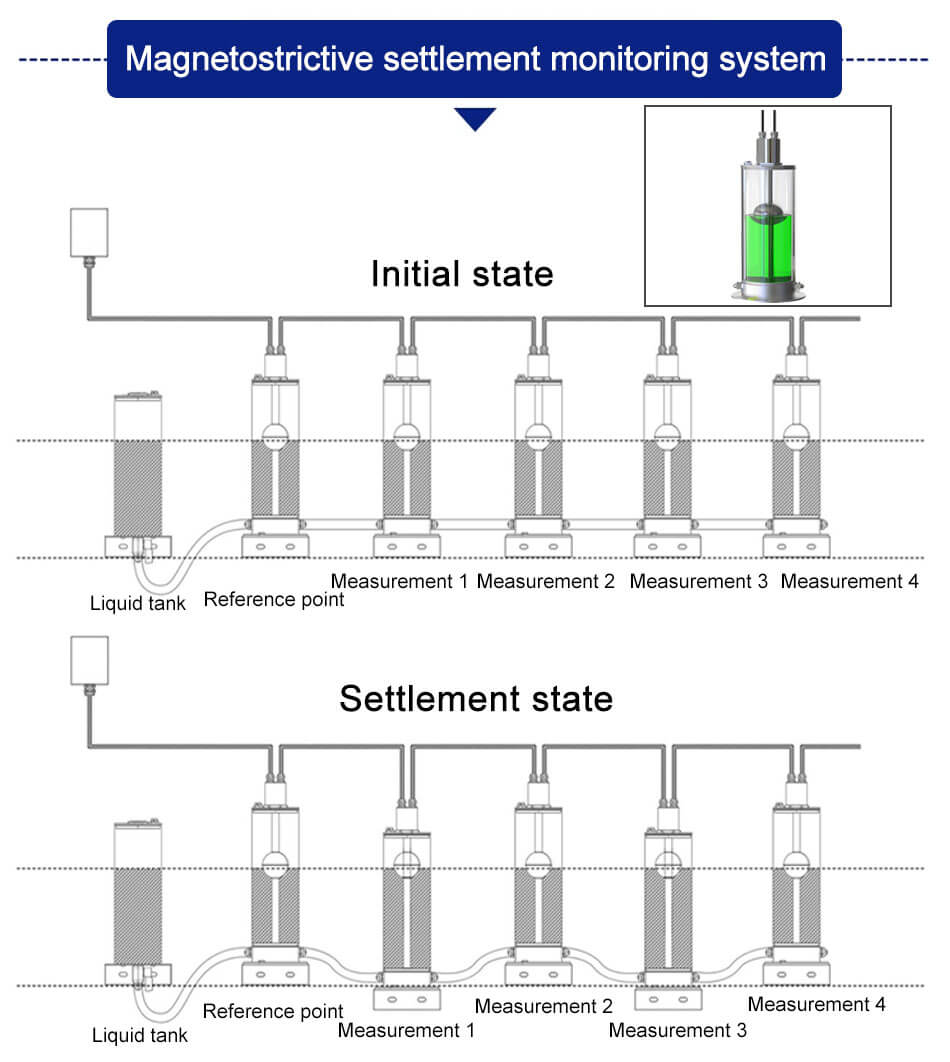
What should be paid attention to when installing a magnetostrictive hydrostatic settlement cell?
- Select a suitable installation position: The settlement cell should be installed on stable ground that is not easily disturbed by external forces to ensure the accuracy of the measurement results. The installation location should be a stable, flat site with good visibility, such as the surface of a stable building or structure, or a solid ground foundation.
- Install the bracket: When the settlement cell is installed against a wall, it must be mounted on a bracket to be used. The bracket installation should be firm and capable of withstanding horizontal loads.
- Adjust the levelness: Before fixing the settlement cell, its levelness needs to be adjusted. The installation frame is equipped with 3 sets of adjustment bolts to form a 3-point support for the instrument base plate, facilitating the leveling of the instrument during installation.
- Prevent electromagnetic interference: Since the liquid level changes are captured based on magnetic field variations, it is not recommended for use in places with strong magnetic fields, such as power plants or near large electrical equipment.
- Influence of ambient temperature: The float has a large volume; if the temperature changes significantly, the volume change of the air inside the float will cause buoyancy changes, leading to large errors. Therefore, it is recommended to conduct data comparisons under constant temperature. In places with large temperature differences between day and night, heat insulation and sun protection treatment must be applied. If the temperature is near or below zero, antifreeze must be provided and added after mixing with water.
- The installation position of the liquid storage tank should ensure that the internal liquid level of the settlement unit is slightly below the middle to achieve the maximum range.
- If the water pipe cannot be properly installed on the connector, you need to prepare boiling water to soak the connector for 10 seconds before connecting. When cutting the water pipe, the interface must be cut flush to avoid leakage.
- There should be enough liquid medium available in the container to avoid filling failure caused by insufficient liquid medium during the operation, which should meet at least 1 to 2 times the basic demand of (n+1)L based on the number of devices. After filling is completed, the bubbles in the pipe wall and liquid chamber must be discharged cleanly; otherwise, due to the temperature difference between day and night, the thermal expansion and contraction of the gas will significantly affect the measurement results.
- The cable connections between the two devices should be protected with corresponding waterproof measures according to the usage environment.
- For outdoor installation, to prevent wild animals from biting the pipes and cables, protective measures need to be taken for the pipes and cables.
- When installing monitoring points over a long distance, the height difference between the reference point and each monitoring point should be as small as possible, ideally less than 1/4 of the range.
- It is recommended that the length of a single connecting pipe be less than or equal to 300 meters. Excessively long pipelines will increase liquid resistance and prolong the liquid level stabilization time. Generally, a length of 3~15 meters is recommended to balance response speed and liquid level stability. Although a pipe that is too short has a faster response time, the liquid level stability will be slightly worse. When measuring over long distances, it is recommended to use multiple sets (reference point + monitoring points) to ensure data stability and response speed.
- There is a waterproof and breathable valve at the top of the device, which will cause the liquid filling speed to be slow. During actual installation, to speed up the filling process, it can be removed with a wrench and reinstalled after the liquid is filled.
How to choose the best settlement monitoring system?
Settlement is a slow process; over a short period, the changes reflected in the liquid level of the storage tank will be very subtle. Whether this minute change can be detected accurately and in real-time is the key to measuring the quality of a settlement monitoring system. This places extremely high requirements on the real-time performance and precision of the hydrostatic level sensors integrated into the system. Since it is an outdoor installation, the temperature coefficient, waterproof rating, and lightning protection of the hydrostatic level sensor are all critical technologies. In addition, the installation dimensions and ease of replacement of the settlement cells are also important technical indicators.
What is the calculation method for the settlement detection system?
Taking the settlement cell at Address 1 as the reference point, the displacement change of the monitoring point relative to the reference point is the settlement amount. The calculation method is as follows:
Change in the reference cell: Δh0 = initial value – real time value
Change in the measurement cell: Δhi = initial value – real time value
Settlement of the measurement cell relative to the reference cell: ΔH = Δhi – Δh0
When ΔH > 0, it indicates that the observation point has risen.
When ΔH = 0, it indicates that there is no change at the observation point.
When ΔH < 0, it indicates that the observation point has settled (decreased).
How is the settlement cell wired?
Brown wire connects to power positive (Wide voltage 10-30VDC), black wire connects to power negative, yellow wire connects to 485-A, and blue wire connects to 485-B.
Related Blogs
Table of Contents A pressure transducer is a device that measures the pressure of a gas or liquid and converts it into an electrical
Table of Contents Vibration monitoring is an effective method for assessing the condition of mechanical equipment and performing fault diagnosis. By installing vibration sensors
Table of Contents In our daily lives, air itself exerts pressure, known as atmospheric pressure. Living at the Earth’s surface, we have become accustomed
Table of Contents What is differential pressure? Differential pressure is the difference between the values of the pressures at different locations. For example, if
Table of Contents The commonly used communication method for data acquisition and control is RS-485. RS-485 is a general communication standard. It can not
Natural disasters such as floods and heavy rains pose threats to lives and property around the world. Without a proper flood monitoring system, these
Table of Contents What is a water level sensor? A water level sensor is a device designed to measure the height of a liquid,