

Table of Contents In our daily lives, air itself exerts pressure, known as atmospheric pressure. Living at the Earth’s surface, we have become accustomed
Differential Pressure Sensor
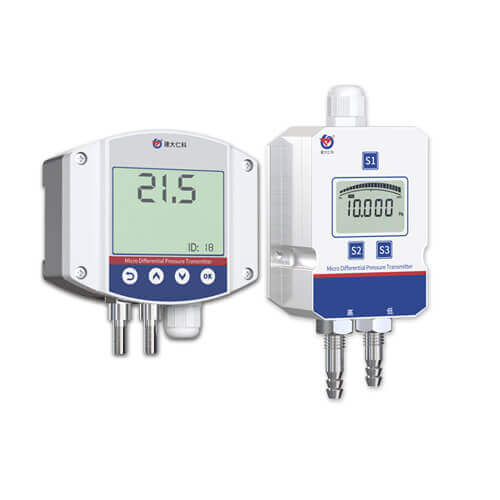
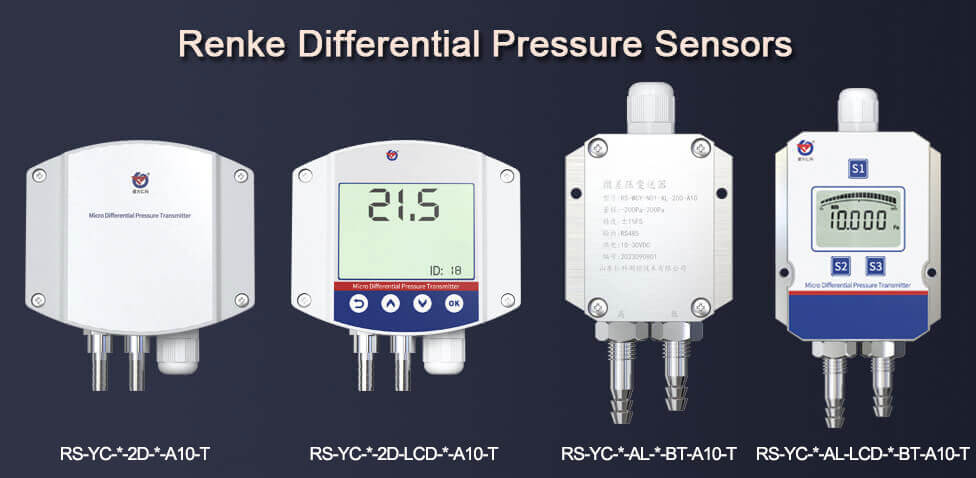
The RS-YC-*-2D-*-A10-T and RS-YC-*-AL-*-BT-A10-T differential pressure sensors are wall mounted models with a wide measuring range, optional from -10 kPa to 10 kPa, and are equipped with an LCD display. Our differential pressure sensor is designed with reverse polarity protection and instantaneous overcurrent and overvoltage protection, meeting EMI protection requirements. Widely used in pressure measurement in clean rooms, boilers, vacuum cleaners, air conditioners, etc.
- Model: RS-YC-*-2D-*-A10-T/RS-YC-*-AL-*-BT-A10-T
- MOQ: 1 PCS
- Delivery date: within 24 hours
- Price:$54.5
About - Differential Pressure Sensor
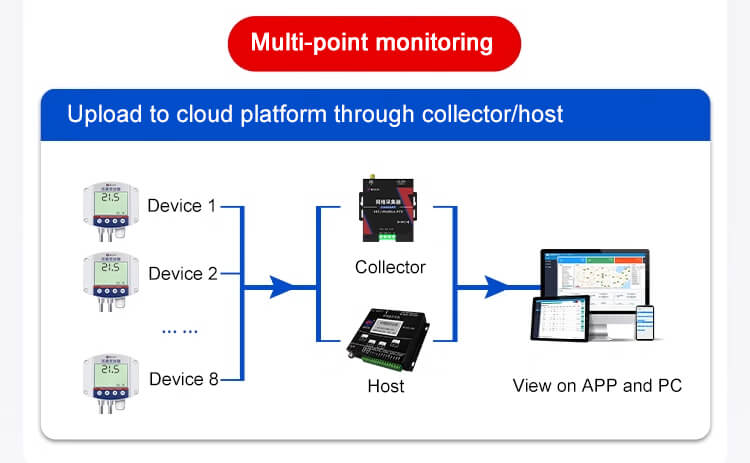
The RS-YC-*-2D-*-A10-T and RS-YC-*-AL-*-BT-A10-T differential pressure sensors have a built-in MEMS pressure sensor and a dedicated conditioning chip. It utilizes advanced pressure sensor technology and low-power, high precision digital processing technology to provide complete pressure calibration and temperature compensation. Our differential pressure sensors provide multiple output options including RS485, 0-5 V, 0-10 V, and 4-20 mA, allowing easy connection to on site PLCs, configuration software, configuration interfaces, and industrial controllers. With our matching network concentrator, the monitoring host uploads data to our free monitoring cloud platform, and you can view real-time data, historical data, alarm records, etc. via browser or cell phone APP.
Parameters
| Type | RS-YC-*-2D-*-A10-T | RS-YC-*-AL-*-BT-A10-T |
| Power supply | DC10~30V | DC10~30V |
| Power consumption | 0.1W (RS485), 0.3W (Analog) | 0.3W (RS485), 0.5W (Analog) |
| Signal output | RS485/4-20mA/0-5V/0-10V | RS485/4-20mA/0-5V/0-10V |
| Measuring range | -10kPa~10kPa | -10kPa~10kPa |
| Operating environment | -40℃~+60℃, 0%RH~95%RH (Non-condensing) | -40℃~+60℃, 0%RH~95%RH (Non-condensing) |
| LCD working temperature | -20℃~+60℃ | -20℃~+60℃ |
| Accuracy | ±1%FS | ±1%FS |
| Long-term stability | +0.2%FS | +0.2%FS |
| Compensation temperature | -5℃~65℃ | -5℃~65℃ |
| Pressure interface | Pyramid connector outer diameter φ6mm; Quick connector inner diameter φ8mm | Pagoda-shaped nozzle φ6mm |
| Shell material | ABS plastic | Aluminum alloy |
| Measuring medium | Gas compatible with contact material | Gases compatible with contact materials |
RS-YC-*-2D-*-A10-T
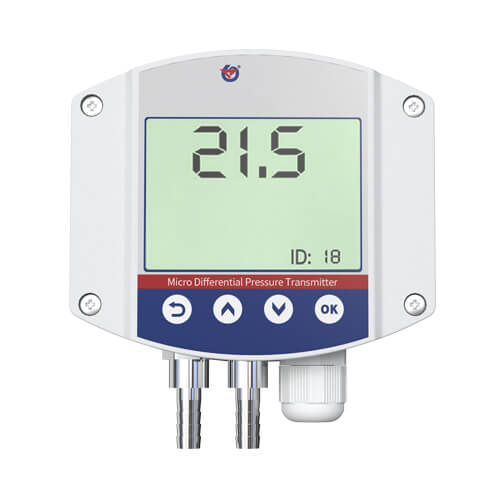
The RS-YC-*-2D-*-A10-T differential pressure sensor housing is made of high protection plastic material and is available in versions with or without a display. The display version is equipped with a high quality LCD screen and dust resistant buttons. It allows users to view real time data and manually set or modify parameters, making operation convenient and efficient. It features a built in automatic temperature compensation function, which reduces the influence of ambient temperature changes on measurement results and automatically corrects temperature drift. The bottom uses a high quality waterproof connector with strong locking performance, providing excellent waterproofing and aging resistance. It is widely used for the detection and control of air or inert gases.
RS-YC-*-AL-*-BT-A10-T
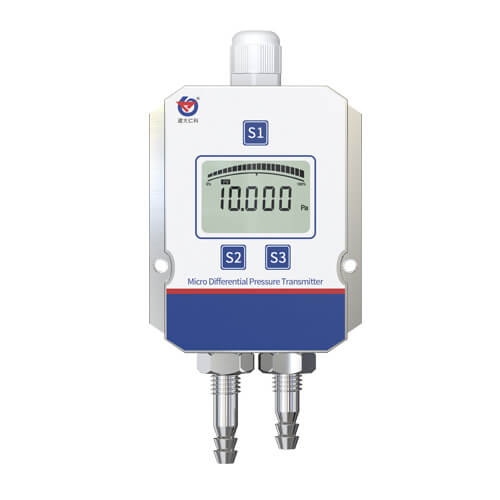
The RS-YC-*-AL-*-BT-A10-T differential pressure sensor features a die-cast aluminum alloy housing with a painted finish. It is precision assembled using stress isolation technology, offering strong anti-interference performance, resistance to acids and alkalis, and excellent long term stability. This model is available in both display and non-display versions. The pressure ports use φ6 mm barbed fittings, making installation simple and convenient. Compared with the RS-YC-*-AL-*-T, the aluminum housing differential pressure sensor is better suited for applications with higher environmental adaptability requirements, such as monitoring pressure differences at reactor inlets and outlets in chemical production, boiler air supply systems, and dust collection equipment. The aluminum housing effectively withstands mechanical impact and environmental corrosion, ensuring stable and reliable long-term operation.
Working principle
When a liquid or gas passes through the high and low pressure chambers, the force they exert on the two ends of the sensor creates a pressure difference. By measuring this pressure difference, we can learn about the flow of the fluid. Specifically, differential pressure sensors typically consist of two measuring membranes. As the fluid passes through the sensor, the force they exert on the two membranes causes the membranes to deform. The sensor will have some resistance or capacitance sensors installed inside the sensor to measure the deformation of the membranes. By calculating the change in resistance or capacitance, we can obtain the pressure exerted by the fluid on the sensor.
If you tell us the specific details such as the installation location, dimensions, etc., we will be happy to provide you with a detailed solution.
Renke technical team
FAQs - Differential Pressure Sensor
What is differential pressure?
Differential pressure refers to the difference in pressure between two points in the system. The expression is ΔP=P1-P2.
What is differential pressure sensor?
Differential pressure sensor is a device used to measure the pressure difference between two objects. Differential pressure sensor is a widely used sensor in industry and science.
What are some applications for differential pressure sensors?
Differential pressure sensors are widely used in textile workshop, boiler air supply, underground ventilation and other power, coal, spinning cotton box, dust removal equipment, industry pressure process control field.
What should you pay attention to when installing a differential pressure sensor?
Many factors need to be considered when installing a differential pressure sensor, such as protection class, supported fluid type and flow rate range, lateral temperature gradients and zero drift due to temperature changes. For optimum measurement results, install the transducer carefully following the guidelines provided by the manufacturer.
Why is the output signal unstable or fluctuating greatly?
The causes may be:
1. unstable supply voltage.
2. Improper choice of installation location and external interference.
3. There is air leakage or obstruction in the pressure line.
Solution:
1. Check whether the supply voltage is stable, if necessary, use a stabilized power supply.
2. Re-select the installation location to avoid external interference, such as vibration or electromagnetic interference.
3. Check whether there is air leakage or obstruction in the pressure pipe, repair or clean it in time.
Why do the results of differential pressure sensors have large errors?
The cause may be:
1. Improper selection of the installation location, resulting in the pressure sensor is subject to lateral force.
2. Temperature gradient or unevenness exists in the pressure line, causing sensor temperature error.
3. aging or damage to the sensor.
Solution:
1. Re-select the installation position to avoid the influence of lateral force on the pressure sensor.
2. Ensure that the temperature of the pressure pipeline is uniform, and take insulation measures to reduce the temperature error.
3. Regularly check and replace the aging or damaged sensors.
Why is temperature compensation not effective?
The cause may be:
1. The temperature sensor is faulty or not calibrated in time.
2. Ambient temperature fluctuates greatly, exceeding the temperature compensation range.
Solution:
1. Check whether the temperature sensor is working properly and calibrate it as required.
2. If the ambient temperature fluctuation is large and beyond the temperature compensation range, consider taking temperature isolation measures or using a pressure transmitter with a larger temperature range.
Related Blogs
Table of Contents What is differential pressure? Differential pressure is the difference between the values of the pressures at different locations. For example, if
Table of Contents The dew point depends on how much water vapor is present in the air. If the air is very dry with
Table of Contents What is a vibration sensor? Vibration sensor is a device that measure the vibration speed and frequency of mechanical motion and
Table of Contents With the development of technology, the Internet of Things (IoT) has become an indispensable part. It connects a variety of devices
Long-term rainfall and melting snow have raised water levels and flooded city roads, causing flooding. Frequent and extreme flooding is inevitable and endangers community
Table of Contents Water is the source of life, integral to every aspect of human production and daily living. In many scenarios, ensuring health
Table of Contents Have you or your friends ever experienced a burst pipe or indoor flooding? Even if you don’t live in a flood-prone