
Table of Contents Water leak detection is designed to detect and repair leaks in pipes, equipment or building structures in
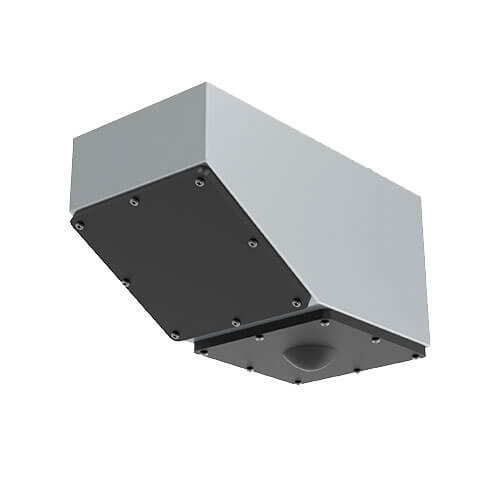
Radar Flow Meter
Renke radar flow meter adopts the radar measurement principle to monitor water flow velocity, water level height, water volume and flow rate. Without the need to excavate riverbeds or contact water, it avoids siltation and corrosion, ensuring measurement accuracy. It is mainly used in situations where flow and water level monitoring are required, such as in canals and rivers.
- Model: RS-RAD-N01-3-T
- MOQ: 1 PCS
- Delivery date: within 24 hours
- Price:$462
About - Radar Flow Meter
This radar flow meter can be used with our pole and host. It can detect water flow rate and water level. The flow meter uses radar technology to achieve simple and fast non-contact water surface flow rate measurement. The non-contact radar flow measurement system is not corroded by sewage and is not affected by sediment when measuring speed.
Working principle
Our radar flow meter uses a non-contact method to monitor water flow velocity and water level height. It collects the fluid surface velocity and calculates the average flow velocity of the cross-section through a model. Then, it calculates the cross-sectional area based on the water level measured by the water level gauge and the section information. The flow rate is obtained using the formula: Flow Rate = Average Velocity × Cross-sectional Area × Correction Coefficient, where the correction coefficient is calculated based on the standard value obtained from the actual measurement environment. After obtaining the flow rate data, the water volume over a certain period is equal to the flow rate multiplied by the duration of that period.

When radar waves strike the water surface at an inclined angle, a calm water surface reflects the electromagnetic waves away from the radar, resulting in a weak reflected signal received by the device. This phenomenon is not directly related to flow velocity. The key factor is whether the radar can receive sufficient reflected energy for measurement. When the water surface is completely still, the reflected energy is weak, which may lead to inaccurate measurements or failure to measure. When surface ripples are minimal, data stability may be affected. In contrast, water surfaces with fish scale like ripples provide excellent reflection characteristics and can effectively reflect radar signals.
Parameters
| Power supply | DC 10-30V |
| Max. power consumption | 1.3W |
| Component temperature and humidity resistance | -40℃~+80℃, 0%RH~95%RH (non-condensing) |
| Flow rate range | 0.1 ~20m/s |
| Flow rate accuracy | ±2% |
| Flow rate resolution | 0.01m/s |
| Water level range | 0.15 ~ 65m (maximum range when measuring water level only) |
| Range accuracy | ±1mm@(4m,40%RH,25℃) |
| Range resolution | 1mm |
| Usage height | 0~20m |
| Protect class | IP67 |
Installation
Under the same conditions, the higher the installation height, the weaker the echo and the worse the signal quality. Especially for scenes with low water flow velocity, the ripples are small and more difficult to measure. At the same time, the area of radar wave irradiation will be larger. It is possible that the beam will irradiate the bank of the channel and be interfered by moving targets on the bank. If it is installed too low, it will not be conducive to anti-theft protection, so the recommended height for pole installation is 3-4 meters.
Select the installation site
The selection of the measuring channel section is directly related to the accuracy of the data. To ensure the accuracy of the results, the following conditions should be met:
1. There are no huge rocks blocking the water in the test channel section, no large whirlpools, turbulence, etc.
2. The water flow in the test channel section is stable and concentrated.
3. The test channel section needs to be hardened and the measuring section should be regular.
4. The test channel section should be kept smooth to prevent the accumulation of floating objects.
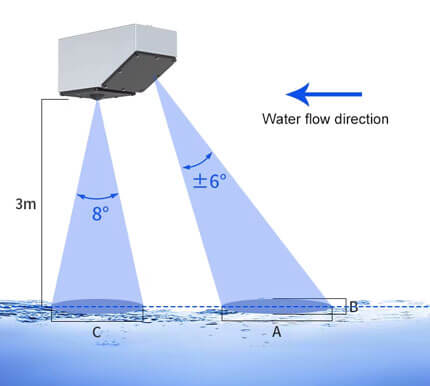
Install the radar flow meter in the middle of the channel or river or as close to the center as possible, with one side of the inclined surface facing the water flow direction.

Antenna beam range
The radar flow meter integrates a water level gauge and a velocity meter. The antenna beam angle for the water level gauge is 8°, while the radar velocity beam angle is ±6×±12°. When the water level gauge illuminates the water surface, the coverage area is approximately circular. When the velocity meter illuminates the water surface, the coverage area is approximately elliptical, as shown in the figure. Accurately understanding the illumination range of radar waves helps in selecting a suitable installation site and avoiding scenarios prone to interference, such as branches swaying in the wind along riverbanks or floating debris in the water.
Notes
- When installing the flow meter, the water level meter and the velocity meter radar must not be blocked, otherwise it will affect the measurement accuracy.
- When installing the flow meter, try to ensure that the upper surface of the shell is horizontal and installed in the middle of the channel.
- The radar flow meter beam is recommended to face the incoming water direction.
- The velocity meter is only affected by dynamic targets. When the channel is hardened and there are no weeds or trees, even if the beam is irradiated on both sides of the channel, it will not affect the measurement data.
FAQs - Radar Flow Meter
Radar flowmeter and ultrasonic flowmeter are two commonly used technologies in modern industrial flow measurement. There are some differences between these two flowmeters in terms of principle, application and accuracy.
Working principle: Radar flowmeter uses microwave technology to measure flow. Ultrasonic flowmeter uses the propagation speed of ultrasonic waves in the fluid to measure flow.
Application: Radar flowmeter is suitable for flow measurement of various liquids and gases, including high viscosity liquids, corrosive liquids and liquids containing suspended particles. Its non-contact measurement method enables it to adapt to harsh environments. Ultrasonic flowmeter is also suitable for flow measurement of a variety of fluids, including clean liquids, sewage and gas. It can adapt to different measurement requirements such as pipe diameter changes, fluid temperature and pressure changes by adjusting the frequency and emission angle of ultrasonic waves.
Accuracy: The measurement accuracy of radar flowmeter is usually high, reaching ±1%~2%. It is not affected by the physical and chemical properties of the fluid. The measurement accuracy of ultrasonic flowmeter is affected by many factors, such as fluid temperature, pressure, composition and flow state.
Wide voltage power input 10~30V is acceptable. When wiring the 485 signal line, pay attention that the A/B lines cannot be connected in reverse, and the addresses of multiple devices on the bus cannot conflict.
It is mainly used for non-contact flow measurement in open channels, rivers, irrigation areas, underground drainage networks, flood prevention and early warning, etc.
If the radar flow meter cannot receive a signal or the signal is weak, it may be due to antenna damage, poor connection or signal interference. At this time, you can check whether the antenna is intact, confirm whether the connection is tight, and try to change the installation position to avoid interference sources.
When the water surface is in a still state, the reflected energy is weak, which may lead to inaccurate measurement results or a failure to measure. Conversely, when the water surface exhibits disordered ripples or when ripples are not prominent, the stability of the data will be affected, further resulting in significant differences in the measured flow values.
Zero drift is a common problem of radar flow meter, which may be caused by temperature changes, mechanical wear or circuit aging. To solve this problem, the flowmeter needs to be calibrated regularly to ensure its accuracy. In addition, the impact of zero drift can be reduced by software compensation or hardware adjustment.
The large gap in the radar flow meter data may be due to bubbles, impurities or electromagnetic interference in the fluid. At this time, you can install a filter or take other measures to eliminate the interference. At the same time, you can improve data stability by optimizing the algorithm or increasing the sampling frequency.
Radar flow meter*1
Waterproof mating connector cable (5m)*1
Mounting bracket
Mounting screws
Warranty card and Certificate of conformity
Related Blogs
Table of Contents What is differential pressure? Differential pressure is the difference between the values of the pressures at different
Table of Contents The dew point depends on how much water vapor is present in the air. If the air
Table of Contents What is a vibration sensor? Vibration sensor is a device that measure the vibration speed and frequency
Long-term rainfall and melting snow have raised water levels and flooded city roads, causing flooding. Frequent and extreme flooding is
Natural disasters such as floods and heavy rains pose threats to lives and property around the world. Without a proper
Table of Contents Water is the source of life, integral to every aspect of human production and daily living. In
Table of Contents Have you or your friends ever experienced a burst pipe or indoor flooding? Even if you don’t