Table of Contents “IoT devices” is one of the most familiar terms in the tech world today. From the smartwatch on your wrist to
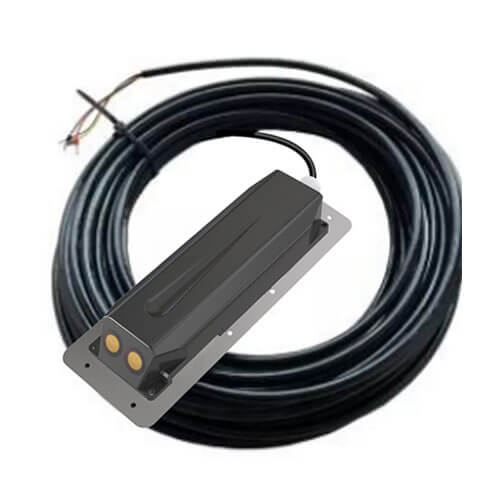
Doppler Flow Meter
This Doppler flow meter measures flow velocity by calculating changes in frequency, and can simultaneously measure water level and water temperature. Our high-precision Doppler flow meter offers excellent measurement performance, with a flow range of 0.03~5 m/s and accuracy is ±1.0% ±1 cm/s, making it suitable for a wide range of complex fluid environments.
- Model: RS-DOPL-N01-1/2-EX
- MOQ: 1 PCS
- Delivery date: within 24 hours
- Price: $231
About - Doppler Flow Meter
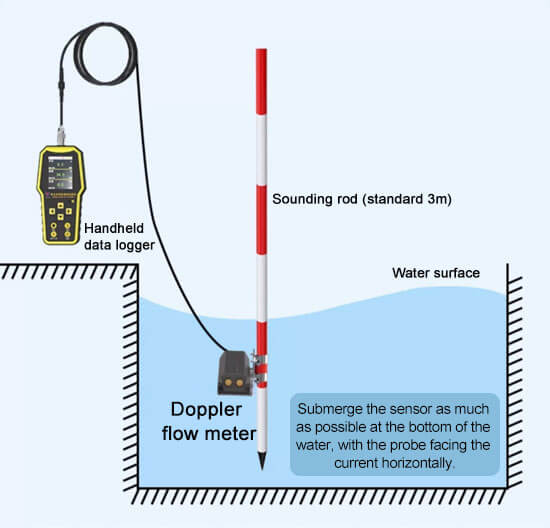
Our Doppler ultrasonic flow meter features an RS485 output, offers high accuracy, is lightweight, and can distinguish the direction of water flow. It is suitable for applications requiring fluid velocity measurement and is widely used for measurement and monitoring in open channels, rivers, and partially filled pipes. It can be used in conjunction with the handheld data logger provided by our company, making it convenient to take measurements at different locations.
Introduction
Our Doppler flow meter uses the ultrasonic Doppler principle to measure flow velocity and can simultaneously measure water level and water temperature. Its housing is made of ABS engineering plastic, which is sturdy, impact-resistant, and provides an effective waterproof seal. It operates when submerged at least 5 cm below the water surface. We offer two models for your selection: a unidirectional measurement model (range: 0.03-5 m/s) and a bidirectional measurement model (range: 0.03-10 m/s). The unidirectional model has a standby current of only 65 mA/12 V and a measurement current of 106 mA/12 V. The bidirectional model has a standby current of 72 mA/12 V and a measurement current of 126 mA/12 V. Bidirectional measurement distinguishes the direction of water flow and calculates positive cumulative flow, negative cumulative flow, and net flow. Our Doppler flow meter has an IP68 protection rating. With its compact and lightweight design, it is suitable for narrow installation spaces and enables flexible and efficient monitoring and control.
Features
- Features high-quality gas-conducting cables that can remain submerged in water year-round. The multi-layered protective design provides a high level of protection.
- Fully electronic design with a wide voltage input range, low power consumption, and no mechanical parts. Offers the advantages of accurate measurement, high stability, and strong resistance to interference.
- Can distinguish the direction of water flow and separately calculate positive cumulative flow, negative cumulative flow, and net flow.
Parameters
| Types | Unidirectional measurement | Bidirectional measurement |
|---|---|---|
| Power supply | DC10~30V | DC10~30V |
| Power consumption | Standby current 65mA/12V, Measurement current 106mA/12V | Standby current 72mA/12V, Measurement current 126mA/12V |
| Flow rate range | 0.03~5m/s | 0.03~10m/s |
| Flow rate accuracy | ±1.0%±1cm/s | ±1.0%±1cm/s (@0.03~5m/s) |
| Water level range | 0.03~5m | 0.03~5m |
| Water level accuracy | 0.3%±0.5cm | 0.3%±0.5cm |
| Temperature range | -10℃~60℃ | -10℃~60℃ |
| Temperature accuracy | ±1℃ | ±1℃ |
| Instantaneous flow range | 0~99.99m³ | 0~99.99m³ |
| Cumulative flow range | 0.1-999999m³ | 0.1-999999m³ |
| Measurement interval | Default 3s (Adjustable) | Default 3s (Adjustable, minimum is no less than 2s). |
| Signal output | RS485 | RS485 |
| Operating temperature | -10℃-60℃ | -10℃-60℃ |
| Protection rating | IP68 | IP68 |
FAQs - Doppler Flow Meter
How does the Renkeer Doppler flow meter work?
When the ultrasonic source and the observer are moving relative to each other, the frequency received by the observer differs from that of the ultrasonic source. Therefore, small particles and air bubbles moving with the water relative to the ultrasonic transducer will also cause a change in the frequency received by the transducer, and this change increases as the velocity of the suspended particles in the water increases. By measuring this Doppler shift, the flow velocity at the point where the Doppler flowmeter is located is determined. Multiplying this by the cross-sectional area of the channel yields the flow rate.
Since Doppler flow velocity measurement relies on the speed of sound in water, and the speed of sound in water is closely related to water temperature, a temperature sensor is built into the Doppler flowmeter to measure temperature and correct for the speed of sound.
Water depth is measured using a pressure-based method to determine the distance between the Doppler flowmeter’s location and the water surface. The device includes pre-programmed cross-sectional models for trapezoidal, rectangular, circular, and U-shaped channels, enabling the calculation of flow rates for common channel types.
Where is this Doppler ultrasonic flow meter used?
It is primarily used in open irrigation channels, municipal sewer pipes, and hydrological basins. It is particularly suitable for monitoring low water levels; the water level should ideally be at least 20 centimeters, with the sensor submerged by at least 5 centimeters. In standard pipes and channels, water depth is measured using a pressure Doppler flowmeter, while flow velocity is measured using an ultrasonic Doppler flowmeter, and flow rate is calculated from these measurements.
How do I wire this Doppler flowmeter?
Power Cables:
Connect the red wire to the positive terminal (10-30 V+)
Connect the black wire to the negative terminal (10-30 V-)
Signal wires:
Connect the yellow wire to RS485A.
Connect the blue wire to RS485B.
The red air tube must remain unobstructed and in open communication with the atmosphere. Take care to protect it during installation; in particular, secure it with tape when threading it through conduits to prevent water ingress. The red air tube must not be kinked, and the bending angle must not exceed 90° when threading it through conduits.
What should be considered when installing a Doppler flow meter?
- The water surface at the installation site must be 20 cm higher than the top of the Doppler flow meter to ensure accurate flow velocity measurements. If the flowmeter is too close to the water surface, the measured flow velocity will deviate significantly from the actual value. If there are sediments such as silt or gravel on the riverbed, the flowmeter should be raised by at least 5 cm (depending on the site conditions).
- Consider the turbidity of the river water. If the water is relatively turbid and the current is slow, it is recommended to use the Doppler flowmeter in combination with a non-contact level sensor to prevent clogging of the pressure transmitter.
- Consider the drag caused by the mounting bracket. It is recommended to use round tubing for the bracket to minimize drag.
- The cable cannot withstand the impact of water flow; prolonged exposure to such impacts can cause damage or breakage. The cable should be routed inside the mounting bracket to avoid direct impact from the water flow.
- Consider whether there are branches, weeds, or rocks at the site. If debris is present, it is best to install a protective barrier at least 5 meters in front of the flow meter.
- Ensure there are no obstacles within 3.0 meters directly in front of the Doppler flowmeter or within 1.0 meter directly behind it. Install the device in the center of the channel whenever possible, but take the support structure’s load-bearing capacity into account.
- If the device is not capable of bidirectional measurement, install it facing directly toward the direction of water flow.
If a rectangular channel is 2 meters wide, how many meters of straight channel are needed upstream and downstream when installing a Doppler current meter?
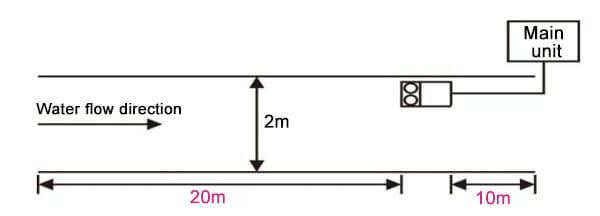
In a standard channel, there should be 20 meters of straight channel upstream and 10 meters downstream.
A trapezoidal channel has an upper base width of 5 meters, a lower base width of 2 meters, and a height of 2 meters. How should the channel’s width be calculated?
The width of the channel should be based on the width at the highest flood stage. If the flood stage exceeds the highest point of the trapezoidal channel, then the width of the upper base of the trapezoidal channel should be used as the standard. If the width at the highest flood stage is 4 meters, there must be a 40-meter-long straight channel upstream of the installation site and a 20-meter-long straight channel downstream.
How should a Doppler flow meter be installed downstream of a gate or pump?
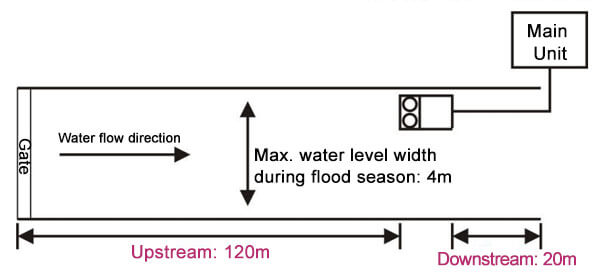
If installed downstream of a gate, pay special attention to the water surface to ensure it is stable.
If the Doppler flowmeter is installed at a distance from the gate equal to 30 times the channel width, but the water surface remains unstable, increase the distance between the device and the gate until the flow stabilizes. There is no limit to this distance; it could be 60 times the channel width, 80 times the channel width, or more, until the flow stabilizes.
How is a Doppler flow meter installed in a circular pipe?
When installing inside a pipe, ensure that the lowest water level is at least 20 centimeters above the flowmeter. If the pipe’s inner diameter is small, the distance from the water surface may be less than 20 centimeters, but it must be at least 5 centimeters below the water surface. Measurements can be taken when the pipe’s inner diameter is greater than 400 millimeters. Full-pipe flow is not required; measurements can also be taken under non-full-pipe conditions. Select a location with steady water flow for installation. There should be a straight pipe section upstream of the installation site equal to 10 times the pipe’s inner diameter, and a straight pipe section downstream equal to 5 times the pipe’s inner diameter. Choose a location with steady water flow; in areas with turbulent flow, measurements will be unstable and errors will be significant.
Related Blogs
Table of Contents A pressure transducer is a device that measures the pressure of a gas or liquid and converts it into an electrical
Table of Contents In our daily lives, air itself exerts pressure, known as atmospheric pressure. Living at the Earth’s surface, we have become accustomed
Table of Contents In the fields of electrical engineering and electronics, we frequently encounter various analog signals such as voltage and current. In nature,
Table of Contents What is Hydrology? Hydrology refers to the various phenomena of water changes and movement in nature. It studies the formation, circulation,
Table of Contents What is differential pressure? Differential pressure is the difference between the values of the pressures at different locations. For example, if
Long-term rainfall and melting snow have raised water levels and flooded city roads, causing flooding. Frequent and extreme flooding is inevitable and endangers community
Table of Contents The commonly used communication method for data acquisition and control is RS-485. RS-485 is a general communication standard. It can not
Natural disasters such as floods and heavy rains pose threats to lives and property around the world. Without a proper flood monitoring system, these