
Table of Contents Since the dawn of industrial development, the emission of various toxic gases and solid waste has continuously polluted our air, soil, and

Sound Sensor
The RS-ZS-BZ-*-T onboard sound sensor is primarily used for real-time noise measurement in various environments such as industrial sites, transportation, factories, construction projects, and public spaces. With this noise level meter, customers no longer need to worry about processing complex sound signals. Instead, they can focus on their areas of expertise and create value more efficiently.
- Model: RS-ZS-BZ-*-T
- MOQ: 1 PCS
- Delivery date: within 24 hours
- Price: $20
About - RS-ZS-BZ-*-T Sound Sensor
This sound sensor features a high-performance pre-polarized back electret condenser microphone, equipped with a filter foam for enhanced noise reduction. It adopts a standard 2.54 mm pin header and an independently packaged design, making it easy to embed into other devices or enclosures. The sensor utilizes a modular split-structure design, providing excellent ventilation, easy dust removal, and high measurement accuracy for more precise detection. The cable length between the probe and the PCB can be customized based on application requirements. Multiple output interfaces are reserved, including UART (TTL), I2C, RS-485, and analog output options, ensuring flexible integration into a wide range of applications.
Parameters
| Working voltage | 4.5~5.5V (default), 10~28V (optional) | |
|---|---|---|
| Power consumption | 18.9mA@5V, 31.0mA@12V, 27.8mA@24V | |
| Circuit working environment | -20℃~+60℃, 0%RH~95%RH (non-condensing) | |
| Output signal | UART (TTL) | Output voltage: 0~3.3V Input voltage: 0~3.3V compatible with 5V |
| RS-485 | ModBus-RTU communication protocol | |
| 0~3V | 0~3V corresponds to 30~120dB | |
| IIC | I/O input high level voltage: 0~1V I/O input low level voltage: 2.3~3.3V I/O output high level voltage: 2.9~3.3V I/O output low level voltage: 0~0.4V |
|
| UART or RS-485 communication | 9600 N 8 1 | |
| Measure range | 30dB~130dB(0~3V is 30dB~120dB) | |
| Frequency weighting | A weighting | |
| Frequency response range | 20Hz~12.5kHz | |
| Response time | Fast mode | 500ms |
| Slow mode | 1.5s | |
| Stability | Less than 2% during the use period | |
| Reference calibration point | 94dB calibration, reference sound pressure level 20uPa, frequency 1kHz | |
| Accuracy | ±0.5dB (at reference pitch, 94dB@1kHz) | |
| Dust cover effect | In the range of 50~115dB, the effect is ≤0.5dB. In the other ranges within the range, the effect is ≤0.7dB. | |
| Working environment | Air temperature: -20~+60℃, static pressure: 65kPa~106kPa. There is no strong mechanical vibration, impact, strong electromagnetic field and corrosive gas around. | |
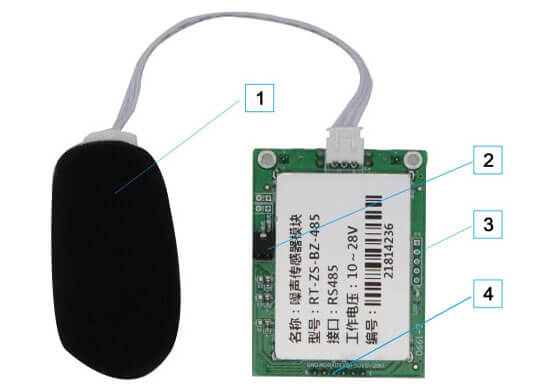
Features and Details
- It has two modes, slow and fast measurement, to meet the requirements of different customers.
- PCB onboard installation, 30~130dBA wide range, 20~12.5kHz wide frequency measurement.
- Adopt high-performance prepolarized back-electret condenser microphone, wide dynamic range and stable performance.
- Power supply 4.5V~5.5VDC, 10~28VDC optional, output connection TTL or RS-485 optional at the factory.
- Built-in 25kΩ~50kΩ weak pull-up resistor (typical value 40kΩ).
| No. | Name | Description | |
|---|---|---|---|
| 1 | Sound probe | Contains electret microphone, plastic sheath, dustproof cotton. | |
| 2 | Mode selection terminal | If the jumper cap is short-circuited, it is fast mode, and the noise update time is 500ms; if it is not short-circuited, it is slow mode, and the noise update time is 1.5s. | |
| 3 | Running indicator light | Running indicator light, flashes once every 1s. | |
| 4 | Pin number | Name | Description |
| 1 | 10-28V | 10-28V power input (for 10~28V power supply) | |
| 2 | +5V | 5V power input (for 4.5~5.5V power supply) | |
| 3 | TXD/A | RS485: Serial data transmission (output voltage 0~3.3V), 485-A line IIC: SCLK |
|
| 4 | RXD/B | RS485: Serial data reception (input voltage 0~3.3V, 5V input tolerance), 485-B line IIC: DATA |
|
| 5 | AO | Reserved | |
| 6 | GND | Negative pole of power supply | |
Working Principle - Renke Sound Sensor
In addition to the RS-ZS-BZ-*-T sound sensor, we also offer the wall-mounted sound sensor, outdoor sound sensor and long-pole sound sensor. When our sound sensors detect noise, the filtering method they use is A-weighted.
What is A-weighting? Sound waves have two characteristics: frequency and sound pressure. Frequency reflects the sharpness of sound and is measured in Hz. Sound pressure level indicates the loudness of sound and is measured in dB. Taking the I2C sound sensor as an example, it can detect noise in the frequency range of 20Hz to 12.5kHz, with a sound pressure level range of 30dB to 130dB. A-weighting is the process of filtering sound frequencies, the frequency range of the A-weighting filter spans from 20Hz to 20kHz. At present, A-weighting is widely used in environmental noise measurement and is a standard feature in many sound level meters. The A-weighting system can be used for measuring all types of environmental noise, such as traffic, railway, and aircraft.
Our ears have varying sensitivity to different sound frequencies, being most sensitive to mid-range frequencies around 500Hz to 6kHz, while less sensitive to low and high frequencies. To simulate the human ear’s sensitivity across frequencies, sound level sensor is equipped with a frequency weighting network that adjusts the electrical signal to match human auditory perception. This process is known as frequency weighting. It emulates the human ear’s response to different frequencies and applies corresponding weighting to the sound signals. A-weighting significantly attenuates low-frequency sounds (below 50Hz) and high-frequency sounds, while maintaining relative stability in the mid-frequency range, closely matching the human hearing response.
FAQs - Sound Sensor
What is the difference between TTL, RS485 and I2C?
TTL refers to Transistor-Transistor Logic circuits. In TTL signals, logic level 0 corresponds to 0V, and logic level 1 corresponds to either 3.3V or 5V. In communication and serial devices, TTL denotes a voltage level standard used for data transmission. When performing serial communication, signals output directly from microcontrollers are typically at TTL level.
RS485 is a serial communication interface standard. To enable long-distance transmission, it adopts a differential signal method. Our RS485 sound sensor output RS485 signals via a TTL-to-RS485 converter chip. Compared to TTL, RS485 in our sound sensor includes an additional conversion circuit. TTL supports full-duplex communication but has poor anti-interference capability and is not suitable for long-distance transmission. In contrast, RS485 supports half-duplex communication in a query-response mode and offers stronger noise immunity, making it ideal for long-distance applications.
IIC (Inter-Integrated Circuit) is a serial communication protocol used for data exchange between electronic devices. The IIC bus consists of two lines: Serial Data Line (SDA) and Serial Clock Line (SCL). All devices connected to the IIC bus share these two lines for data transmission and synchronization. Both SDA and SCL are bidirectional lines connected to a positive power supply through current sources or pull-up resistors. When the bus is idle, both lines remain at a high logic level.
What is the difference between A-weighting, C-weighting, and Z-weighting?
A-weighting simulates the human ear’s response to sound by significantly attenuating low and mid-frequency electrical signals. Measurements using A-weighting are typically denoted as dB(A).
C-weighting is designed to reflect the frequency characteristics of high-intensity noise, simulating the human ear’s response to high sound pressure levels. It applies less attenuation to low frequencies and offers a relatively flat response across the full frequency spectrum, providing a more uniform treatment of audible frequencies without emphasizing or suppressing lows or highs.
Z-weighting, also known as zero-weighting, provides a flat frequency response over the 20Hz to 20kHz range. It applies no frequency weighting, meaning all frequencies are treated equally during measurement.
B-weighting and D-weighting are now obsolete and no longer in use.
What is the standard for a secondary sound level meter?
- Frequency Range: The typical required frequency range is 20Hz to 12.5kHz.
- Measurement Range: Using the commonly adopted A-weighting as an example, the measurement range generally spans from 30dBA to 130dBA.
- Frequency Weighting: A-weighting is required; some devices also support C-weighting and Z-weighting.
- Time Weighting: Usually includes F (Fast) and S (Slow); some models may also offer I (Impulse).
- Measurement Accuracy: The measurement error is generally required to be within a certain range, typically within ±0.5dB.
- Self-Noise: Under A-weighting, self-noise is typically ≤25dB; under C-weighting ≤30dB; under Z-weighting ≤35dB.
- Directivity: The device must meet specific free-field response requirements in the reference incident direction, and deviations in measurements under different angles of incidence must remain within the specified limits.
- Environmental Requirements: Normal operating conditions include an ambient temperature range of 0℃ to 40℃, relative humidity from 25% to 90%, and atmospheric pressure from 65kPa to 108kPa.
- Calibration Point: The sound level meter is calibrated using a standard sound pressure level of 94dB or 114dB.
What is the electret of the sound sensor?
An electret refers to a dielectric material that possesses a permanent electric dipole moment or is capable of storing electric charge over a long period, similar to how a permanent magnet retains magnetism. It converts sound signals into electrical signals by utilizing changes in surface charge on the material. When sound waves strike the diaphragm of an electret microphone, the distance between the diaphragm and the electret changes, causing a variation in capacitance. This change alters the charge distribution and generates an electrical signal corresponding to the sound input.
What is sound pressure?
Sound pressure is the variation in atmospheric pressure caused by the disturbance of sound waves; it represents the pressure change induced by sound. The sound pressure level refers to the sound pressure exerted on a unit area.
Sound pressure sensitivity, also known as sound pressure response, is defined as the ratio of the open-circuit voltage at the output of the receiving transducer to the actual sound pressure on the receiving surface.
What is a free field?
A free field is an acoustic environment where only direct sound is present, with no reflected sound.
What are the noise calibration points?
The sound sensor generally use 94dB or 114dB as noise calibration reference points.
94dB corresponds to the sound pressure level of many common noise sources. The International Organization for Standardization (ISO) recommends 94dB as the standard reference value for sound sources in ISO 3744. Selecting 94dB as the calibration sound pressure level allows the calibrator to cover the measurement range of most sound sensors. The sound emitted by the calibrator at one standard atmosphere pressure in normal temperature air, measured at a distance of 1 meter from the source, is 94dB.
The 114dB calibration signal represents a higher sound pressure level, suitable for more precise measurements. The 114dB calibration is often used in field applications, such as environmental noise monitoring, meeting general industrial and scientific research requirements. Standard sound sources are typically defined as sound emitters with fixed sound pressure levels. Common standard sound sources on the market include 94dB@1kHz and 114dB@1kHz calibrators. The 1kHz frequency is a crucial calibration point.
How to define noise?
Sound is generated by the vibration of objects, producing sound waves that propagate through a medium (such as air, solids, or liquids) and can be perceived by the auditory organs of humans or animals. The object initially producing the vibration is called the sound source. Sound propagates as waves-mechanical vibrations transmitted through any medium. Sound waves with frequencies between 20Hz and 20,000Hz are audible to the human ear. Any sound that interferes with people’s rest, study, or work is generally referred to as noise.
What are the applications of the sound sensor?
Environmental Protection
By monitoring noise levels, appropriate environmental protection measures can be developed to reduce negative impacts on plants, animals, and humans. Relevant scenarios include botanical gardens, forests, wildlife reserves, and environmental protection agencies.
Occupational Safety
Excessive noise in the workplace can adversely affect employees’ health and productivity. Real-time noise monitoring ensures that workplace noise levels comply with national standards, safeguarding employee occupational safety. Relevant scenarios include kindergartens, schools, and factories.
Quality of Life
Noise from traffic, construction, and other sources near residential areas can severely impact residents’ quality of life. Noise detection enables timely interventions to reduce noise pollution and improve the living environment. Relevant scenarios include residential communities, apartments, construction sites, and highways.
Scientific Research
In fields such as biology, physics, and acoustics, noise monitoring provides critical data support for research activities. Relevant scenarios include laboratories, universities, and research institutes.
How does a sound sensor work?
Sound Level Meter Method: This method evaluates the environmental impact of a sound source by measuring the intensity of the emitted sound. It is the most commonly used approach, suitable for various environments and scenarios. All noise sensors produced by our company operate based on the sound level meter principle.
Spectrum Analysis Method: This approach enables a more detailed analysis of the frequency components and distribution of sound, allowing for a more precise assessment of its environmental impact.
Related Blogs
Table of Contents The Internet of Things (IoT) is one of the hottest technology words in the past few years, which can collect, share, analyze
Table of Contents The commonly used communication method for data acquisition and control is RS-485. RS-485 is a general communication standard. It can not only
The main purpose of environmental monitoring is to provide data on environmental quality and changing trends to ensure the safety of public life and property.
The weather sensors are the sensing end of the weather station and collect various weather-related data. The weather station can obtain the main parameters and
Table of Contents The key to the smart industry lies in the collection of data and information. Sensors are the nerve endings of the smart
In the current society, noise pollution has become the third-largest source of pollution after air and water pollution. To ensure normal rest and sleep, the