
In our daily lives, air itself exerts pressure, known as atmospheric pressure. Living at the Earth’s surface, we have become accustomed to this pressure and often do not perceive its presence. This invisible and intangible physical quantity, however, is ubiquitous in both our daily life and industrial activities. From inflating tires to deep-sea exploration, the accuracy of pressure measurement is critical. Different applications have varying requirements regarding whether atmospheric pressure is included, which has led to the development of three industrial pressure measurement conventions: gauge pressure, absolute pressure, and vacuum pressure.
Many people assume that pressure is simply a force evenly distributed over a given area. In reality, pressure comes in different types, and there are numerous ways to measure it. All these measurement methods are fundamentally based on differential pressure, meaning they are defined by the difference between a starting point and an endpoint.
For the past 15 years, Renke has focused on developing and manufacturing high-quality pressure sensors and temperature and humidity sensors. As a senior product manager at Renke, I have been responsible for addressing related questions throughout this period. In this article, I will guide you through a detailed understanding of the relationships among gauge pressure, absolute pressure, and vacuum pressure.
Pressure Type Definitions
To clearly understand the types of pressure, it comes down to determining where we set the reference point.
1. Gauge pressure: pressure that uses atmospheric pressure as its zero reference
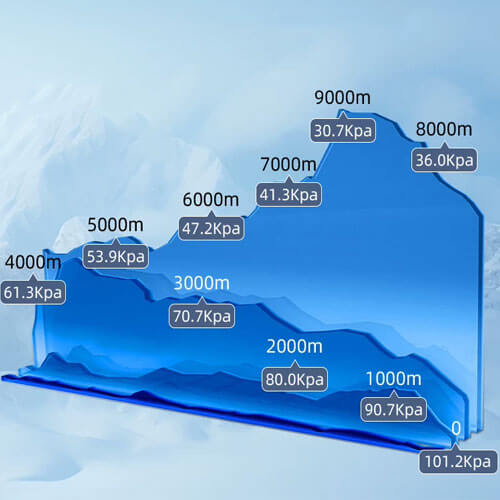
Gauge pressure is the pressure measured relative to atmospheric pressure. It uses the Earth’s natural atmospheric pressure as the zero reference, and this atmospheric pressure varies with time and location. When the atmospheric pressure at the measurement site changes, the starting point or zero point of gauge pressure also changes. For example, atmospheric pressure is lower at higher altitudes and higher at lower altitudes.
Therefore, fluctuations in atmospheric pressure directly affect gauge pressure, and gauge readings vary with altitude changes and weather related pressure shifts. Gauge pressure can be positive or negative. Pressure higher than atmospheric pressure is positive, while pressure lower than atmospheric pressure is negative, which is also known as vacuum level. Since industrial equipment and measurement instruments generally operate under atmospheric pressure, gauge pressure is the most commonly used form of pressure in industrial applications.
Gauge pressure allows engineers to make intuitive judgments. Whether a boiler is overpressurized, whether a tire is adequately inflated, whether pipeline pressure meets requirements, whether the discharge pressure of a pump is stable, and many similar decisions do not require knowing the absolute pressure. All that matters is whether the pressure is higher or lower than atmospheric pressure. For this reason, gauge pressure has become the most widely used pressure form in the industrial field.
2. Absolute pressure: pressure that uses a vacuum as its zero reference
Absolute pressure is the pressure measured relative to a theoretical absolute vacuum. If all gas in a space were completely removed to create a perfect vacuum, that would represent the zero point of absolute pressure. However, a perfect vacuum is impossible to achieve even in outer space. A zero absolute pressure, or absolute vacuum, exists only as an idealized physical concept that cannot be fully realized in nature or in practical engineering, and can only be approached asymptotically.
Absolute pressure forms the basis of many physical calculations. For example, in gas state equations, the behavior of gas molecules is directly linked to the actual pressure they experience, which makes absolute pressure essential. In semiconductor manufacturing, gas density calculations, scientific experiments, and similar fields, absolute pressure provides the most physically meaningful description of pressure. Common units include Pa, kPa, bar, mbar, psi, and Torr, all of which can be directly used to represent absolute pressure.
3. Vacuum pressure: pressure that is lower than normal atmospheric pressure
When pressure falls below atmospheric pressure, it enters the range of vacuum pressure. Vacuum pressure is still referenced to atmospheric pressure, only in the downward direction, which makes it a form of negative pressure. There are two ways to express vacuum pressure. One is the negative pressure commonly used in engineering, such as -0.06 MPa, meaning the chamber is 0.06 MPa lower than atmospheric pressure; this is a form of gauge vacuum pressure. The other is absolute vacuum level, such as 25 kPa abs, meaning the pressure is only 25 kPa above absolute vacuum.
The Relationship Among Gauge Pressure, Absolute Pressure, and Vacuum Pressure
The relationship among gauge pressure, absolute pressure, and vacuum pressure is very clear. They are not independent concepts but are closely connected. The relationships are as follows:
Absolute Pressure = Atmospheric Pressure + Gauge Pressure
Absolute pressure equals the sum of atmospheric pressure and gauge pressure. For example, if the gauge pressure is 50 kPa and the atmospheric pressure is 100 kPa, the absolute pressure is 150 kPa.
Vacuum Pressure = Atmospheric Pressure – Absolute Pressure
Vacuum pressure equals atmospheric pressure minus absolute pressure. For instance, if the absolute pressure is 30 kPa and the atmospheric pressure is 100 kPa, the vacuum pressure is 70 kPa.
Gauge Pressure = -Vacuum Pressure
Vacuum level can be considered the negative value of gauge pressure. For example, when the vacuum level is 40 kPa, the gauge pressure is -40 kPa, indicating that the system pressure is 40 kPa below atmospheric pressure.
If the gauge pressure is positive, it indicates pressure above atmospheric pressure. If the gauge pressure is negative, it indicates the system is in a vacuum state. Once this principle is understood, any pressure conversion can be easily performed.
Why Is It Necessary to Distinguish Among Them?
Distinguishing absolute pressure, gauge pressure, and vacuum pressure is essential because they represent three different reference systems that serve different engineering purposes.
- Absolute pressure is used to reveal physical fundamentals
- Gauge pressure is used to express the effective force in engineering
- Vacuum pressure is used to describe the degree of underpressure in low pressure systems
Pressure is not a single number but a physical quantity that must have a clearly defined reference. If these are confused, it can lead to calculation errors, overpressurized equipment, misinterpreted instrument readings, and even safety incidents.
1. Different applications
Gauge pressure uses local atmospheric pressure as the zero reference and directly reflects the pressure of the equipment relative to its surroundings. For example, the pressure shown on factory pressure gauges is usually gauge pressure, which is used to monitor whether equipment is operating properly, such as the pressure in a steam pipeline.
Absolute pressure uses a complete vacuum as the zero reference and represents the true physical value of pressure, independent of changes in atmospheric conditions. Absolute pressure is required in thermodynamic calculations, such as steam state analysis, because it directly affects energy transfer and efficiency calculations.
Vacuum pressure is used to describe conditions below atmospheric pressure. For example, the performance of condensers or vacuum pumps is defined by the difference between atmospheric pressure and absolute pressure.
2. Ensuring mechanical safety
In negative pressure systems such as boiler draft systems or vacuum packaging, negative pressure prevents flue gas leakage and maintains product sealing. If a negative gauge pressure value is mistakenly treated as a vacuum pressure value, the actual vacuum strength may be underestimated, creating safety risks. Excessive back pressure can also reduce turbine efficiency, and its measurement depends on using the correct pressure definition. Misidentifying these pressure types may lead to equipment overload or unnecessary energy consumption.
3. Choosing the right measuring instrument
Different applications may require different types of pressure measurements, which makes accurate conversion and calculation essential. Each pressure type has a different zero reference point. Absolute pressure gauges use a vacuum as the zero reference, gauge pressure instruments use atmospheric pressure as the zero reference, and vacuum gauges reference atmospheric pressure as well. Distinguishing these pressure types ensures that the correct measuring instrument is selected.
4. Compliance with safety standards
Pressure vessel and pipeline codes clearly specify whether the design pressure is gauge pressure or absolute pressure. Confusing the two may result in designs that do not meet standard requirements, causing issues during inspection or safety audits and potentially leading to legal liability. In vacuum or low-pressure processes, using gauge pressure instead of vacuum pressure to describe the pressurized state can result in nonstandard operation and increased safety risks.
What Instruments Are Used to Measure Pressure?
1. Mechanical pressure gauge
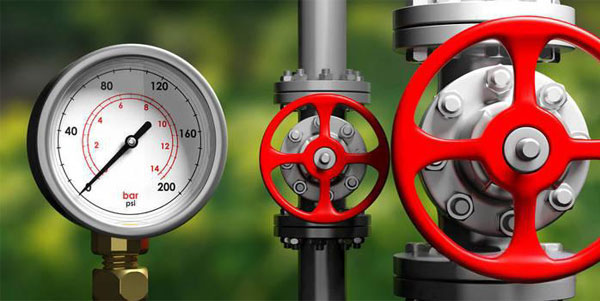
Mechanical pressure gauges are the most traditional and common pressure measurement devices. They directly convert pressure changes into pointer movement through a mechanical structure. For example, Bourdon tube pressure gauges use the slight bending of a metal tube under pressure, which moves the pointer via a lever and gear mechanism. Capsule pressure gauges use diaphragm deformation under pressure to drive the pointer, allowing measurement of low or pulsating pressures. Diaphragm pressure gauges transmit the medium’s pressure through a diaphragm to a spring or pointer mechanism. Mechanical pressure gauges have a simple and durable structure, making them suitable for direct on-site reading.
Pressure sensors convert pressure-induced changes in resistance, capacitance, inductance, or piezoelectric elements into standard electrical signals through circuits, enabling digital measurement. Common types include piezoresistive, strain gauge, capacitive, piezoelectric, and fiber optic pressure sensors. These sensors can continuously monitor pressure changes and support remote data acquisition and automated control.
3. Vacuum gauge
Vacuum gauges are specifically used to measure pressures below atmospheric pressure, that is, vacuum pressure. Common types include thermal conductivity vacuum gauges, ionization vacuum gauges, and capacitive vacuum gauges. They can accurately measure pressures ranging from near atmospheric pressure to extremely high vacuum levels, such as 10⁻⁹ Pa. The high sensitivity and specialized design of vacuum gauges allow them to provide reliable readings in low-pressure environments, meeting the requirements of precise process control and vacuum level assessment.
Differential pressure sensors measure the pressure difference between two points rather than the absolute pressure itself. These devices are commonly used for liquid level measurement, filter blockage monitoring, and duct system pressure differential monitoring. Differential pressure sensors can directly output the pressure difference, facilitating continuous monitoring and control without the need for manual conversion.