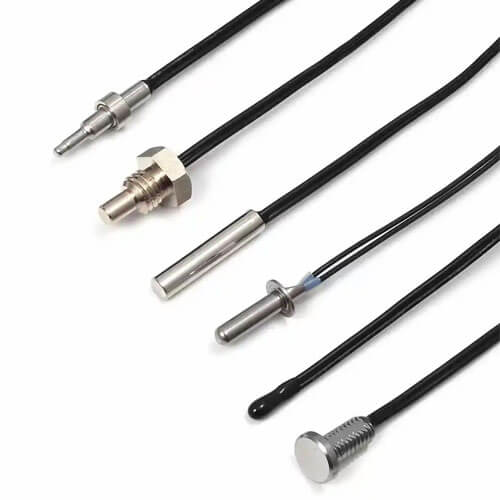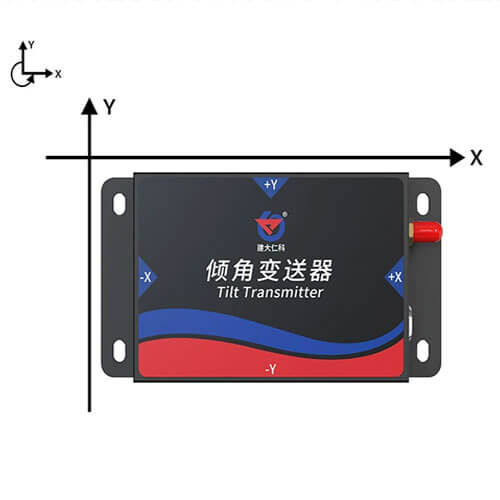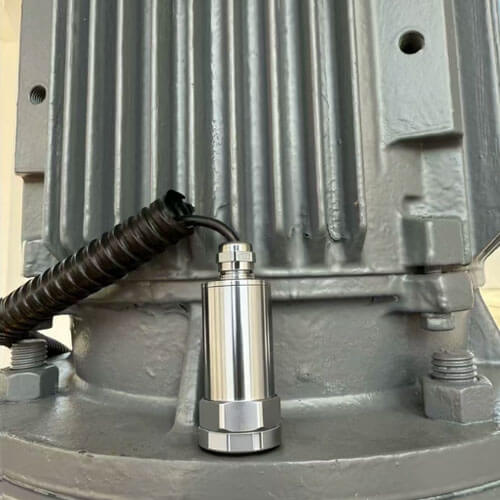
During operation, mechanical equipment (such as motors, pumps, and fans) vibrates due to imbalances, wear, loosening of internal parts, or changes in external loads. This vibration causes changes in physical quantities such as velocity, displacement, and acceleration of the mechanical structure. To monitor whether these changes deviate from the normal state, temperature and vibration sensors (integrating vibration and temperature measurements) are widely used as key “sensory terminals” for equipment condition monitoring.
To prevent measured data distortion, severe signal interference, or sensor damage caused by improper installation of expensive temperature and vibration sensors, it is crucial for users to understand “how to select” and “how to install” them.
Five Installation Methods for Vibration Sensors
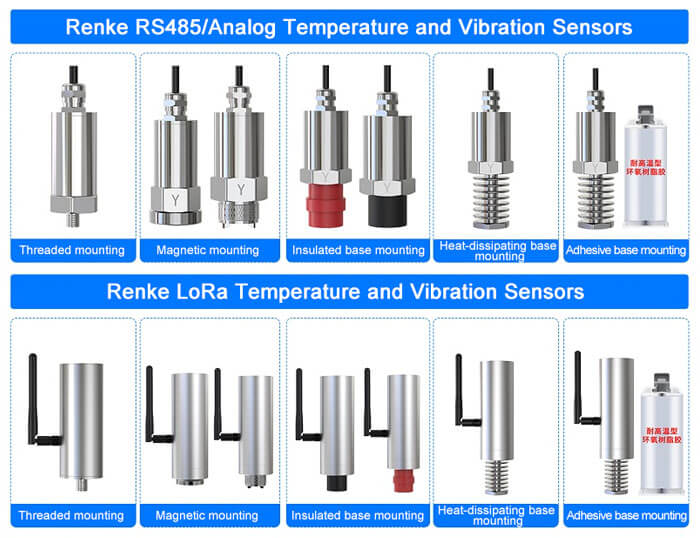
To match different project requirements, our temperature and vibration sensors offer five installation methods: threaded, magnetic, insulated base, heat-dissipating base, and adhesive base. No matter the environment, these options provide a precise match to meet the specific monitoring needs of your project.
1. Threaded mounting
Threaded mounting involves directly screwing the vibration sensor into a pre-machined threaded hole on the machine, creating a rigid mechanical contact. Threaded mounting ensures the vibration sensor is firmly fixed to the surface of the machine and is the most reliable mounting method for vibration measurement.
Our vibration sensors come with standard external threads (M5, M8, M10) by default, and the base features an M5 internal thread. If you have other requirements, the base thread can be converted to M5, M8, M10, 1/4 inch, or other specifications through thread adapters; customization is also supported.
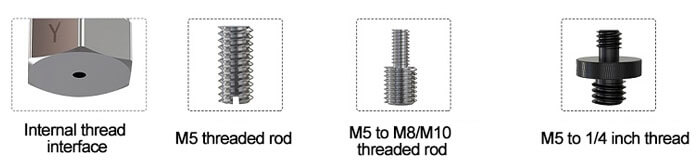
Extremely high precision: The rigid connection ensures that vibration waveforms are transmitted without distortion, effectively reducing measurement errors caused by equipment shaking and truly reflecting the equipment’s vibration state.
Excellent repeatability: Provides high measurement consistency after disassembly and reinstallation.
Strong anti-interference: Lacks additional elastic or magnetic components, making it immune to external magnetic fields and temperature fluctuations.
Complex installation: The process requires drilling and tapping the equipment surface, which is a destructive operation with a tedious installation procedure. This fixed installation method is not suitable for applications where sensors need to be moved frequently.
Threaded mounting is suitable for mechanical equipment with pre-existing threaded holes or surfaces where drilling and tapping are permitted. It is ideal for critical units requiring extremely high data accuracy (such as compressors, steam turbines, and high-speed fans) and for long-term fixed monitoring where frequent movement is not required.
2. Magnetic mounting
Magnetic mounting uses a strong magnetic base to attach the vibration sensor to the surface of the equipment being measured. This is a non-destructive, convenient, and quick-disassembly installation method. When drilling is not permitted or when temporary inspections and multi-point round-robin measurements are required, magnetic mounting is the best solution. By adding magnetic bases of different specifications, the temperature and vibration sensor can be directly adsorbed onto the surface of ferromagnetic materials.
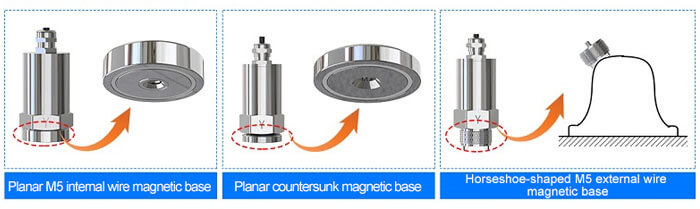
Renke provides three types of magnetic bases: flat M5 internal thread, flat countersunk, and horseshoe M5 external thread to meet the needs of different installation points. The flat magnetic base has a suction force of 35 kg, which is sufficient to withstand general industrial vibration. The horseshoe base has a suction force of 19 kg, which can meet the requirements for fixing on curved surfaces.
| Magnetic base type | Appearance characteristics | Thread specifications | Matching sensor | Attraction force | Upper temperature limit | Applications |
|---|---|---|---|---|---|---|
| Flat M5 internal thread magnetic base | Circular flat surface with a central M5 internal thread hole | M5 internal thread | M5 external thread vibration sensors | 35kg | 80℃ | Flat surfaces such as motor housings and pump bodies |
| Flat countersunk magnetic base | Circular flat surface with a central countersunk hole (no internal thread) | Countersunk hole (with M5 countersunk screw) | M5 internal thread vibration sensors | 35kg | 80℃ | Also suitable for flat mounting for a smoother surface |
| Horseshoe M5 external thread magnetic base | Horseshoe-shaped curved design with M5 external thread | M5 external thread | M5 internal thread vibration sensors | 19kg | 80℃ | Curved surfaces such as motor end covers and pipes |
Easy installation: No drilling, welding, or threading is required; it adheres directly to the surface of metal equipment. This is invaluable for on-site commissioning, equipment inspection, or temporary fault diagnosis.
Non-destructive: It does not alter the equipment structure, making it particularly suitable for precision equipment where modification is not permitted or for equipment still under warranty.
High flexibility: One temperature and vibration sensor can serve multiple devices, reducing initial investment costs.
Temperature limitations: Long-term use in environments exceeding 80°C will cause the magnetic steel to demagnetize, significantly reducing suction. If the equipment surface temperature is higher than 80°C, do not use magnetic mounting.
Poor installation consistency: Different personnel, different adsorption positions, and varying surface roughness will all affect the repeatability of measurement results.
Limited precision: Magnetic connection is inherently not a rigid fixation. In high-frequency vibration or high-acceleration scenarios, slight slippage or insufficient coupling can occur, leading to signal distortion.
Magnetic vibration sensors are primarily used for equipment inspection, fault diagnosis, and temporary testing scenarios. They are suitable for rapid deployment on motors, fans, pumps, reducers, and other equipment to collect vibration data, helping O&M personnel perform status assessments and anomaly localization.
3. Insulated base mounting
When equipment like motors or generators is operating, issues such as shaft voltage, leakage current, or strong electromagnetic fields may occur. If a vibration sensor is directly connected via metal, it can unintentionally become a “conductive path,” causing measurement data to jump or become abnormal. An insulated base blocks the electrical connection through physical isolation while ensuring mechanical fixation. By adding a layer of electrical insulation material (such as rubber or resin) between the mounting base and the equipment, the vibration sensor is completely electrically isolated from the equipment housing. Our company offers both rubber and resin insulated bases for users to choose from based on their specific needs.
- Rubber insulated base: Provides complete electrical isolation and effectively blocks leakage and ground loop interference. It is more economical than resin bases. It is suitable for low-frequency vibration monitoring where there are no specific requirements for acceleration measurement.
- Resin insulated base: Offers better material rigidity, higher temperature resistance, and minimal loss of precision. It has a slighter impact on radial vibration and temperature accuracy, allowing for more effective transmission of high-frequency vibration signals. It is suitable for equipment requiring full spectrum analysis in the presence of electromagnetic interference.
Strong electrical isolation: It effectively cuts off the electrical path between the equipment and vibration sensors, preventing ground loops, electromagnetic interference, and stray currents from affecting the vibration signal.
Lower sensitivity: The insulation layer acts as a “buffer” at the installation interface, which causes attenuation of high-frequency vibration signals and affects frequency response. This is particularly disadvantageous for high-frequency analysis, such as early-stage bearing failure detection.
When using an insulated base, precision can only be guaranteed for the Z-axis. The measurement accuracy for the X and Y axes, as well as temperature, will be attenuated. Therefore, insulated bases are suitable for scenarios where requirements for radial vibration are not high and the focus is primarily on axial vibration.
4. Heat-dissipating base mounting
The surface temperature of certain mechanical equipment (such as hot rolling motors, dryer cylinder bearings, and high-temperature fans) can reach as high as 150°C, which far exceeds the endurance limit of ordinary vibration sensors (usually 80°C). In these cases, a heat-dissipating base must be used. Also known as a high-temperature attenuation base, it works by adding a heat dissipation layer to increase the physical distance between the transmitter circuit and the sensor contact point, thereby strengthening heat dissipation. This reduces heat conduction from the motor surface to the internal circuitry, ultimately allowing the temperature and vibration sensor to withstand high temperatures up to 150°C.
High temperature resistance: Utilizes passive cooling without the need for an external power supply or fans. Ultra-high temperature versions can be customized, with 240°C options available for extreme working conditions.
Strong compatibility: Features M8 internal threads at both ends, making it compatible with most conversion screws.
Weakened mechanical coupling: The heat dissipation structure usually introduces additional interfaces or material layers, making the vibration transmission path “softer.” This leads to amplitude attenuation and a decrease in high-frequency response.
Heat-dissipating base installation is primarily used in high-temperature working conditions. Typical applications include steam turbines, metallurgical equipment, kiln induced draft fans, and pumps for high-temperature media where surface temperatures are elevated.
5. Adhesive base mounting
When drilling is not possible on the surface of the equipment (such as composite material housings or fiberglass), and magnetic attraction is not feasible (high temperatures can easily cause demagnetization), adhesive bonding becomes the only viable method. Adhesive bases use adhesives (such as wax, double-sided tape, epoxy resin, etc.) to fix vibration sensors to the monitoring equipment. For equipment with high temperatures where drilling is not possible, temperature and vibration sensors can be installed using a heat dissipation base (to reduce heat conduction), and high-temperature resistant epoxy resin is recommended.
Strong adaptability: It can conform to almost any surface shape without damaging the equipment.
Easy installation: No drilling or tapping required. It is suitable for thin-walled structures, precision equipment, or situations where modification is prohibited, while providing a relatively continuous and uniform contact interface.
Environmental sensitivity: Adhesive performance may degrade, or debonding may occur in environments with high temperature, high humidity, oil contamination, or strong vibration impact.
Frequency response impact: The introduction of an adhesive layer affects the sensor’s frequency response. The mounting resonance frequency is heavily influenced by the thickness and hardness of the glue.
Adhesive base mounting is suitable for special occasions where drilling and magnetic mounting are impossible. It is widely used in pipeline monitoring, cast aluminum motors, composite structural parts, and various thin-walled or irregularly shaped components.
How to Choose the Best Installation Method?
| Installation method | Drill-free installation | Upper temp limit | Application |
|---|---|---|---|
| Threaded mount | No | 150℃ (default 85℃) | Fixed monitoring equipment where drilling is permitted |
| Magnetic (flat) mount | Yes | 80°C | Planar ferromagnetic objects where drilling is not permitted during temporary inspections |
| Magnetic (horseshoe) mount | Yes | 80°C | Curved surfaces such as motor end covers and pipes |
| Rubber insulated base | No | 80°C | Low-frequency equipment with leakage current |
| Resin insulated base | No | 120°C | High-frequency monitoring equipment with electromagnetic interference |
| Heat dissipation base | No | 150°C (customizable 240°C) | High-temperature equipment (100°C~150°C) |
| Adhesive base | Yes | Depending on adhesive | Non-magnetic equipment that cannot be drilled |
Renke’s temperature and vibration sensors offer five installation methods, covering almost all application scenarios in industrial settings. Choosing the right installation method is the first step in ensuring accurate measurements from the temperature and vibration sensor, and a crucial foundation for reliable predictive maintenance of equipment. We go beyond simply providing a product; we are committed to offering every user a complete solution from installation selection to data application. Selecting the correct installation method is the first step in realizing the value of a high-precision temperature and vibration sensor. Choosing a reliable partner is a key step in ensuring the long-term stable operation of equipment.

This article is written by the Renke technical team. Renke has extensive practical experience in rotating machinery fault diagnosis, condition-based maintenance (CBM), and vibration frequency analysis. By integrating feedback from thousands of industrial sites, we have summarized these five key vibration sensor installation techniques, aimed at ensuring your monitoring data is accurate and effectively preventing the risk of equipment downtime.