What is an anemometer?
An anemometer is a meteorological instrument used to measure air velocity and, in many configurations, wind direction. In professional meteorology, wind measurement is not limited to a single scalar value. It often involves time averaged wind speed, gusts, turbulence intensity, directional variability, and in advanced applications, three dimensional wind vector components.
The earliest mechanical anemometers appeared several centuries ago and were primarily qualitative tools. With the development of fluid mechanics, electronics, and digital signal processing, modern anemometers are capable of providing high accuracy, high frequency, and long term stable measurements. Today, anemometers are widely used in meteorological observation, wind energy assessment, aviation, environmental monitoring, HVAC systems, industrial process control, and scientific research.
There is no single anemometer suitable for all applications. Measurement range, response time, directional sensitivity, environmental resistance, and maintenance requirements vary significantly among different designs. Selecting the correct anemometer requires a clear understanding of both the measurement principle and the operating environment.
From an R&D perspective, different anemometer designs show distinct long-term behaviors in calibration drift, bearing wear, and environmental sensitivity. These differences become especially evident after years of continuous outdoor deployment in meteorological stations and industrial monitoring sites.
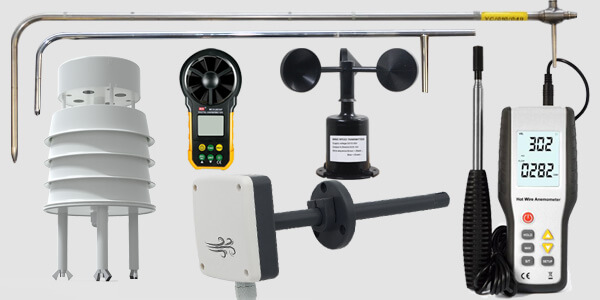
Common applications of anemometer
Anemometers are used in far more complex ways than simply measuring “wind speed.” Typical professional applications include:
- Measurement of mean wind speed and wind direction over a defined averaging period, commonly 1 minute, 10 minutes, or longer for climatological statistics.
- Measurement of fluctuating velocity components and frequency spectra of airflow, particularly in boundary layer studies and wind tunnel experiments.
- Determination of Reynolds stress, velocity correlation, and temporal or spatial turbulence characteristics in turbulent flow fields.
- Measurement of wall shear stress, usually achieved using hot film probes mounted flush with the surface. The measurement principle is similar to hot wire velocity measurement but optimized for near wall flow.
- Measurement of fluid temperature using thermal anemometry, where the relationship between probe resistance and temperature is pre calibrated, allowing temperature to be derived from resistance variation.
7 different types of anemometer
- Cup anemometers
- Propeller anemometers
- Hot wire anemometers
- Vane anemometers
- Ultrasonic anemometers
- Pressure anemometers
- Tube anemometers
1. Cup anemometers
Cup anemometers are the most widely used wind sensors in operational meteorological stations. The classic rotating cup anemometer was developed in the mid 19th century by John Thomas Romney Robinson, not Ruby Sun. The original design used four cups, but subsequent experimental studies demonstrated that a three cup configuration offers improved dynamic response and reduced directional bias. This three cup structure has since become the industry standard.
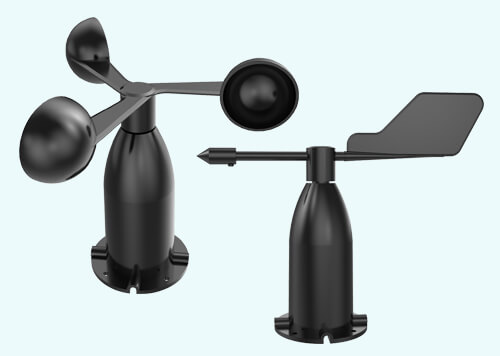
A typical cup anemometer consists of three hemispherical or conical cups mounted symmetrically on horizontal arms connected to a vertical shaft. When exposed to wind, the asymmetric drag on the concave and convex sides of the cups causes rotation. Under steady flow conditions, the rotational speed is approximately proportional to the horizontal wind speed. Rotation is commonly detected using magnetic switches, optical encoders, or Hall sensors, and converted into an electrical signal.
Cup anemometers primarily measure horizontal wind speed and are insensitive to vertical flow components. They are therefore well suited for synoptic meteorology and long term climate observation.
Advantages: Cup anemometers offer a wide measurement range, robust mechanical structure, and excellent long term stability. With proper material selection, such as anodized aluminum wind sensor or UV resistant plastics wind sensor, they exhibit strong corrosion resistance and are suitable for continuous outdoor operation. Their cost effectiveness and standardized performance characteristics make them the preferred choice for weather stations worldwide.
Disadvantages: The aerodynamic behavior of rotating cups is complex. The calibration factor depends on cup shape, arm length, bearing friction, and Reynolds number. Although extensive empirical calibration exists, there is no complete analytical model describing all influencing parameters. As a result, linearity deviations can occur, especially at very low or very high wind speeds.
2. Propeller anemometers
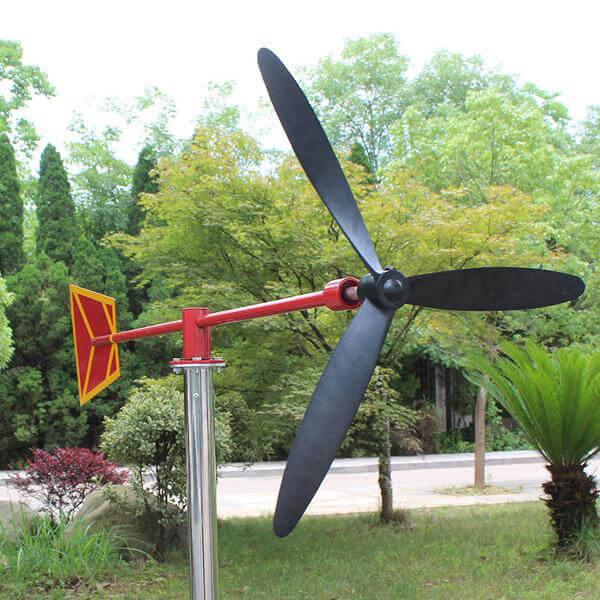
Propeller anemometers measure wind speed using a horizontally mounted rotor with typically three or four blades. The propeller rotates around a horizontal axis, and its rotational speed is proportional to the wind speed component aligned with the rotor axis.
To ensure correct alignment with the incoming wind, the propeller is usually combined with a wind vane. The vane forces the rotor to face directly into the wind, ensuring that the measured speed corresponds to the true wind direction. The aerodynamic design of the vane and housing is critical to minimize flow distortion.
Propeller anemometers measure the wind speed component along a single axis and are therefore directional sensors by nature.
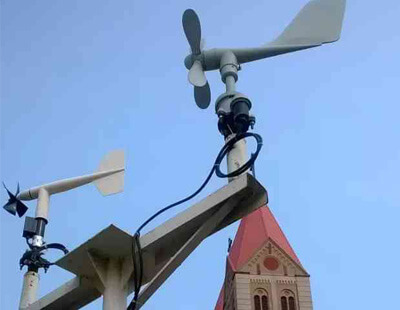
Advantages: Propeller anemometers are simple in structure, relatively easy to install, and provide good sensitivity at low to moderate wind speeds. When constructed with corrosion resistant materials, they are suitable for many outdoor applications.
Disadvantages: In cold and humid climates, ice accumulation on the propeller blades and vane can severely affect measurement accuracy or completely block rotation. Without active heating, propeller anemometers are unreliable in icing conditions, leading to data gaps in winter observations.
3. Hot wire anemometers
Hot wire anemometers are thermal velocity sensors that convert airflow velocity into an electrical signal based on convective heat transfer. A very thin metallic wire is electrically heated and exposed to the airflow. As air flows past the wire, heat is removed by convection. The rate of heat loss is directly related to the flow velocity.
As the wire cools, its temperature and electrical resistance change. By measuring this resistance change under controlled conditions, the flow velocity can be calculated. The relationship between heat loss and velocity is typically described by King’s law.
Hot wire anemometers can operate in constant current, constant voltage, or constant temperature modes, with constant temperature being the most common in high precision applications.
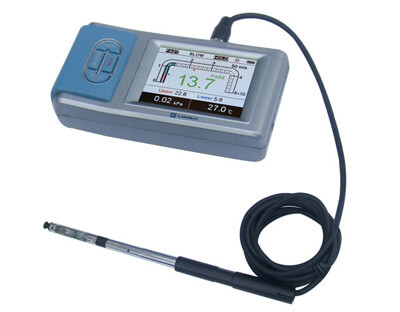
Advantages: Hot wire anemometers offer extremely high sensitivity and fast response, making them ideal for measuring low wind speeds and turbulent fluctuations. Their time constant can be on the order of milliseconds, enabling detailed turbulence and frequency spectrum analysis.
Disadvantages: Hot wire sensors are highly sensitive to ambient temperature variations and contamination. Temperature drift is a major source of error if not properly compensated. The fragile sensing wire is susceptible to damage, and the overall system cost is relatively high compared to mechanical anemometers.
4. Vane anemometers
Vane anemometers are compact, portable wind measurement devices commonly used for field inspections and HVAC diagnostics. They typically consist of a small axial impeller connected to a digital counting and display unit. Wind speed is derived from the rotational speed of the impeller.
These instruments are usually handheld and battery powered. Due to their portability, they are popular in outdoor activities and on site inspections where quick measurements are required.
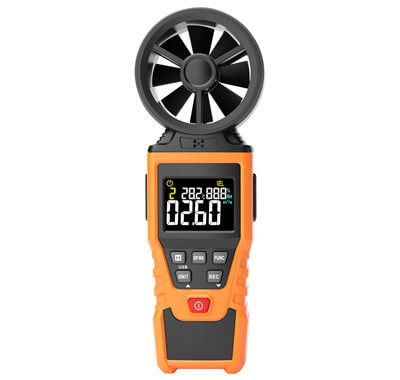
Advantages: Vane anemometers are lightweight, easy to operate, and require no installation. They are relatively inexpensive and well suited for spot measurements.
Disadvantages: The measurable wind speed range is limited, and long term unattended monitoring is not feasible. Data transmission and remote monitoring are generally not supported. Battery replacement is frequent under continuous use.
5. Ultrasonic anemometers
Ultrasonic anemometers measure wind speed and direction using the propagation characteristics of sound waves in air. Pairs of ultrasonic transducers transmit and receive sound pulses along fixed paths. The time required for a sound pulse to travel between two transducers differs depending on whether the wind is blowing with or against the sound path.
By measuring the time difference in opposite directions, the wind speed component along that path can be calculated. Using multiple paths arranged orthogonally, two dimensional or three dimensional wind vectors can be derived.
The ultrasonic anemometers are more advanced instruments for measuring wind speed and direction. Because it overcomes the inherent shortcomings of mechanical anemometers, it can work normally all-weather and for a long time, and it is more and more widely used. It will be a powerful substitute for mechanical anemometers.
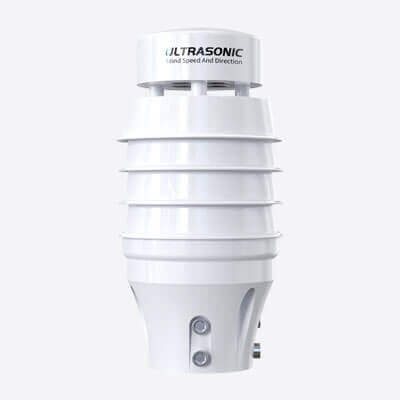
Advantages: Ultrasonic anemometers have no moving parts, eliminating mechanical wear and reducing maintenance. They offer fast response, high precision, and excellent performance at very low wind speeds. They are capable of measuring turbulence and gusts with high temporal resolution.
Disadvantages: Installation requires careful alignment and sufficient open space to avoid flow distortion. The cost is significantly higher than that of mechanical anemometers, which may limit their use in large scale deployments.
6. Pressure anemometers
Pressure anemometers determine wind speed by measuring the pressure difference between total pressure and static pressure in a flowing gas. The most widely used pressure anemometer is the Pitot tube, invented by Henri Pitot.
A Pitot tube consists of a forward facing opening that senses stagnation pressure and side openings that sense static pressure. The difference between these pressures represents the dynamic pressure, which is related to flow velocity through Bernoulli’s equation.
Pressure anemometers are commonly used in wind tunnels, ventilation systems, and aerospace testing.
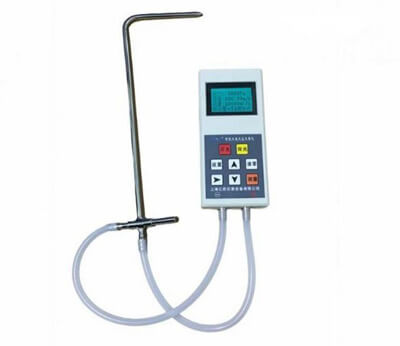
Advantages: Pressure anemometers provide stable and repeatable measurements and are suitable for a wide range of positive, negative, and differential pressure conditions. They are well suited for controlled flow environments.
Disadvantages: Their application is limited in natural wind measurement due to sensitivity to flow direction and the need for precise alignment. They are less practical for open atmosphere measurements.
7. Tube anemometers
Tube anemometers are designed specifically for measuring airflow inside ducts, pipes, and ventilation systems. Most tube anemometers are based on thermal measurement principles and are optimized for confined flow environments.
By measuring local wind speed and combining it with the known cross sectional area of the duct, real time air volume flow can be calculated. Advanced designs incorporate electromagnetic interference protection to ensure stable operation in industrial environments.
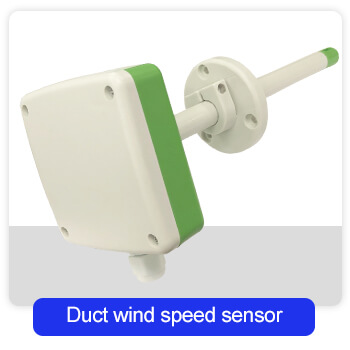
Advantages: Tube anemometers provide accurate airflow measurements in confined spaces such as HVAC ducts. They offer fast response and good stability, even at low wind speeds.
Disadvantages: Installation often requires drilling or insertion into the duct, increasing installation complexity. Improper installation can introduce flow disturbance and measurement error.
How to choose a suitable anemometer?
Range
Before selecting an anemometer, the required wind speed range must be clearly defined. Additional parameters such as temperature, humidity, or atmospheric pressure measurement should also be considered. Power supply options, including mains power, battery, or solar power, must be evaluated based on deployment conditions.
Accuracy
Anemometer accuracy typically ranges from ±0.2 percent to ±2 percent, depending on the measurement principle and calibration method. Higher accuracy instruments generally involve higher cost and more stringent installation requirements. The selection should balance performance requirements and budget constraints.
Quality
Durable housing, high quality bearings, and stable electronic components are critical for long term reliability. For outdoor installations, UV resistance, corrosion resistance, and environmental sealing directly affect service life and maintenance costs.
Application
The operating environment determines the most suitable anemometer type. Outdoor meteorological monitoring, industrial process control, laboratory research, and HVAC diagnostics each impose different technical requirements. Ease of installation and compatibility with existing systems should also be considered.
After sales service
Professional technical support during installation, calibration, and maintenance is essential for reliable long term operation. Strong after sales service ensures data continuity and reduces project risk.
Anemometers vary widely in measurement principle, performance, and application scope. There is no universally optimal solution. Selecting the correct anemometer requires a clear understanding of measurement objectives, environmental conditions, and long term operational requirements. With proper selection and installation, anemometers provide reliable and valuable wind data for a wide range of applications.

This article was written by the Renke technical team. Our team has over 15 years of experience in anemometer design, calibration, and long-term field deployment in environmental and industrial monitoring applications.