What is a water level sensor?
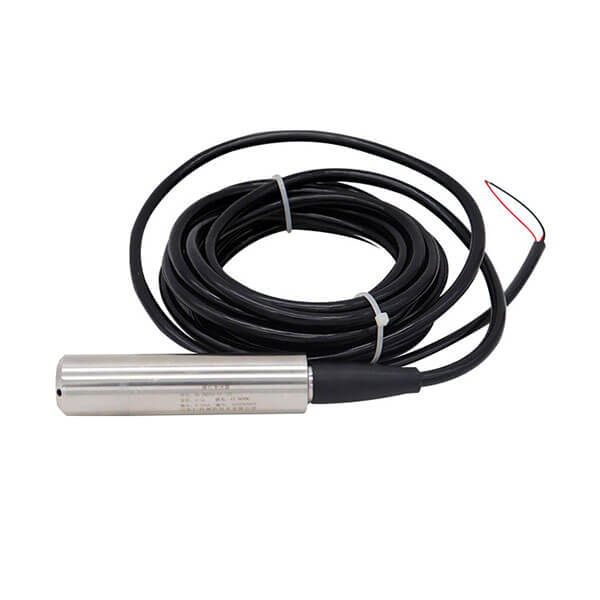
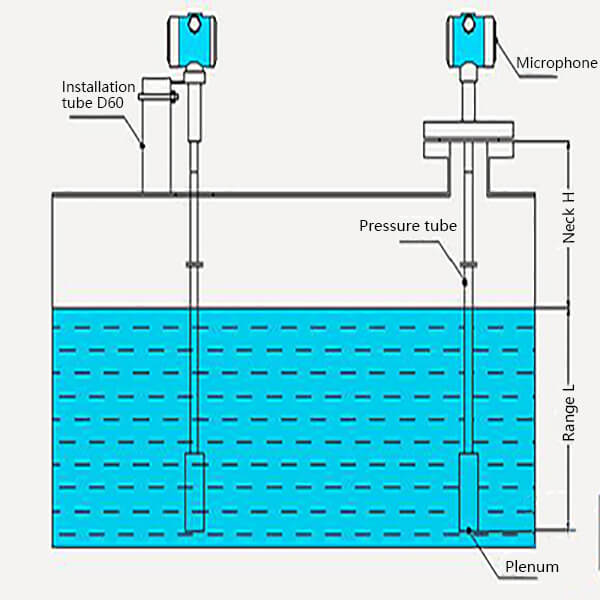
A water level sensor is a device designed to measure the height of a liquid, typically water, in a tank, reservoir, or other container. According to the method of measuring the liquid level, it can be divided into two types: contact type and non-contact type. The input type water level transmitter we call is a contact measurement, which converts the height of the liquid level into an electrical signal for output. It is currently a widely used water level sensor.
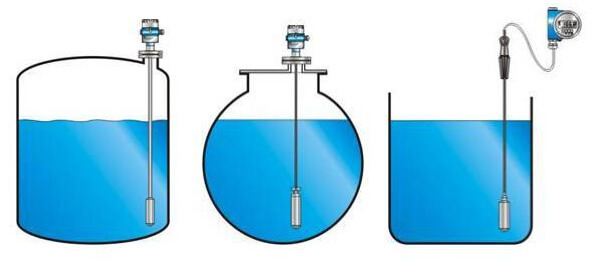
Depending on the measurement method, water level sensors are divided into two main categories:
- Contact sensors – the sensing element is submerged in or physically touches the liquid. Examples: hydrostatic (submersible), float, and capacitive sensors.
- Non-contact sensors – the sensor measures liquid level without any physical contact. Examples: ultrasonic, radar, and optical sensors.
Each type has distinct advantages in terms of accuracy, maintenance, media compatibility, installation method, and cost. The best choice depends on your specific application.
How does a water level sensor work?
Different water level sensor types operate on different physical principles. The three most widely used principles are:
1. Hydrostatic pressure (submersible sensors)
The water level sensor operates based on the principle that hydrostatic pressure is directly proportional to the height of the liquid. When the sensor is placed at a certain depth in the liquid to be measured, the pressure on the front surface of the sensor will be converted into the liquid level height.
The calculation formula is:
P = ρ × g × H + Po
Where:
P is the pressure at the sensor surface
ρ is the density of the liquid
g is the local gravitational acceleration
H is the depth of the sensor below the liquid surface
Po is the atmospheric pressure above the liquid
2. Echo principle (ultrasonic and radar sensors)
The sensor is mounted above the liquid surface. It emits sound waves (ultrasound) or electromagnetic microwaves (radar) pulses downwards towards the liquid surface. The pulse reflects off the surface and returns to the sensor. By measuring the round-trip travel time, the sensor calculates the distance to the liquid surface:
Distance = (Speed of signal × travel time) / 2
The liquid level is then derived by subtracting this distance from the known total height of the tank.
3. Mechanical buoyancy (float sensors)
A sealed float rests on the surface of the liquid. As the liquid level rises or falls, the float moves accordingly. This movement is connected mechanically or magnetically to a switch, potentiometer, or encoder, thereby outputting a liquid level signal.
What are the types of water level sensors?
Water level sensors come in a variety of types, depending on the measurement method, installation environment, and application. Here are 7 types of liquid level sensors for your reference:
1. Optical water level sensor
The optical sensor is solid-state. They use infrared LEDs and phototransistors, and when the sensor is in the air, they are optically coupled. When the sensor head is immersed in the liquid, the infrared light will escape, causing the output to change. These sensors can detect the presence or absence of almost any liquid. They are not sensitive to ambient light, are not affected by small bubbles when in liquid. This enables them to reliably record status changes, allowing long-term monitoring with low maintenance.
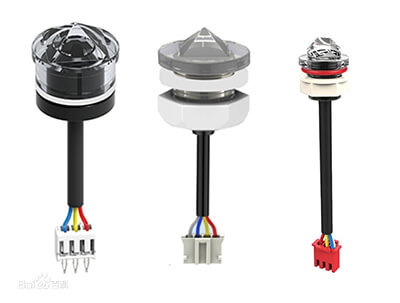
- Best applications: High-purity liquid detection in medical equipment and laboratory instruments, coolant and hydraulic oil low-level alarms, leak detection, and any application requiring fast, clean point-level switching.
- Advantages: No moving parts, extremely fast response, compact size, unaffected by bubbles and ambient light (unlike photocell sensors), long service life.
- Disadvantages: Designed for point detection only, cannot measure continuous level. Direct sunlight and heavily coloured or opaque liquids can interfere with the optical path. Lens contamination from oily or viscous liquids reduces reliability.
2. Capacitive liquid level sensor
A capacitive liquid level sensor uses two conductive electrodes in its circuit—typically made of metal. One is called the sensing electrode, and the other is the reference electrode. The space between them forms the sensor’s measurement zone. When the sensor probe is immersed in liquid, the capacitance changes as the area of the probe covered by the liquid increases.
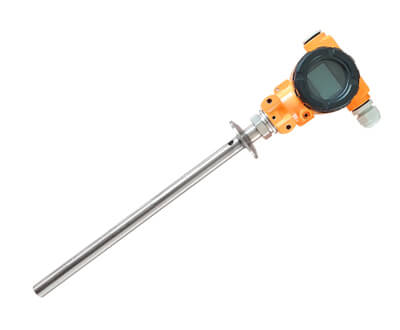
- Best applications: Chemical dosing tanks, food and beverage tanks (hygienic versions available), lubricant and oil tanks, and process vessels requiring continuous level measurement without mechanical parts.
- Advantages: No moving parts, high reliability, can measure through tank walls (non-contact version), suitable for a broad range of liquid types.
- Disadvantages: Electrode coating or contamination changes the effective capacitance and requires periodic cleaning or recalibration. Not suitable for liquids that leave heavy deposits.
3. Hydrostatic level sensor
The hydrostatic level sensor is based on the principle that the static pressure of the liquid is proportional to the height of the liquid. It uses an isolated diffused silicon sensitive element or pressure sensitive sensor with excellent performance to convert the static pressure into an electrical signal, which is then converted into a standard electrical signal (generally 4-20mA/1-5VDC) after temperature compensation and linear correction.
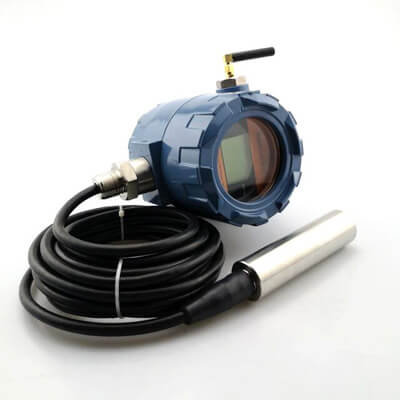
- Best applications: Deep wells, groundwater monitoring boreholes, rivers and open reservoirs, industrial storage tanks, and water supply infrastructure, wherever a top-mounted sensor is impractical.
- Advantages: high accuracy, simple structure, easy to install and operate. It is suitable for clean or slightly contaminated liquids.
- Disadvantages: affected by temperature and density variations in the liquid. Not ideal for viscous or corrosive liquids without proper protection.
4. Diaphragm liquid level sensor
The diaphragm or pneumatic level switch relies on air pressure to push the diaphragm, which engages with a micro switch inside the main body of the device. As the liquid level increases, the internal pressure in the detection tube will increase until the microswitch is activated. As the liquid level drops, the air pressure also drops, and the switch opens.
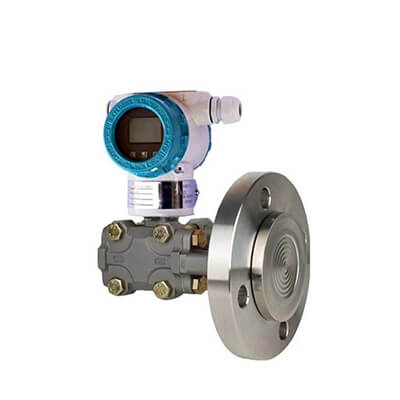
- Best applications: High/low level alarms in aggressive chemical tanks, slurry vessels, and tanks in explosive atmospheres where electrical sensors are restricted.
- Advantages: No electrical components in contact with liquid, suitable for aggressive and flammable media, no power in the tank required.
- Disadvantages: Requires a clean, dry compressed air supply. As a mechanical device, the diaphragm and microswitch require periodic inspection and replacement over time.
5. Float water level sensor
The float switch is the original level sensor. They are mechanical equipment. The hollow float is connected to the arm. As the float rises and falls in the liquid, the arm will be pushed up and down. The arm can be connected to a magnetic or mechanical switch to determine on/off, or it can be connected to a level gauge that changes from full to empty when the liquid level drops.
The use of float switches for pumps is an economical and effective method to measure the water level in the pumping pit of the basement.
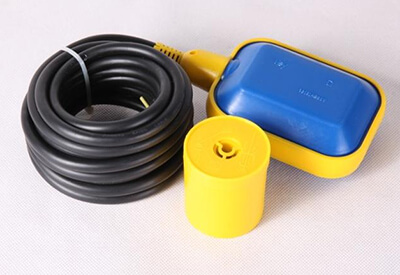
- Best applications: Pump start/stop control in sumps and tanks, high/low level alarms, cooling tower make-up water control, and any application requiring simple and low-cost level detection.
- Advantages: No power required for basic switch operation, works with virtually any liquid, extremely low cost, and simple to install and replace.
- Disadvantages: Moving parts are subject to mechanical wear and sticking in liquids with suspended solids or scale. Float size limits use in narrow tanks. Not suitable for continuous precision measurement without an encoder mechanism.
6. Ultrasonic liquid level sensor
The ultrasonic level gauge is a digital level gauge controlled by a microprocessor. In the measurement, the ultrasonic pulse is emitted by the sensor (transducer). The sound wave is reflected by the liquid surface and received by the same sensor. It is converted into an electrical signal by a piezoelectric crystal. The time between the transmission and reception of the sound wave is used to calculate the Measure of the distance to the surface of the liquid.
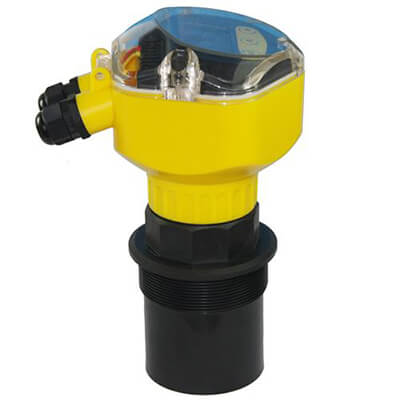
The working principle of the ultrasonic water level sensor is that the ultrasonic transducer (probe) sends out a high-frequency pulse sound wave when it encounters the surface of the measured level (material), is reflected, and the reflected echo is received by the transducer and converted into an electrical signal. The propagation time of the sound wave. It is proportional to the distance from the sound wave to the surface of the object. The relationship between the sound wave transmission distance S and the sound speed C and the sound transmission time T can be expressed by the formula: S=C×T/2.
- Best applications: Open tanks, rivers and open channels, water treatment lagoons, wastewater sumps, and any application where the sensor cannot make contact with the liquid.
- Advantages: non-contact measurement, the measured medium is almost unlimited, and it can be widely used for measuring the height of various liquids and solid materials.
- Disadvantages: Measurement accuracy degrades in the presence of heavy foam, vapour, dust, or large temperature gradients in the air gap between sensor and liquid surface. Not suitable for enclosed pressurised vessels.
A radar liquid level sensor is a non-contact liquid level measurement device based on the principle of electromagnetic wave reflection. It emits high-frequency electromagnetic waves toward the liquid surface and receives the echo signal, calculating the liquid level height using the time difference or frequency difference. Its core technology relies on the propagation characteristics of microwave signals, enabling it to adapt to complex working conditions such as high temperature, high pressure, corrosive environments, and steam.
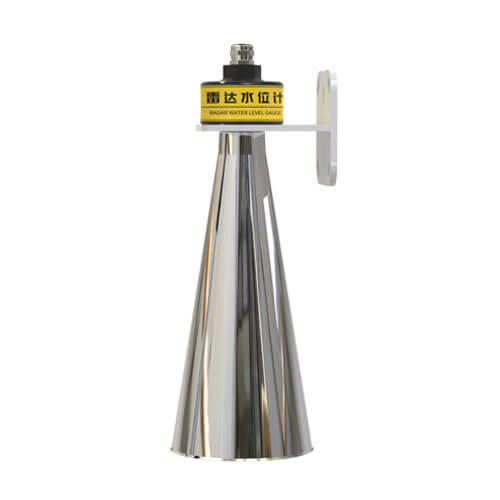
- Best applications: Petrochemical tanks, corrosive chemical storage, high-temperature or high-pressure vessels, liquids with foam or heavy vapour, and outdoor open channels with severe weather conditions.
- Advantages: Unaffected by temperature, dust, steam, and vapour; highest accuracy of non-contact types; wide application range across industries.
- Disadvantages: Can generate false echoes from internal tank structures (agitators, nozzles, brackets) if not correctly configured.
Where to use water level sensors?
The uses of water level sensors include the following applications:
- Water level measurement of pools and water tanks.
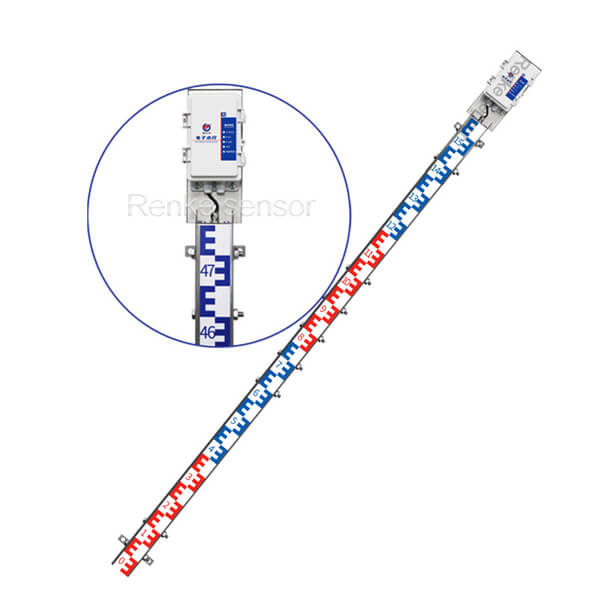
- Water level measurement of rivers and lakes.
- Marine level measurement.
- Level measurement of acid-base liquids.
- Oil level measurement of oil trucks and mailboxes.
- Swimming pool water level control.
- Tsunami warning and sea-level monitoring.
- Cooling tower water level control.
- Sewage pump level control.
- Remote monitoring of the liquid level.
What are the benefits of water level sensors?
- Simple structure: There are no movable or elastic elements, so the reliability is extremely high, and there is no need for regular maintenance during use. The operation is simple and convenient.
- Convenient installation: When using, first connect one end of the wire correctly, and then put the other end of the water level probe into the solution to be measured.
- Ranges are optional: you can measure the water level in the range of 1-200 meters, and other measurement ranges can also be customized.
- Wide range of applications: suitable for liquid level measurement of high temperature and high pressure, strong corrosion, high pollution, and other media. Building an electronic water level gauge on the river bank can be used for tide monitoring.
- Wide range of measuring medium: High-precision measurement can be carried out from the water, oil to paste with high viscosity, and wide-range temperature compensation is not affected by the foaming, deposition, and electrical characteristics of the measured medium.
- Long service life: Generally, the liquid level sensor can be used for 4-5 years in a normal environment, and it can also be used for 2-3 years in a harsh environment.
- Strong function: It can be directly connected to the digital display meter to display the value in real-time, or it can be connected to a variety of controllers and set the upper and lower limits to control the water volume in the container.
- Accurate measurement: The built-in high-quality sensor has high sensitivity, fast response, and accurately reflects the subtle changes of the flowing or static liquid level, and the measurement accuracy is high.
- Variety of types: liquid level sensors have various structural designs such as input type, straight rod type, flange type, thread type, inductive type, screw-in type, and float type. It can meet the measurement needs of all different places.
How to choose the right water level sensor?
Measurement range
- 0~5m (short range): Float switch, optical (point only), capacitive
- 5~50m (medium range): Hydrostatic (submersible)
- 50~200m or open channels: Ultrasonic, radar
- Any depth, non-contact required: Ultrasonic (clean conditions), radar (harsh conditions)
Liquid type and condition
- Clean water, light contamination: Hydrostatic, ultrasonic, float
- Corrosive acids or strong alkalis: Radar (non-contact) or PTFE-coated hydrostatic
- Viscous liquids, slurries, pastes: Radar (80 GHz guided-wave)
- Foamy or turbulent liquid surface: Radar (80 GHz outperforms ultrasonic in foam)
- Flammable / explosive media: Diaphragm or intrinsically safe-rated radar
Installation environment
- Outdoor open channel, river: Radar or ultrasonic (non-contact, weatherproof)
- Enclosed pressurised vessel: Radar or diaphragm
- High temperature (>80°C): Radar, diaphragm, or high-temp hydrostatic
- Hazardous area (ATEX/IECEx required): Intrinsically safe-certified radar or float
- Narrow tank or standpipe: Hydrostatic or guided-wave radar

This article was compiled and edited by the Renke Technical Team, drawing directly from real questions, installation challenges, and selection inquiries submitted by Renke's customers and field partners over more than 15 years of liquid level sensor manufacturing and deployment. This article is not a theoretical study; rather, it consolidates practical insights gained from extensive customer interactions across more than 30 countries and diverse industrial sectors. By the way, below are popular water level sensors from Renke: