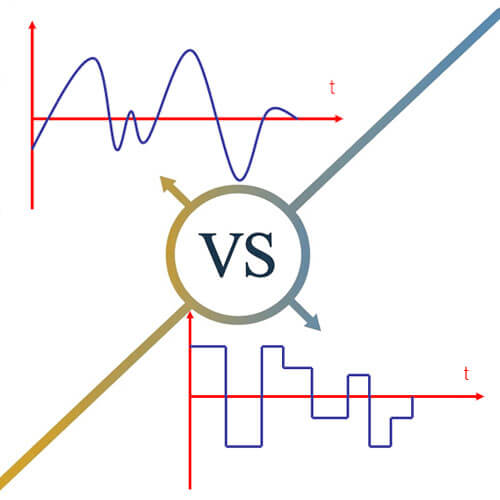
Temperature and humidity sensors are among the most basic sensing devices widely used in commercial, industrial, and residential setups. Traditionally, temperature sensing was done through RTDs, thermocouples, NTCs, and analog sensors. But with innovations in embedded systems, IoT, and robotics, the need for digital temperature and humidity sensor has grown ever since.
Now, temperature and humidity sensors are widely used in consumer electronics, healthcare, environmental monitoring, and industrial automation. Compared with analog temperature and humidity sensors, digital sensors feature additional components like analog-to-digital converters and signal conditioning circuits. At the same time, they offer better noise cancellation and can have built-in calibration features.
Both types of sensors offer advantages and drawbacks. More importantly, there are specific use cases for each type. In this article, we will discuss the key differences, application areas, and factors affecting the choice of temperature and humidity sensors.
What is Analog Temperature and Humidity Sensor?
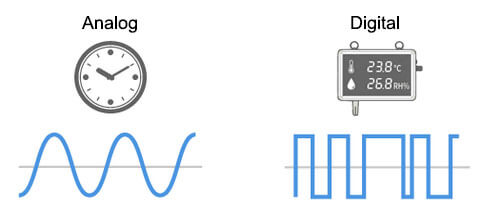
An analog temperature and humidity sensor detects environmental temperature and humidity and converts them into continuous electrical signals (voltage, current, or resistance) for measurement and monitoring.
Unlike digital sensors, which output data in binary (0s and 1s), analog sensors provide a raw signal that directly represents the physical magnitude of the temperature or humidity.
What is Digital Temperature and Humidity Sensor?
A digital temperature and humidity sensor is an integrated device that measures ambient temperature and humidity and outputs the data as digital signals (binary data composed of 0s and 1s).
Unlike analog sensors that produce continuously changing electrical signals, digital sensors process measurement data internally. They typically combine a sensing element, an analog-to-digital converter (ADC), and a communication interface within a single chip, enabling direct and stable digital output.
Analog vs Digital Temperature and Humidity Sensors
Digital and analog temperature and humidity sensors differ in how they process signals. Digital sensors are more comprehensive in a way that they feature signal conditioning, conversion mechanisms, and noise suppression mechanisms. This section provides a comparison between the two types.
1. Working principle
In principle, the sensing mechanisms of both digital and analog temperature and humidity sensors are quite similar. The difference lies in the way the sensed signal is processed and delivered as the output.
An analog temperature and humidity sensor delivers a continuous current or voltage signal at the output. The electrical quantities are proportional to the sensed physical quantities. For example, a thermistor or RTD changes its resistance with temperature, while a thermocouple uses the Seebeck effect to change voltage according to sensed temperature, and generate an analog signal at the output.
Likewise, there are capacitive and resistive humidity sensors that change their properties according to the sensed moisture. When analog sensors are interfaced with microcontrollers or digital processors, they require additional circuits like analog-to-digital converters to be interpreted in a processable form.
Digital sensors output sensed information directly in a digital form. Often, these sensors use communication protocols like I2C, SPI, or UART, which makes it easier for microcontrollers to interpret the signals. Typically, digital temperature and humidity sensors are equipped with ADCs (analog to digital converters) and signal processing circuits for filtering, calibration, and data suppression. For example, the DHT11 and SHT30 series of temperature sensors provide digital outputs.
Moreover, digital sensors can have additional components like real-time clocks and optional graphical user-interfaces for easier integration with computing devices. For instance, the LCD Temperature humidity sensor offers a simple and clear LCD display for wall-mounted applications.
Analog vs. Digital Signals video from @khanacademy
2. Voltage signal degradation
Since analog temperature and humidity sensors produce a continuous output, the signal is often a low-voltage signal. The problem arises when this signal needs to be carried over long distances, as wire resistance and environmental factors cause significant voltage drops.
On the other hand, digital temperature and humidity sensors transmit signals in discrete values. Unlike analog sensors, digital sensors can maintain better signal integrity and accuracy as long as the voltage remains within the defined thresholds.
Why long-distance transmission becomes unstable in analog and digital temperature and humidity sensors?
Digital sensors are better immune to singal integrity problems as compared to analog sensors. In long-distance transmission, analog signals become unstable due to wire resistance and environmental noise.
On the other hand, digital signals only deteriorate if the voltage levels go beyond the preset thresholds. Once that happens, it could lead to bit errors, timing issues, and a total loss of frame.
3. EMI sensitivity
Electromagnetic Interference (EMI) is a major challenge for analog signals, especially in industrial setups. The interference distorts the signals, particularly in fields closer to switching devices and motors. It induces unwanted voltages and noise that can eventually corrupt sensed signals. So unless the cables are well grounded or shielded, EMI tends to increase inaccuracy in analog signals.
In digital temperature and humidity sensors, the discrete logic levels reduce the effect of EMI. They are much less sensitive to such minor interferences. Moreover, digital transmission protocols often include error-checking mechanisms like CRC, and Checksums that provide basic error detection. As a result, signal accuracy is much better with digital temperature and humidity sensors.
Why are my temperature and humidity sensor field readings different from PLC readings?
As EMI and noise can distort the signals, you can always expect variation in readings obtained on field and the ones received at the PLC. To overcome these differences, it is important to use proper signal shielding and grounding techniques.
Is it preferable to use 4-20 mA signals to counter noise challenges?
Yes, one of the more effective and widely used methods to avoid noise issues is to use 4-20mA signals. This current loop is a standard practice in industries because it has a high immunity to noise. Since current remains same over long distances, it doesn’t succumb to signal degradation. Hence, most factories and industrial sensing units go by this method for medium to long-range communication. More importantly, 4mA baseline also makes it easy to detect faults.
Therefore, they are reliable for short to medium ranges, while 4-20 mA analog signals remain preferred for long-distance industrial use.
4. Error checking mechanisms
Analog signals rarely use error detection mechanisms. Typically, noise filters are used to subtract potential noise attained during transmission. So, there is always a chance of corrupted data at the receiver side.
But digital temperature and humidity sensors are equipped with built-in error checking and detection mechanisms, which improve data reliability.
Why are digital sensors often recommended for IoT projects?
Digital temperature and humidity sensors are recommended precisely because of error detection mechanisms. For instance, if you wish to install a temperature sensor in a remote location, you can rely on the received signal accuracy because of the detection mechanisms present inside the sensors. Moreover, digitally communicated data is easier to process for microcontrollers, reducing the dependency on their own ADC and signal conditioning modules.
5. Power consumption
Analog temperature and humidity sensors have simplified circuitry. Eventually, they require less power to operate. On the other hand, digital sensors feature multiple modules like ADCs, amplifiers, internal processing and communication, etc., where each module requires power to operate. As a result, digital temperature and humidity sensors require more power to operate.
This can be a challenge in low-power IoT applications because it can increase the overall cost of the system. To tackle such issues, digital sensors may also feature power-saving modes.
Which of the two sensor types have a lower maintenance cost?
Analog temperature and humidity sensors typically have a lower maintenance cost because of low power consumption. Digital sensors may require more frequent battery replacements, which can be a challenge for remote applications such as IoT. Therefore, it is better to use energy-efficient methods to deploy digital temperature and humidity sensors for sustainable and long-term applications.
When evaluating maintenance costs, it is essential to balance power consumption with calibration frequency and diagnostic capabilities. While analog sensors are traditionally noted for their simplicity, digital sensors often offer a lower Total Cost of Ownership (TCO) in long term deployments. Modern digital sensors support ultra-low-power sleep modes, enabling multi year battery life for IoT applications. More importantly, they eliminate the need for manual on-site calibration and offer remote diagnostics, addressing the high labor costs associated with “signal drift” in analog systems. Therefore, for sustainable and long-term applications, deploying digital sensors with optimized power-saving strategies is the superior approach.
6. General signal drifting
Temperature and humidity sensor outputs changes gradually over time due various factors such as:
- Continuous exposure to environment
- Contamination
- Aging materials and components (resistors, capacitors, etc.) inside the sensors
This is a persistent problem especially in analog humidity sensors because air-borne contaminants and moisture distort the physical performance of the sensor over time.
So, if you’re wondering why does my sensor data drift over time, you might want to check the calibration and installation date of your sensor. But this is totally a natural phenomenon and happens to all sensors over time.
A simple fix is to:
- Recalibrate your sensors if you’re using analog sensors
- Apply compensation algorithms if you’re using digital sensors.
In any case, cyclic calibration ensures higher reliability of sensed temperature and humidity for both types of sensors.
7. Cost
In most industrial applications, sensor cost can dictate the use of a specific type. Analog sensors have a simpler construction, which means they are cheaper as a unit. But you will need signal conditioning, ADCs, and amplifier circuits to make the signal readable for digital microcontrollers. In a way, analog temperature and humidity sensors come with a hidden cost because it’s not convenient to use them without external circuits.
On the other hand, digital sensors comprise all modules and circuits necessary to deliver a digital output, which increases their cost. From usage point of view, digital sensors are easier to integrate and compatible with most digital processors, so they balance the cost in the long-term.
Which sensor type is cheaper?
If you want to deploy a small number of sensors for your project and are willing to build your own ADCs and signal conditioning circuits, then an analog temperature and humidity sensor may suffice. But for large-scale deployment and ease of use, digital temperature sensors could be a better and cost-friendly option.
Application of Analog and Digital Temperature and Humidity Sensors
Temperature and Humidity sensors are widely used across several industries. Here are some of the more renowned application areas:
HVAC Industry
HVAC systems use temperature and humidity sensors for climate control in buildings. So, you will find them in most corporate, educational, health, and administrative setups. Generally, HVAC systems use analog temperature sensors with 0 to 10V or 4 to 20mA outputs, because they can directly integrate with BMS and PLCs.
On the other hand, digital temperature sensors are used in thermostats and modern HVAC controllers for IoT applications. Since analog sensors are easier to work with in PLC applications and have easier maintenance, they dominate the HVAC sector.
Meteorological stations
Weather stations generally require high-accuracy data from remote locations. Therefore, digital temperature and humidity sensors are widely preferred, as they have built-in error correction, better accuracy, and calibration features.
The sensed data is usually logged onto microcontrollers and data loggers using I2C, RS485, SDI-12 communication protocols. Since digital sensors provide data in a readable form without need of further processing, they become an ideal choice for weather sensing applications.
Industrial automation
Factories requiring continuous monitoring of processing plants often use analog sensors with 4 to 20mA ranges. These sensors provide input to PLCs and offer:
- High noise immunity
- Long-distance communication support
- Easy integration with PLCs
Where is it necessary to use 4-20mA signal?
Environments with motors and heavy machines, analog sensors with 4 to 20mA signals become critical to the cause. That’s because they are more robust and compatible with legacy PLC systems. On the other hand, digital sensors are more useful for localized control systems.
Cleanrooms
Cleanrooms rely heavily on signal integrity and accuracy of sensors. Because cleanrooms are typically closed environments, both 4-20mA and digital temperature and humidity sensors with high precision can be used. The use cases for both types vary as:
- 4-20mA signals are easier to integrate with PLCs and offer centralized monitoring.
- Digital sensors provide high accuracy and seamless datalogging.
But if you have a choice, it’s better to go for digital temperature and humidity sensors because of built-in compensation and low drift.
IoT systems
Most IoT applications are based on remote or wireless sensing which requires digital communication protocols. Often, you will see an Arduino, Raspberry Pi, or ESP32 as the receiver controllers connected to these sensors. So, it’s almost a no-brainer to use a digital temperature sensor for IoT applications.
Digital sensors are easier to integrate with IoT systems, and have all the essential tools that make communication easier and effective in the long term.
For analog temperature and humidity sensors, the additional step to convert data from analog to digital can increase components and also push the cost and maintenance constraints considerably.
Conclusion
Analog and digital temperature and humidity sensors play a pivotal role in modern applications. Both have specific use cases, applications, drawbacks, and advantages. Based on your applications, you can pick from a wide range of modern temperature and humidity sensors for your projects. This article outlines the essential things to help you make better decisions for your upcoming projects.

Composed of senior hardware engineers and software architects, the Renke Technical Team stands at the forefront of environmental sensing technology. We specialize in the end-to-end development of temperature and humidity monitoring systems, from underlying hardware to specialized technical support. At Renke, we don't just build devices; we engineer precision. Our mission is simple: Focus on the user and capture every degree of change. By offering tailored, one-stop monitoring solutions worldwide, we empower industries with the robust data needed for superior environmental control.