




Table of Contents What is TVOC? Is it a gas? TVOC refers to Total Volatile Organic Compounds, which is one of the air quality
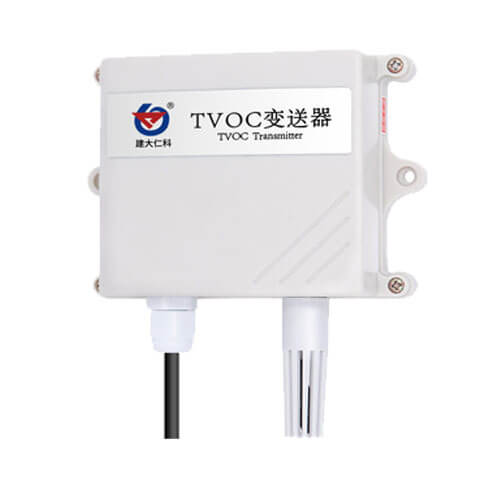
TVOC Sensor
The RS-TVOC-*-2-4-T series is an industrial-grade wall-mounted TVOC sensor that effectively monitors the TVOC content in the environment. It can communicate directly with PLCs, user hosts, and configuration software, facilitating secondary development. It uses high-performance signal acquisition circuitry for high accuracy. It supports RS485, 4-20mA, 0-5V or 0-10V signal output.
- Model: RS-TVOC-*-2-4-T
- MOQ: 1 PCS
- Delivery date: within 24 hours
- Price: $40
About - TVOC Sensor
Environmental pollution caused by interior decoration has attracted more and more attention, and TVOC is the most serious of the three organic pollutants (polycyclic aromatic hydrocarbons, volatile organic compounds, and aldehydes) in the air. VOC refers to organic substances whose saturated vapor pressure exceeds 133.32pa at room temperature, its boiling point is between 50°C and 250°C, and exists in the air in the form of evaporation at room temperature. Its toxicity, irritation and carcinogenicity can affect the skin and mucous membranes, cause great damage to the human body. The TVOC sensor launched by our company can effectively monitor the TVOC content in the environment.

Wall mounted TVOC sensor
The RS-TVOC-*-2-4-T series is an easy-to-install wall-mounted TVOC sensor. It utilizes semiconductor detection principles for accurate TVOC concentration measurement. The sensor features a built-in high-sensitivity gas detection module, ensuring rapid response. Our TVOC sensor is energy-efficient and double-waterproofed, with internal waterproof strips providing an IP65 protection rating, effectively preventing damage from water and dust, and functioning normally even in harsh environments with high dust levels. It incorporates an anti-interference module, and the signal cable uses a four-core waterproof shielded cable, offering strong anti-interference capabilities and stable signal output. It is widely used in greenhouses, workshops, offices, factories, and other similar locations.
RS-TVOC-*-2-4-T parameters
| Power supply | DC 10-30V |
|---|---|
| Max. power consumption | 0.4W (Analog), 0.5W (RS485) |
| Operating environment | -40℃~+80℃, 0%RH~95%RH (Non-condensing) |
| Measuring range | 0~60000ppb |
| Accuracy | 8%FS (@C4H8, 50000ppb, 25℃, 50%RH) |
| Resolution | 1ppb |
| Measured object | Volatile Organic Compounds |
| Data refresh time | 2s (Analog), 1s (RS485) |
| Output signal | RS485/4-20mA/0-5V/0-10V |
| Warm-up time | ≥24h |
Fixed TVOC gas detector
The RS-FPC-TVOC-*-*-T series is an explosion-proof TVOC gas detector. It features a built-in high-sensitivity TVOC sensor and supports remote infrared control technology, allowing parameter modification without disassembly. This TVOC gas detector has a large LCD display and audible and visual alarm functions; it will emit an audible and visual alarm signal when the concentration exceeds the preset alarm value. Its protection rating is IP66, and its explosion-proof markings are: Ex db IIC T6 Gb; Ex tb IIIC T80℃ Db, making it suitable for harsh environments. This explosion-proof TVOC gas detector is priced at $105.

RS-FPC-TVOC-*-*-T parameters
| Power supply | DC 10-30V |
|---|---|
| Average power consumption | 1W (Additional power consumption when alarm light is working: 1W) |
| Operating environment | -20℃~+60℃, 0%RH~95%RH |
| Measuring range | 0~60ppm |
| Accuracy | 8%FS (@C4H8, 50000ppb, 25℃, 50%RH) |
| Resolution | 0.001ppm |
| Measured object | Total Volatile Organic Compounds |
| Output signal | RS485/4-20mA/0-5V/0-10V |
| Warm-up time | ≥24h |
| Explosion-proof mark | Ex db IIC T6 Gb; Ex tb IIIC T80℃Db |
| Relay load capacity | 250VAC 1A/30VDC 3A |
TVOC online monitoring
When installing TVOC sensors at multiple locations, they can be used in conjunction with our environmental monitoring host. The host can simultaneously collect TVOC sensor data from different measuring points, process the data, and centrally upload it to the cloud platform. The cloud platform supports login via computer and mobile terminals. Users can log in anytime, anywhere using their account and password to view real-time and historical data from different TVOC sensors. Through the cloud platform, we can set an upper limit alarm value for TVOC gas concentration. For example, the alarm value can be set to 0.28 mg/m³. If the TVOC gas concentration approaches or reaches this upper limit, the cloud platform will issue alarms via platform alarms, SMS alarms, email alarms, etc., so that managers can take measures to reduce the TVOC gas concentration as soon as possible.
FAQs - TVOC Sensor
1. What is TVOC?
TVOC (Total Volatile Organic Compounds) refers to the collective term or comprehensive indicator of various volatile organic compounds (VOCs) in the air, and is often used to assess indoor air quality. Usually, we call formaldehyde, benzene, ammonia, xylene and other volatile gases in the indoor environment TVOC gas.
2. What level of TVOC is safe?
The US EPA explicitly states that there are no uniform federal mandatory VOC concentration standards for non-industrial indoor environments. The German Federal Environment Agency (UBA)’s TVOC indoor air quality classification guidelines are a frequently cited international reference, but they are hygiene assessment guidelines, not globally unified mandatory standards. The UBA’s published classification references are as follows:
≤ 0.3 mg/m³: Hygiene-safe
0.3-1 mg/m³: Acceptable provided individual pollutants do not exceed the corresponding guideline values
1-3 mg/m³: Significant pollution levels
3-10 mg/m³: High hygiene risk
>10 mg/m³: Unacceptable
3. What are the harmful of tvoc?
TVOCs are not a single chemical substance; therefore, their hazards depend on the specific volatile organic compounds they contain, their concentration, and the duration of exposure. The U.S. Environmental Protection Agency (EPA) notes that some VOCs can have both short-term and long-term health effects.
Short-term exposure hazards: When the concentration of certain VOCs in the air is high, they can irritate the eyes, nasal passages, and throat, causing headaches, dizziness, nausea, fatigue, and respiratory discomfort. Some people may also experience skin allergic reactions.
Long-term exposure hazards: Long-term or repeated exposure to certain harmful VOCs may damage the liver, kidneys, or central nervous system. For example, benzene has been identified as a human carcinogen; however, this does not mean that all VOCs are carcinogenic.
4. What is a TVOC sensor?
A TVOC sensor is an instrument used to detect the level of total volatile organic compounds in the air. It can be used to assess indoor air quality and monitor changes in the concentration of organic pollutants.
5. What is TVOC air quality?
The sum of all VOCs is called total volatile organic compounds (TVOC). The gas volume of each category and the sum of all gases (TVOC) is an important reflection of the relevant organic compounds found in indoor air.
6. How does TVOC sensor work?
TVOC sensors primarily detect volatile organic compounds (VOCs) in the air using two principles:
- MOS (Metal-Oxide-Semiconductor) sensors: VOCs react with the surface of the sensitive material, causing a change in resistance. The sensor estimates the TVOC concentration based on the electrical signal. They are relatively inexpensive and commonly used for indoor air quality monitoring.
- PID (Photoionization Detection) sensors: These utilize ultraviolet light to photoionize some VOCs. The sensor calculates the gas concentration by measuring the resulting weak current. They offer high sensitivity and are commonly used for industrial environmental monitoring.
7. What are the types of tvoc sensors?
According to the different installation methods in different places, it can be roughly divided into three types: wall-mounted TVOC meter, explosion-proof TVOC gas detector, and portable TVOC gas detector.
8. What is the application of tvoc gas detector?
TVOC gas detector is suitable for oil extraction, smelting, chemical industry, municipal administration, sewage treatment, power gas, mining, tunnel construction, fire storage, papermaking, pharmaceutical, brewing and other environments that need to detect toxic and harmful gases for work!
9. How to calibrate TVOC sensor?
For MOS semiconductor sensors, preheating in clean air and recording a baseline are typically performed before calibration using a standard VOC gas of known concentration, adjusting the sensor’s response curve or conversion coefficient. For PID sensors, a standard gas (such as isobutylene) is used for zero-point and span calibration.
During calibration, temperature, humidity, and gas flow rate should be controlled, and the preheating time and calibration procedure specified by the manufacturer should be followed. It is important to note that some TVOC sensors output relative values or estimates based on a specific gas; therefore, the response to all VOCs cannot be directly calibrated using a single standard gas.
10. How to wire a wall-mounted TVOC transmitter?
- RS485 Type:
Brown wire to positive power supply (10~30VDC), black wire to negative power supply, yellow wire to 485-A, blue wire to 485-B. - Analog Type:
Brown wire to positive power supply (10~30VDC), black wire to negative power supply, yellow wire to positive TVOC signal, white wire to negative TVOC signal.
11. Where to download the manual?
Please contact us for manual.
Related Blogs
Table of Contents Carbon monoxide is a colorless and odorless toxic gas at room temperature. People cannot perceive its presence through smell. Therefore, carbon
Table of Contents Ammonia is the most dominant alkaline gas in the atmosphere and plays an important role in aerosol nucleation. It is also
Table of Contents Biologists estimate that the human nose can distinguish on the order of ten thousand odor types, while dogs can identify hundreds
Air is a precious natural resource. But air pollution is increasing due to industrial production and human activities. At present, air pollutants include carbon
Monitoring hazardous gases in the surrounding environment is fundamental to ensuring workplace safety. Many gases, such as carbon monoxide, hydrogen sulfide, etc., are difficult
Table of Contents Carbon dioxide is a gaseous compound produced by the reaction of carbon and oxygen. Its chemical formula is CO2. A carbon
We all know that the chemical properties of ozone are extremely active. Its energy when it is free produces strong oxidation in an instant,
Why is a gas detector necessary? In the industrial production process, the leakage of flammable, toxic and harmful gases often occurs, which will cause
What is an air quality monitor? An instrument used to detect air quality can be called an air quality monitor. However, due to the
Monitoring of toxic and harmful gases such as formaldehyde and carbon monoxide in the home environment After the renovation of many new houses, more