
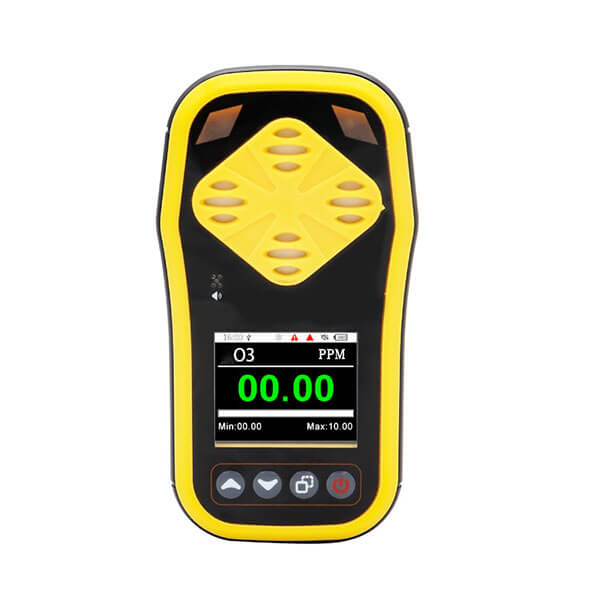
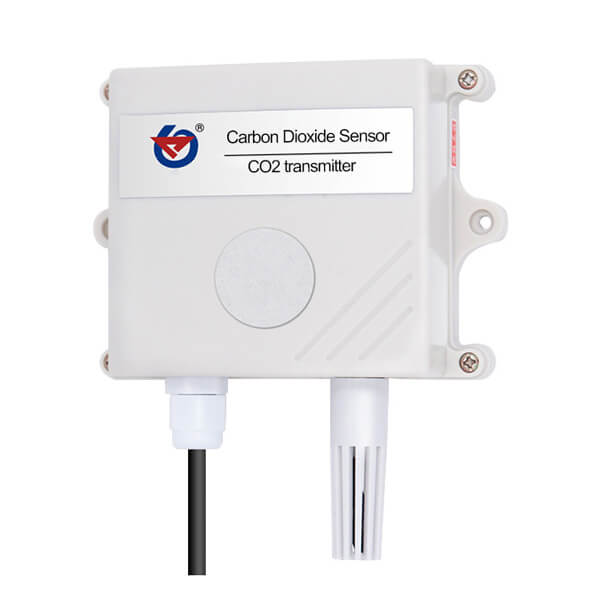
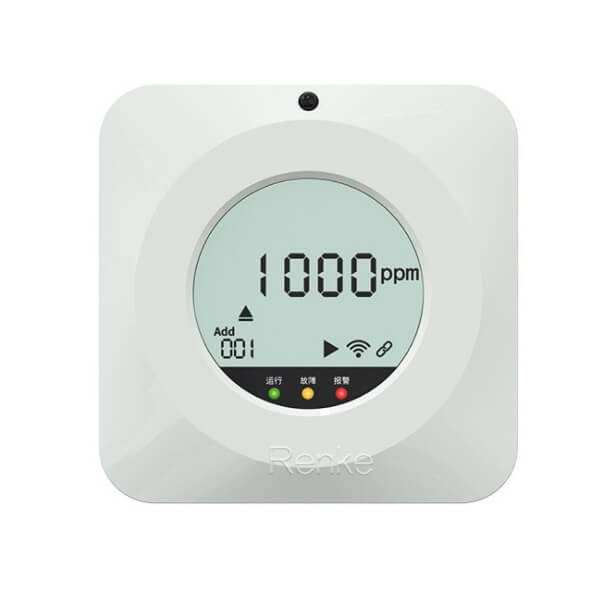

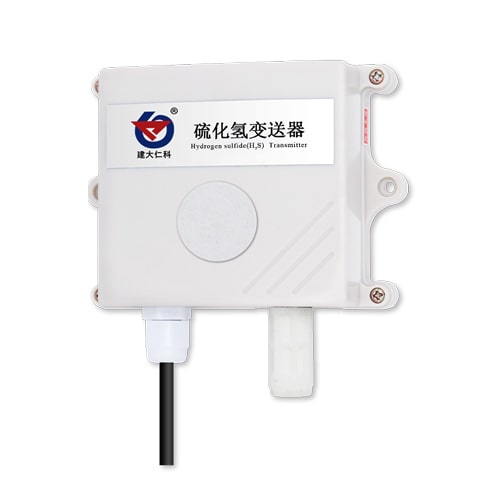
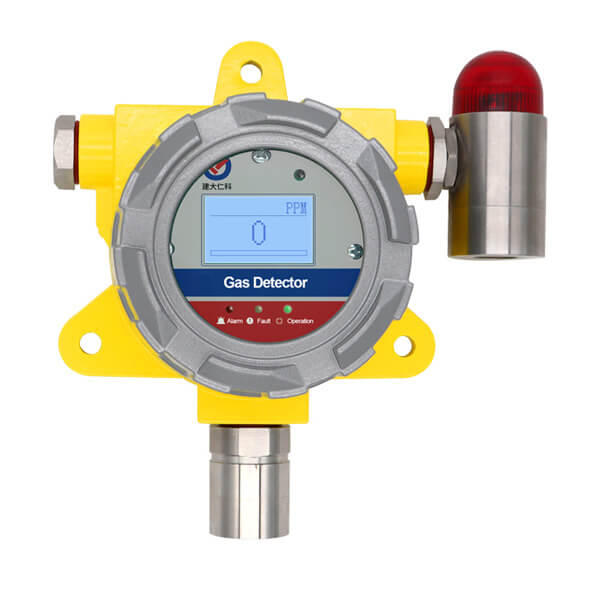

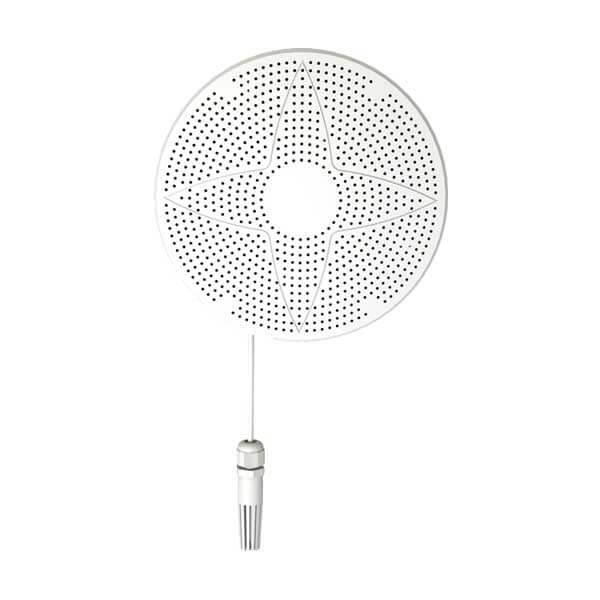

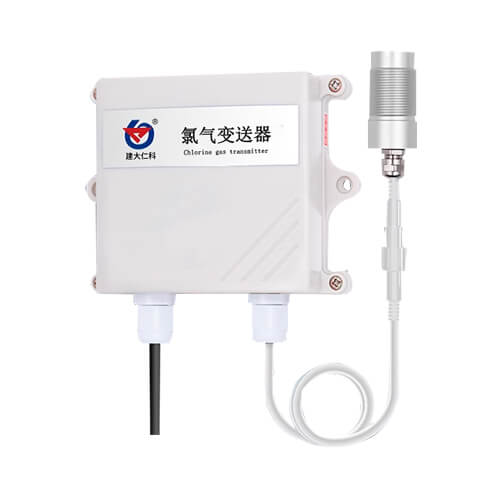
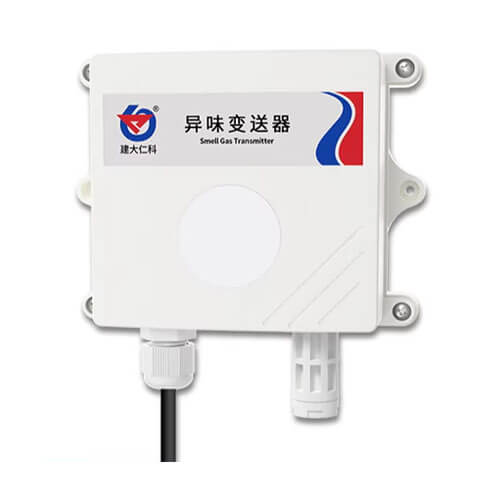
Table of Contents Have you noticed this interesting phenomenon? When using gas detectors, different gases have different concentration units. For example, the unit for

Formaldehyde Sensor
It is an electrochemical formaldehyde sensor. It has high accuracy, fast response speed, and long service life. The output resolution of the formaldehyde sensor can reach 0.01ppm, and it can realize 24-hour online monitoring. With the free cloud platform provided by our company, centralized monitoring of multiple devices in multiple locations can be achieved.
- Model: RS-CH2O-*-2-5P-T
- MOQ: 1 PCS
- Delivery date: within 24 hours
- Price: $56.2~$60.4
About - Formaldehyde Sensor
Formaldehyde is a flammable, colorless, corrosive gas with a strong, pungent odor. It is widely used in building and insulation materials, paper coatings, nail hardeners, cosmetics, and household products. All forms of formaldehyde are highly toxic. It is commonly used as a disinfectant and fumigant to kill bacteria, viruses, and fungi. Choosing an accurate and reliable formaldehyde sensor for real-time monitoring is crucial. Our company offers a variety of formaldehyde transmitters for formaldehyde monitoring in open spaces or enclosed ducts.
RS-CH2O-*-2-5P-T
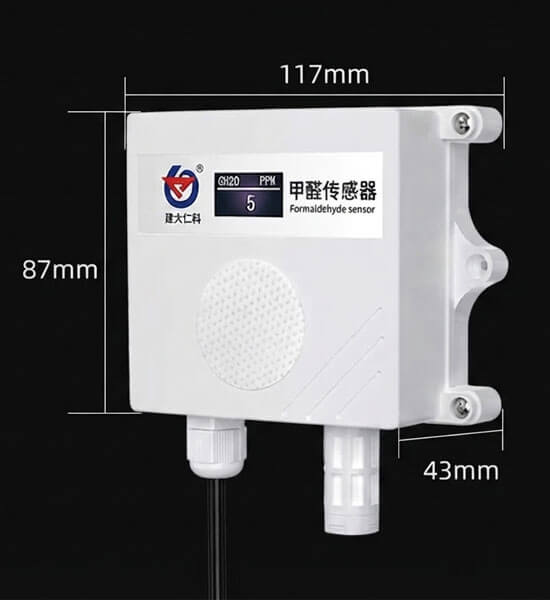
The RS-CH2O-*-2-5P-T is a wall-mounted formaldehyde sensor. It utilizes electrochemical principles and boasts high accuracy, fast response, good stability, and long lifespan. The wall-mounted formaldehyde sensor can be equipped with an OLED display for convenient on-site data viewing, and can also be equipped with an extended probe to monitor formaldehyde gas concentration in enclosed environments. Furthermore, a temperature and humidity sensor can be added internally to the transmitter for combined detection of temperature, humidity, and formaldehyde. It features remote control, selectable output signals (0-5V, 0-10V, 4-20mA and RS485), over-limit alarm, and 24-hour continuous operation. This formaldehyde sensor is widely used in biopharmaceutical plants, eco-friendly home furnishings, livestock farming, greenhouse cultivation, warehousing and logistics, brewing and fermentation, and agricultural production.
Wall-mounted formaldehyde sensor parameters
| Power supply | 10~30V DC |
|---|---|
| Power consumption | 0.12W |
| Measure range | 0~5ppm |
| Accuracy | ±5%FS (@1ppm, 25℃, 50%RH) |
| Resolution | 0.01ppm |
| Working environment | -20~50℃, 15~90%RH non-condensing |
| Pressure range | 91~110kPa |
| Stability | ≤7% signal value/year |
| Response time | ≤35s |
| Warm-up time | ≥5min |
| Zero drift (-20~40℃) | ≤±0.5ppm |
| Repeatability | ≤2% |
| Signal output | RS485/4-20mA/0-5V/0-10V |
RS-CH2O-*-2FL-5P-T
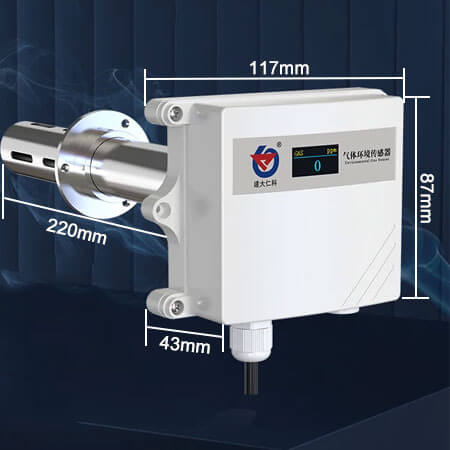
The ducted formaldehyde sensor is specifically designed to measure formaldehyde gas concentration within enclosed pipes. It features a waterproof housing and flange mounting. With an output resolution of 0.01 ppm, it can provide continuous 24-hour online monitoring. Its internal anti-interference circuitry allows it to withstand various electromagnetic interferences, such as those generated by on-site frequency converters. The only difference between the ducted and wall-mounted formaldehyde sensors is their appearance; please refer to the wall-mounted formaldehyde sensor section for specific product parameters. The price of the ducted formaldehyde sensor is: $67 without display, $77.20 with display.
FAQs - Formaldehyde Sensor
Why monitor formaldehyde gas?
When formaldehyde concentrations are too high, the oxygen content in the air decreases significantly, leading to suffocation. When the concentration of formaldehyde (CH₂O) in the air reaches 25%-30%, it can cause symptoms such as headache, dizziness, fatigue, difficulty concentrating, shortness of breath, rapid heartbeat, and ataxia. If not evacuated in time, it can lead to death by suffocation. Skin contact with liquid formaldehyde can cause frostbite. Global warming potential (GWP) analysis shows that formaldehyde’s greenhouse effect is 25 times that of carbon dioxide.
What are the measuring principles of formaldehyde sensors?
Currently, formaldehyde sensors on the market can be categorized into electrochemical, semiconductor, and optical types based on their working principles.
Electrochemical type: Formaldehyde passes through a filter membrane on the sensor surface into the internal electrolyte, where it undergoes a redox reaction at the working electrode, generating a weak current signal proportional to the formaldehyde concentration. This signal is then amplified and processed by the circuit to produce a concentration value.
Semiconductor type: The core component is a metal oxide semiconductor coating. Formaldehyde molecules adsorb onto the material surface, altering the semiconductor’s conductivity. The higher the gas concentration, the greater the change in conductivity.
Optical type: Utilizes ultraviolet light of a specific wavelength to excite formaldehyde molecules, causing them to undergo a photochemical reaction or photodissociation. The concentration is calculated by detecting changes in photocurrent, fluorescence intensity, or ultraviolet absorbance.
Where to use formaldehyde sensor?
Formaldehyde sensors are mainly used in industries or equipment that require long-term online monitoring of formaldehyde concentration, such as smart homes, air cleaners, and air conditioners. In addition, the formaldehyde sensor is suitable for places where further determination of formaldehyde gas is required, such as the petrochemical industry, organic chemical storage places, chemical laboratories, paint and coating industries, etc.
Is the calibration of the HCHO sensor stable?
From the long-term data point of view, the professionally calibrated formaldehyde sensor can guarantee the stability of 3-5 years.
Does temperature affect formaldehyde sensor readings?
Yes. Semiconductor-type sensors are highly sensitive to temperature and humidity, with readings changing significantly with these conditions, sometimes even exhibiting false exceedances. Electrochemical-type sensors are relatively stable, but are also susceptible to temperature and humidity interference. High-end formaldehyde transmitters use independent temperature and humidity sensors for dynamic compensation to eliminate these effects.
Is a 0-1 ppm formaldehyde sensor better than a 0-10 ppm sensor?
No. Measurement range alone cannot directly determine quality; the key factors are resolution, accuracy, and the application scenario. 0-1ppm and 0-10ppm simply represent different measurement ranges. The former is suitable for accurate monitoring of low concentrations, while the latter is suitable for environments with higher concentrations. Which is “better” depends on your needs.
What is the repeatability of the formaldehyde sensor?
Within the range that we can currently test, the repeatability is currently less than 2% of the signal.
Where is the best place to install a formaldehyde sensor?
The transmitter should be installed in a location free from impact, vibration, and strong electromagnetic interference, and easily accessible for maintenance. The clearance between the transmitter installation location and surrounding process piping or equipment should be greater than 0.5m.
It is recommended to install it 0.5m to 1.0m below the release source.
Related Blogs
Table of Contents Carbon monoxide is a colorless and odorless toxic gas at room temperature. People cannot perceive its presence through smell. Therefore, carbon
Table of Contents Ammonia is the most dominant alkaline gas in the atmosphere and plays an important role in aerosol nucleation. It is also
Table of Contents Biologists estimate that the human nose can distinguish on the order of ten thousand odor types, while dogs can identify hundreds
Why is a gas detector necessary? In the industrial production process, the leakage of flammable, toxic and harmful gases often occurs, which will cause
Table of Contents What is IoT? IoT is the “Internet of things“. It is an extended and expanded network based on the Internet. It
Monitoring of toxic and harmful gases such as formaldehyde and carbon monoxide in the home environment After the renovation of many new houses, more
IoT is based on sensors and is an extension of the Internet. It connects all items with the network through sensors, achieving the purpose