



Table of Contents Have you noticed this interesting phenomenon? When using gas detectors, different gases have different concentration units. For example, the unit for

Sulfur Dioxide Sensor
The RS-SO2*-*-2-*-T is a wall-mounted sulfur dioxide sensor designed for applications requiring real-time monitoring of sulfur dioxide gas concentrations. For multi-point monitoring, data from multiple locations can be centrally collected via our monitoring host and uniformly uploaded to the management platform. Our sulfur dioxide sensor offers four output modes: RS485, 0-5 V, 0-10 V, and 4-20 mA.
- Model: RS-SO2*-*-2-*-T
- MOQ: 1 PCS
- Delivery date: within 24 hours
- Price: $105~$235
About - Sulfur Dioxide Sensor
Sulfur dioxide is a colorless, toxic gas with a strong, pungent odor. It is highly soluble in water and is one of the primary atmospheric pollutants, as well as a major cause of acid rain. Currently, SO2 sensors are widely used to monitor sulfur dioxide concentrations.
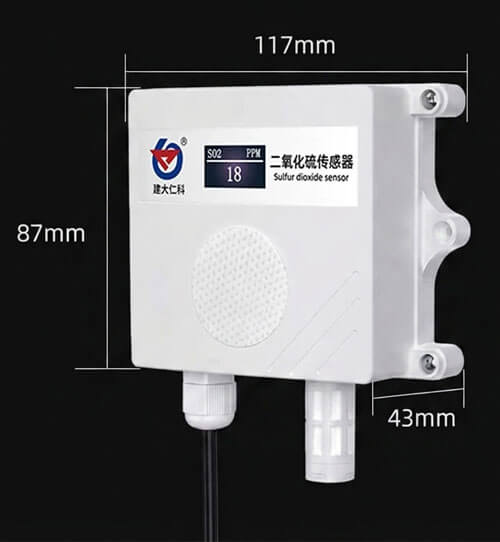
RS-SO2*-*-2-*-T
This wall-mounted SO2 transmitter features a built-in high-precision electrochemical sulfur dioxide sensor with high sensitivity and strong resistance to interference. Combined with our proprietary compensation algorithms and multi-point standard gas calibration technology, it offers exceptional accuracy, stability, and a longer service life, making it the ideal choice for effectively monitoring sulfur dioxide leaks. Our sulfur dioxide sensors are available in two measurement ranges: 0-20 ppm and 0-2000 ppm, and other ranges can be customized to meet customer requirements. The sensor offers a measurement accuracy of up to ±5% FS with excellent repeatability and an error margin of less than 2%. A high-quality OLED display is available as an option, allowing for convenient real-time data viewing on-site with clear visibility even at night. They support a wide DC power input range of 10-30 V, making them compatible with various on-site power sources. Renke SO2 sensors are easy to install and feature an IP65 protection rating, making them suitable for use in harsh environments.
RS-SO2*-*-2-*-T parameters
| Power supply | 10~30V DC |
|---|---|
| Average power consumption | 0.18W |
| Working environment | -20~50℃, 15~90%RH non-condensing |
| Working pressure | 90~110kPa |
| Measure range | 0-20ppm/0-2000ppm |
| Accuracy | ±5%FS or ±10% |
| Resolution | 20ppm:0.1ppm, 2000ppm:1ppm |
| Repeatability | ≤2% |
| Response time | 20ppm:≤45s, 2000ppm:≤70s |
| Warm-up time | ≥5min |
| Zero drift | 20ppm:≤±0.5ppm, 2000ppm:≤±4ppm |
| Stability | ≤2% signal value/month |
| Output signal | RS485/4-20mA/0-5V/0-10V |
RS-SO2-*-2FL-*-T
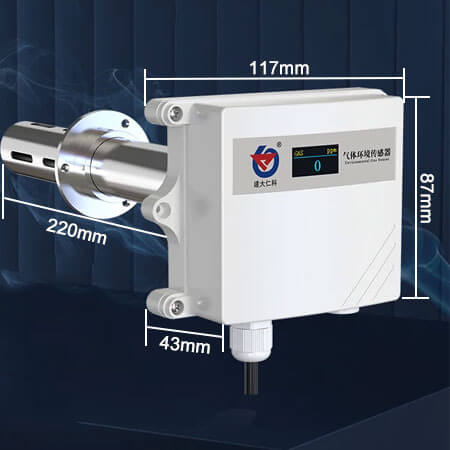
The RS-SO2-*-2FL-*-T ducted sulfur dioxide sensor is specifically designed to measure sulfur dioxide gas concentrations within enclosed pipelines. It features a waterproof housing and is installed via a flange. Thanks to our company’s proprietary compensation algorithm and multi-point calibration using standard gases, this sensor offers a long service life, high accuracy, and excellent stability. Its anti-interference circuit design enables it to withstand various types of electromagnetic interference, such as that generated by on-site variable frequency drives. The only difference between the duct-mounted SO2 sensor and the wall-mounted SO2 sensor is their appearance; for specific product specifications, please refer to the wall-mounted sulfur dioxide sensor. Pricing for the ducted SO2 sensor is as follows: 0-20 ppm (without display) is $115; 0-20 ppm (with display) is $126; 0-2,000 ppm (without display) is $140.5; and 0-2,000 ppm (with display) is $151.
FAQs - Sulfur Dioxide Sensor
What is a sulfur dioxide sensor?
A sulfur dioxide sensor is a device used to monitor the concentration of sulfur dioxide gas in the environment. It converts the monitored data into an electrical signal for output, enabling further processing or alarm notifications.
Why use sulfur dioxide sensors?
Sulfur dioxide (SO2) is a toxic gas with a strong, pungent odor. It is present in the atmosphere at extremely low concentrations and is naturally released during volcanic eruptions. Inhalation of sulfur dioxide has been linked to respiratory diseases and breathing difficulties. It is also a precursor to acid rain and atmospheric particulate matter. Sulfur dioxide gas may be an active component or a byproduct of various industrial processes. High concentrations of sulfur dioxide not only harm the environment but also have negative effects on human health.
What is the working principle of the sulfur dioxide sensor?
Our SO2 sensor uses electrochemical principles, a three-electrode electrochemical sensor.
How does the sulfur dioxide (SO2) sensor work?
SO2 sensors based on electrochemical principles contain a sensitive electrode, a reference electrode, and an electrolyte layer. When sulfur dioxide gas diffuses to the surface of the sensitive electrode, a redox reaction occurs, generating a weak current that is proportional to the gas concentration. This current is amplified and processed by an internal circuit, then converted into a linear voltage signal for output.
Where to use the sulfur dioxide sensor?
SO2 sensor application range: environmental protection industry, cement plant; chemical industry, metallurgy, electric power; sulfuric acid manufacturing plant, pharmaceutical plant, food processing, etc.
Where should the sulfur dioxide sensor be installed?
The sulfur dioxide transmitter should be installed in a location free from shock, vibration, and strong electromagnetic interference, and where maintenance is easily accessible. The clearance between the transmitter installation site and surrounding process piping or equipment should be no less than 0.5 m. It is recommended to install it within a range of 0.3 m to 0.6 m from the bottom of the measurement space.
Which sulfur dioxide sensor is suitable for environmental monitoring?
For environmental monitoring, electrochemical SO2 sensors are the most commonly used option. They are compact, have low power consumption, and are moderately priced, making them suitable for large-scale network deployment; however, they require periodic calibration.
What gases interfere with an SO2 sensor?
Common interfering gases for sulfur dioxide electrochemical sensors include:
NO2 (nitrogen dioxide): Common source of positive or negative cross-interference, depending on the sensor design.
O3 (ozone): Prone to causing positive interference, resulting in elevated readings.
H2S (hydrogen sulfide): Has a structure similar to SO2, making it prone to cross-responses.
Cl2 (chlorine).
NO (nitric oxide): Typically causes minimal interference.
CO (carbon monoxide): Some models exhibit slight cross-sensitivity.
Why does my SO2 sensor drift when humidity changes?
Electrochemical SO2 sensors may experience drift when humidity levels change, primarily due to the following reasons:
1. Changes in Electrolyte Concentration
Reactions within electrochemical sensors rely on an electrolyte (or solid-state polymer electrolyte). When ambient humidity increases, the electrolyte absorbs moisture and becomes diluted; when humidity decreases, moisture in the electrolyte evaporates, causing the concentration to rise. Changes in electrolyte concentration directly affect ion migration rates and electrode reaction efficiency, leading to output signal drift.
2. Changes in the water content of the diffusion membrane
The permeability of the gas diffusion membrane changes with variations in water content, which in turn affects the rate at which gas reaches the working electrode, causing fluctuations in response sensitivity.
3. Baseline current offset
Sudden changes in humidity (especially abrupt transitions from dry to humid conditions, or vice versa) require some time for the sensor to reach a new moisture equilibrium. During this transition period, the baseline current is unstable and can easily be misinterpreted as a change in SO2 concentration.
4. Condensation or Drying on the Electrode Surface
Extreme humidity conditions (excessively high humidity causing condensation, or excessively low humidity causing the electrode to dry out) directly affect the electrochemical reactivity of the electrode.
How to view data?
We offer a free cloud platform for you.
How to get the SO2 sensor manual?
You can leave a message or send us an email to get the manual.
What gases interfere with an SO2 sensor?
Why does my SO2 sensor drift when humidity changes?
Related Blogs
Table of Contents Carbon monoxide is a colorless and odorless toxic gas at room temperature. People cannot perceive its presence through smell. Therefore, carbon
Table of Contents Ammonia is the most dominant alkaline gas in the atmosphere and plays an important role in aerosol nucleation. It is also
Table of Contents Biologists estimate that the human nose can distinguish on the order of ten thousand odor types, while dogs can identify hundreds
We all know that the chemical properties of ozone are extremely active. Its energy when it is free produces strong oxidation in an instant,
Why is a gas detector necessary? In the industrial production process, the leakage of flammable, toxic and harmful gases often occurs, which will cause
Table of Contents What is IoT? IoT is the “Internet of things“. It is an extended and expanded network based on the Internet. It
Monitoring of toxic and harmful gases such as formaldehyde and carbon monoxide in the home environment After the renovation of many new houses, more