



Table of Contents Gas leaks pose serious dangers in residential environments, including potential fire hazards, explosions, and adverse health effects. This article provides a

Methane Sensor
The RS-CH4-*-2-100LEL-T is an industrial-grade methane(CH4) transmitter. Its housing is waterproof and dustproof, ensuring a long service life and the ability to operate in harsh environments. This methane sensor has a measurement range of 0~100% LEL and an accuracy of ±5% FS. It offers excellent quality at an affordable price.
- Model: RS-CH4-*-2-100LEL-T
- MOQ: 1 PCS
- Delivery date: within 24 hours
- Product status: Discontinued
About - Methane Sensor
Methane (CH4) is the primary component of natural gas. Natural gas is considered the safest and cleanest fossil fuel available today and is therefore widely used in industrial and commercial applications. However, methane is a colorless, odorless, flammable, and explosive gas, so its concentration levels must be monitored in real time. For many people working in the natural gas industry, methane transmitters are essential tools for ensuring a safe working environment.
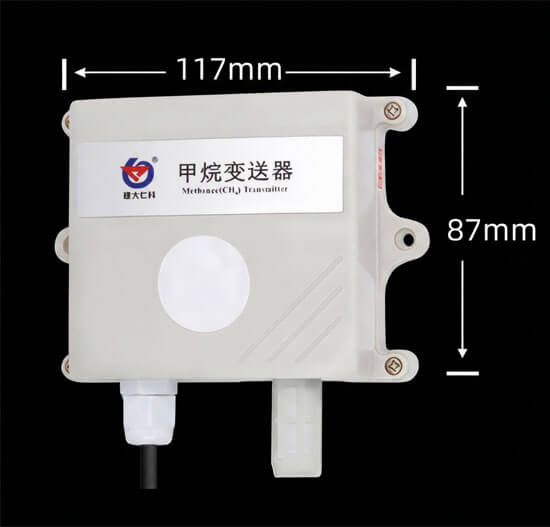
Wall-mounted CH4 sensor
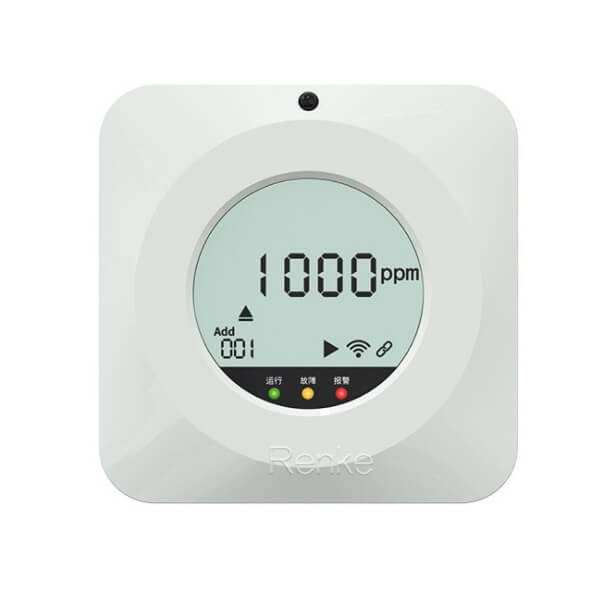
RS-CH4-*-2-100LEL-T wall-mounted methane(CH4) transmitter is safe to use, responds quickly, and offers strong resistance to interference. Thanks to our company’s proprietary compensation algorithm and multi-point calibration with standard gases, it delivers high accuracy, excellent stability, and a long service life. Measurement accuracy is within ±5% FS, and repeatability is within 2%. It supports RS485, 0-5 V, 0-10 V, and 4-20 mA signal outputs. A high-quality OLED display is available as an option, allowing values to be viewed directly on-site. This methane sensor is suitable for use in parking lots, public restrooms, workshops, chemical plants, livestock farms, and other similar settings. As the original manufacturer, Renke offers customized measurement ranges and secondary development services.
Wall-mounted CH4 sensor parameters
| Power supply | 10~30V DC |
|---|---|
| Power consumption | 0.9W |
| Measuring range | 0-100%LEL |
| Accuracy | ±5%FS, oxygen environment with a concentration not lower than 5%VOL. |
| Resolution | 1%LEL |
| Operating environment | -20~40℃, 0~95%RH non-condensing |
| Pressure range | 80~116kPa |
| Stability | ≤7% signal value/year |
| Repeatability | ≤2% |
| Response time | ≤15s |
| Warm-up time | ≥5min |
| Methane zero drift | ±2%FS |
| Output signal | RS485, 4-20mA, 0-5V, 0-10V |
| Lifespan | ≥24 months |
Duct-mounted CH4 sensor
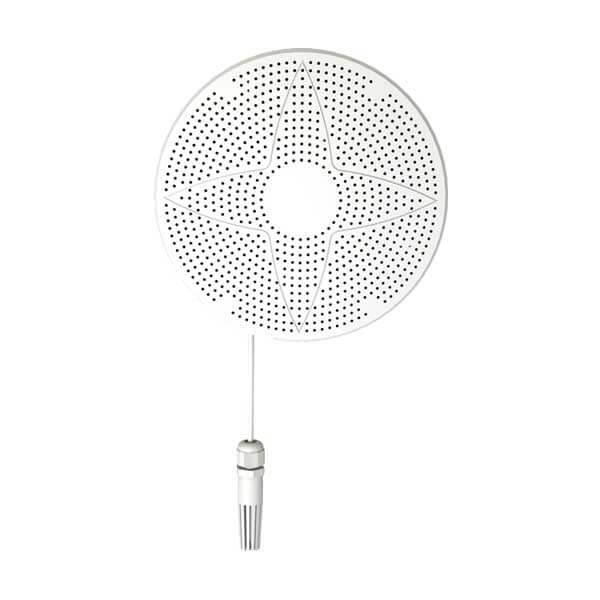
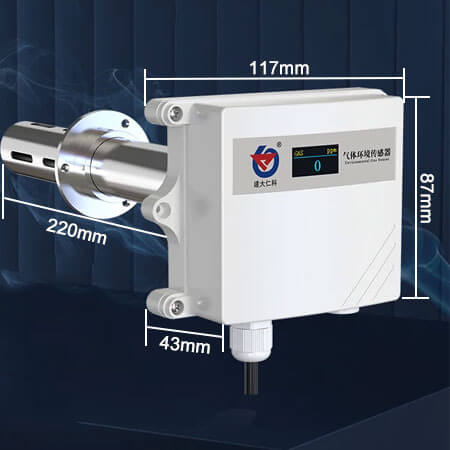
The RS-CH4-*-2FL-100%LEL-T duct mounted methane(CH4) transmitter features a highly sensitive gas probe, offering excellent stability and high repeatability to accurately and rapidly detect methane gas concentrations. Designed specifically for measuring methane concentrations in pipelines, this methane sensor incorporates a waterproof housing and an anti-interference circuit design, enabling it to withstand various strong electromagnetic interferences, such as those from on-site variable frequency drives. It features flange mounting, ensuring a tight seal and simple installation.
FAQs - Methane Sensor
What is methane sensor?
A methane sensor is a device that measures the concentration of methane in the environment, usually with an alarm function. Once the concentration exceeds the limit, it will alarm.
What type of sensor is used to detect methane gas?
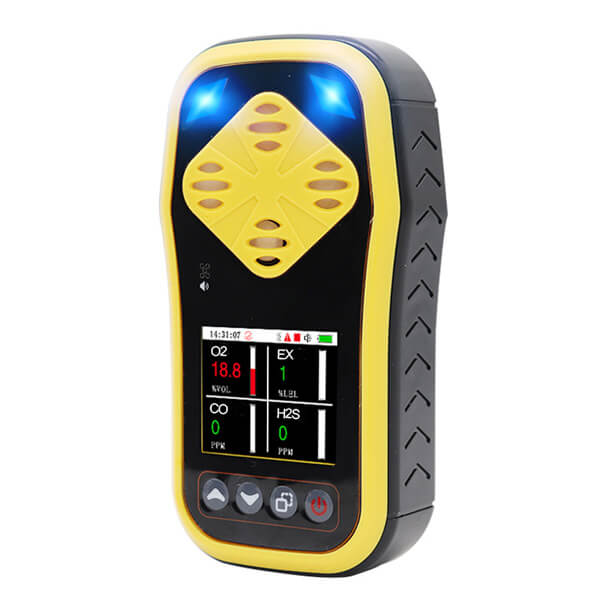
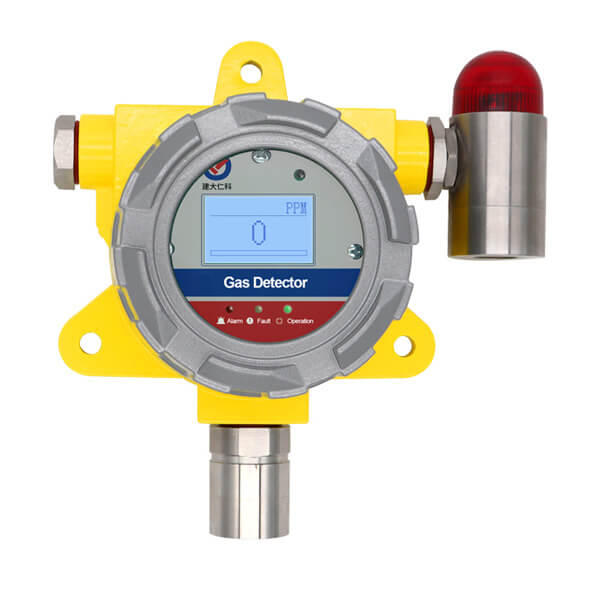
According to different use environments, there are usually three types: wall-mounted methane sensor, portable methane detector, and fixed methane detector.
How to calibrate the CH4 sensor?
Our CH4 sensor has been calibrated before leaving the factory and can be used directly after installation without secondary calibration.
Where should the CH4 sensor be installed?
Methane transmitters should be installed in locations free from shock, vibration, and strong electromagnetic interference, and where maintenance is easily accessible. The clearance between the installation location and surrounding process piping or equipment should be greater than 0.5 m. It is recommended to install the transmitter within 2.0 m above the emission source.
How to wire a methane transmitter?
RS485 type wiring: Brown wire to power positive (10~30VDC), black wire to power negative, yellow wire to 485-A, blue wire to 485-B.
Analog type wiring: Brown wire to power positive, black wire to power negative, blue wire to methane signal positive, yellow (green) wire to methane signal negative.
Why does my methane sensor keep giving unstable readings?
Unstable readings from a methane sensor are typically caused by environmental interference, power supply fluctuations, calibration failure, hardware aging, or wiring faults, and should be troubleshot in the following order.
- Environmental Factors: Sudden temperature changes (>±5°C/h), strong airflow (>2 m/s), dust/ oil residue clogging the air intake, or the presence of cross-interfering gases such as hydrogen or VOCs can cause readings to fluctuate.
- Power and Signal Issues: Unstable supply voltage (e.g., low battery power), aging cables or poor connections, and electromagnetic interference (near variable frequency drives or high-power equipment) can introduce noise or cause intermittent signals.
- Calibration and Service Life: Prolonged lack of calibration leads to zero-point drift or reduced sensitivity; using the sensor beyond its service life (typically 2-3 years for electrochemical types) or exposure to excessive methane surges can damage the components, resulting in unstable output.
- Hardware Failures: Poor solder joints in internal components, dust accumulation in the gas chamber, physical impact, or failure of the waterproofing can directly cause erratic readings or the display to reset to zero.
Why does my methane sensor stay high after the gas is removed?
Possible causes include:
1. Response and recovery time lag: For thermal catalytic or electrochemical sensors, after exposure to high-concentration gases, the oxidation reaction or adsorption-desorption process takes some time to return to normal. If ventilation is insufficient or the concentration was extremely high, the reading will decrease slowly rather than dropping to zero instantly.
2. Zero-point drift: Prolonged lack of calibration, changes in temperature or atmospheric pressure, or component aging can cause a baseline shift, resulting in an abnormally high output signal in the “gas-free” state.
3. Gas residue or blockage in the gas path: Residual gas that has not been completely purged from the sensor’s gas chamber or capillary tube, or dust/oil buildup obstructing gas flow, can cause falsely high readings.
4. Sensor Poisoning or Contamination: Compounds such as silicones, sulfides, and lead can deactivate the catalytic element or cause abnormal sensitivity, leading to sluggish response or locked readings. High humidity and dust accumulation can also interfere with heat dissipation and the reaction.
5. Cross-interference gases: Thermocatalytic sensors respond to hydrogen, carbon monoxide, and other alkanes. If these gases are present in the environment, the reading will still indicate a “high concentration” even if methane has been removed.
What is the LEL of methane?
The lower explosive limit (LEL) of methane is typically 5% by volume; depending on the standard, the specific value may range from 5% to 5.3%.
How to obtain the manual of the CH4 sensor?
To protect the patented technical parameters, please contact us for a manual.
How to buy a CH4 sensor?
Please confirm the model and delivery address with the salesperson through a message or online chat. After payment, we will deliver the goods within 24 hours.
What's on the package list?
Methane transmitter *1
Self-tapping screws *2
Expansion plugs *2
Certificate of conformity, warranty card, wiring instructions, etc.
Related Blogs
Table of Contents Carbon monoxide is a colorless and odorless toxic gas at room temperature. People cannot perceive its presence through smell. Therefore, carbon
Table of Contents Ammonia is the most dominant alkaline gas in the atmosphere and plays an important role in aerosol nucleation. It is also
Table of Contents Biologists estimate that the human nose can distinguish on the order of ten thousand odor types, while dogs can identify hundreds
Table of Contents The key to the smart industry lies in the collection of data and information. Sensors are the nerve endings of the
Table of Contents What is IoT? IoT is the “Internet of things“. It is an extended and expanded network based on the Internet. It
What is an air quality monitor? An instrument used to detect air quality can be called an air quality monitor. However, due to the
Monitoring of toxic and harmful gases such as formaldehyde and carbon monoxide in the home environment After the renovation of many new houses, more